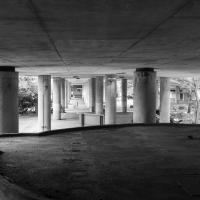
I'm afraid that this is a bit of a badly-curated wander, where I mostly just popped out to find out a little of the history of Underfall Yard and poke around the various open workshops, and, in hindsight, really didn't take pictures in any kind of coherent order. So there's a lot of pictures, but they don't really tell the story that, in hindsight, I seem to have been trying to tell, of the unusual electrical substation in Avon Crescent, the Bristol Electricity that predates the National Grid but is still in use, the history of the hydraulic power house... It's a bit of a mess.
But I suppose sometimes these wanders—always chronologically presented in the order I walked and took photos—simply will sometimes be a bit of a mess. Let's hope you still get something out of it, anyway...
Most of the gear in this docks machine room is belt driven from a motor we'll see in a bit. The motor is electric but the drive system is pretty much the same as it was in the days of steam.
I have now moved buildings, to the Power House. This was the hydraulic cornerstone of the power for many of the key docks systems in Bristol. The hydraulic system powered from these electric (formerly steam) pumps was responsible for opening lock gates, moving sluices, operating cranes, and turning or raising some of the heftiest swing bridges in Bristol.
Here I've finally found my target, according to the nice man giving the demonstrations. The electrical control system used to control the hydraulic system's pumps, along with the pumps themselves, would have been too complicated and time-consuming to re-engineer to modern electrical standards when the National Grid came along, to say nothing of having to close down this cornerstone of many of the important mechanisms of a busy working dock while it was done, so some arrangement was come to with the electricity company to simply keep supplying the old, non-standard 360V electricity, which is why it still comes that way from the Avon Crescent substation.
There are a couple of tanks used to feed the water that gets pumped by the power house. One of them, the "settling tank", apparenlty isn't really needed these days, but served a certain rather crucial purpose when the harbour was more like an open sewer. I'm sure you can figure it out. The other, the header tank, is above the visititor centre in the room behind the wall there.
The powerful electric pumps in this room then use the water to raise the weight of a hydraulic accumulator (I don't know if the one inside the tower in this building is still used, but there's one outside that you can see being raised by the pumping—we'll see it in a bit.)