Tagged: bicycle-handlebar
I'm afraid that this is a bit of a badly-curated wander, where I mostly just popped out to find out a little of the history of Underfall Yard and poke around the various open workshops, and, in hindsight, really didn't take pictures in any kind of coherent order. So there's a lot of pictures, but they don't really tell the story that, in hindsight, I seem to have been trying to tell, of the unusual electrical substation in Avon Crescent, the Bristol Electricity that predates the National Grid but is still in use, the history of the hydraulic power house... It's a bit of a mess.
But I suppose sometimes these wanders—always chronologically presented in the order I walked and took photos—simply will sometimes be a bit of a mess. Let's hope you still get something out of it, anyway...
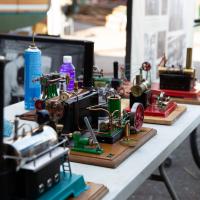
Part of the open day was this delightful collection of miniature steam engines and an on-demand explanation of how steam power works for anyone who was interested.
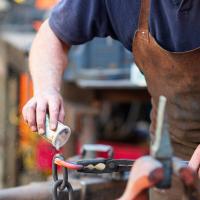
Borax powder being used as flux here, helping to prevent oxidation of the metal surface during the joining of the ends of the link.
Random aside: borax was also used to prepare boracic acid, used in medical dressings, especially for the treatment of leg ulcers. The medical lint was soaked in boric acid and gycerine, and then left to dry, producing "boracic lint". The was then used in cockney rhyming slang to mean "skint".
The Gridiron and Bower Ashton Part Two
03 Dec 2021
On my last wander, to Bower Ashton, I was intending to knock Blackmoors Lane off my list "to-do" list, but got a bit diverted. I also took a little look into the history of the Gridiron, once a cheaper alternative to dry dock that was nestled just south of North Entrance Lock.
Today I had to go to send a parcel off somewhere, so I decided on going to the North Street Post Office via Blackmoors Lane. I didn't have much intention of anything else, but as luck would have it I walked out both at low tide and also as some lockkeepers seemed to be having a bit of a training session, and one of the more senior people was (a) happy to answer a few random questions on the Gridiron and (b) actually knew a lot about it, as Gridiron maintenance had been one of his jobs, more than twenty years ago...
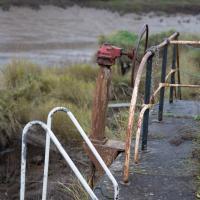
I've always wondered what this wheel is for. It's part of the Gridiron's cleaning system. Water is drawn from North Entrance Lock through a sluice channel and could be diverted one way and another across the surface of the gridiron. I wasn't clear from my conversation with the lockkeeper whether this would open the sluice channel or was the control used to divert the water first to the left of this central point of the gridiron, then to the right, but it's definitely part of the cleaning mechanism.
He said he also used to have to go down the ladder and hose it all down after sluicing it out, and that he found the whole process quite fun!
In Which We Begin and End with Love
05 Mar 2022
I had a lot to get done around the house, so as soon as I heard there might be a shiny new piece of street art near me, under the Cumberland Basin flyovers, I immediately decided that was all the excuse I needed to set off on a round-the-harbour lunchtime walk to get some fresh air and see if I could spot it. So, here's a circular wander that takes in graffiti, boats, wildlife and graffiti again...

And we're back where we started. Incoming from the left is @beardedjourno, who is about to take the banner photo for this article, I believe :)
In the background on the right you can see another piece by AcerONE (also known as Luke) that I've previously featured.