Tagged: apartment
I recently indulged myself by buying a little piece of history. I've mentioned Samuel Loxton and featured and linked to his drawings before, often in the eminently browsable Loxton Collection albums that Bristol Libraries has on Flickr. So when I saw a Loxton drawing of Hotwells pop up on eBay, I decided to get myself a little treat.
I don't think there's any Loxton drawing that features the road I actually live in—it's not very visible from anywhere else, not being one of these Clifton terraces that's perched at the top of a hill, or anything like that, and it's invisible in most views of the area. However, this Loxton drawing, Hotwells, Looking across the river from near the Clifton Bridge station, is probably the closest near-miss I've seen.
I decided to wander out one morning and see if I could reproduce the picture, and also take a photo or two of what's now become of the Clifton Bridge Station, which is still just about discernible in places.
(Then on an even stranger whim I decided to check out a possible little cut-through from Cumberland Road to the harbourside I'd been eyeing up on my commute to work, so walked to Wapping Wharf for a croissant via this potential new route, but that bit's not quite as interesting...)
A Wide Angle View
30 Oct 2021
I had an unsuccessful wander last week, on Tuesday afternoon: my GPS died within about five minutes of leaving the house, and I didn't notice, plus I found hardly anything I'd been looking for. On the plus side, as I was wandering around Park Street I decided to nip into London Camera Exchange on the offchance they had a secondhand Canon 17-40mm lens. I've been thinking of buying one for around a year, I think.
Long story short: not only did they have one, but due to a mistake with their price labelling which they kindly honoured, I now have a shiny new (to me) wide-angle lens and it cost me less than £300, which is a very good price for one of these in good condition (and including a lens hood.)
So, rather than try to salvage Tuesday's walk, here's a walk where I basically just bimbled up to Clifton Village for a coffee and wandered around taking photos of as many wide views as I could find. I took a lot more photos than these seventeen, but as you might expect, a new lens takes some practice getting used to, so most of them ended up in the "outtakes" pile.
Recreating a Loxton Drawing on a Lunchtime Jaunt
05 Nov 2021
I did do a much longer wander earlier in the week, but that'll take me some time to process (and cast a plethora of photos into the "out-takes" pile!) In the meantime, here's my lunchtime jaunt, taken to give myself a break from doing the company bookkeeping to send to my accountant so the taxman doesn't sling me in chokey.
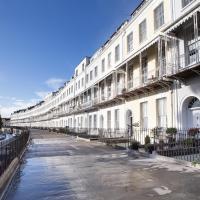
I've recently bought a slightly creased secondhand copy of Redcliffe Press's 1992 collection of Samuel Loxton drawings, Loxton's Bristol: The city's Edwardian years in black and white. It's a nice selection of Bristol Library's collection of the drawings. I'd noticed a drawing of 25 Royal York Crescent, a house I pass quite often, so I thought I'd wander up the crescent on the way to pick up some lunch and try to reproduce it.
On the way back I took a few photos of Clifton Hill Bank as the crowdfunder to make quite a lot of it into a wildflower meadow has just hit its target, so I figured some "before" shots might be a good investment for the future...
I went out simply wanting to knock off the very last little unwalked section of Clanage Road, over by Bower Ashton, which has been annoying me for a while as it's quite close by and I've walked the other bits of it several times. So, my plan was to nip over to Greville Smyth Park via a slightly unusual route to wander Clanage Road and tick it off.
Along the way, though, I inevitably got a bit distracted. I took a few photos of Stork House, a grand Hotwell Road building that's recently been done up a bit (I imagine it's student lets, though I'm not sure) and which I found a reference to in a book about the Port Railway and Pier the other week, and also tried to match up a historical photo of Hotwells before the Cumberland Basin Flyover System laid it waste, which included some interesting markers I'll have to do a bit more digging into...
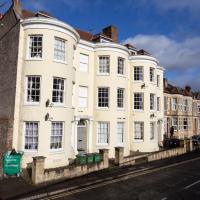
I've always loved the bow windows; if you look closely you'll see the window frames are slightly curved to match the curvature of the walls. Must be quite pricey to have repairs done, I'll wager.
A Door, a Square, a Few Night Shots
04 Dec 2021
I didn't take many pictures on this quite long wander, partly because Lisa and I wandered across to Bedminster via Bower Ashton, which I've snapped quite a lot of on the last couple of walks, and also because we lost the light fairly quickly, though spending a half-hour drinking mulled wine in the Ashton might have had a little to do with that...
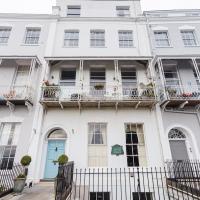
Before we left Hotwells I wanted to visit a door I'd heard about on Cornwallis Crescent and also take a little look at a couple of houses in Dowry Square to consider the 1960s regeneration of Hotwells.
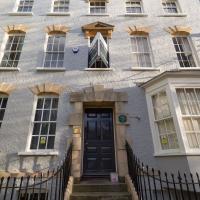
It's currently set up as a set of separate serviced offices. If you're interested in buying the freehold, they're looking for offers in excess of £1m.
As well as being the former home of Master of Ceremonies of the Hot Well, William Pennington, it was for a while The Hotwells Nursery and School for Mothers. Later it looks like it turned into Social Services' Hotwells Day Nursery, if the footage in this BBC documentary, starting at around the 20-minute mark.
Near and Far
05 Jan 2022
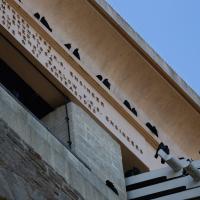
I took advantage of a rare recent day where it wasn't tipping down with rain to get away from my desk on a lunchtime workday and head up to Clifton Village. I'd hoped to snap a reproduction of historical photo which I'd worked out had been taken from the Suspension Bridge, but the gods were not smiling on me. Still, taking only a nice long lens with me worked out very well as the lovely haze of the day made more distant views quite dramatic...
Lunchtime Reproduction (of an old photo...)
17 Jan 2022
This was basically the quick lunchtime jaunt I tried to do at the beginning of January, only this time I actually managed to get to roughly the viewpoint I'd been hoping for to recreate a historical photo of the Bristol International Exhibition.
I did this walk about a month ago, but I've been a bit poorly and not really up to doing much in my spare time, and it's taken me this long to even face processing even these few photos. Hopefully normal service will be resumed at some point and I can carry on trying to walk any roads and paths that I need to do to make this project feel complete...
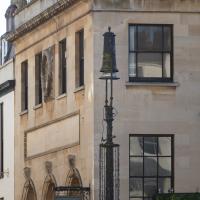
From Electric Arc Lamps in Bristol, by Peter Lamb, a supplement to the Histelec News, August 1997:
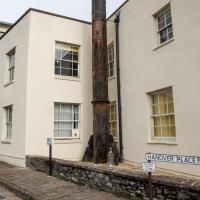
In looking at old photographs of late Victorian or early Edwardian scenes, many of you may have noticed very decorative street lights gracing the foregrounds. These lamp standards had long cylindrical shapes above the lamp, which distinguished them as being electric arc lamps. You may have wondered, like me, what was inside these housings. These cylinders, known colloquially at the turn of the century as “chimneys” were not chimneys at all, but housed the complex mechanisms regulating the carbon electrodes. Only two lamp standards of this distinctive design remain as street furniture on the Bristol streets and these are situated at The Mall, Clifton Village.
Given the long cylindrical shape and the fact it's on the Mall, pretty sure this must be one of the last two electric arc lamps still standing, or possibly the last one, as I couldn't find the other one.
EDIT: Having asked on Next Door, where there've been a few threads about historic lamp restoration, it seems the other one used to stand at the end of West Mall, not far away, was taken away for restoration a long time ago, and has yet to reappear.
There's another Bristol connection too, with Sir Humphrey Davy, as the article continues:
Sir Humphrey Davey is credited with inventing the first arc lamp, when he demonstrated his invention at the Royal Institution in 1810. It was powered by batteries and used charcoal elements enclosed in a vacuum. The vacuum allowed a longer arc with a much higher voltage. It was some years later (1844) that the principle was further developed by a Frenchman by the name of Foucault. He used carbons from the retorts of a gasworks, which were more durable. Thomas Wright devised the first arc lamp which involved adjustment of the carbons automatically as they burnt away, and W.C.Staite used an electric current for the regulation of the carbons. Foucault responded in 1858 by producing his regulating lamp.
(Yes, that is Foucault of Foucault's Pendulum fame.)
Bedminster Trip for New Walking Shoes
26 Feb 2022
I needed to buy new walking shoes—my old ones were squeaking and it was driving me up the wall—so I ordered some for collection from Taunton Leisure on East Street in Bedminster, and decided to make picking them up an official wander.
I didn't cover any new ground within my mile, but I did take advantage of the trip to take in a few interesting things just outside my normal radius, mostly New Gaol-related. Along the way there are a couple of sanitation-related diversions, including a visit to a rare manhole cover. You can hardly wait, I can tell!
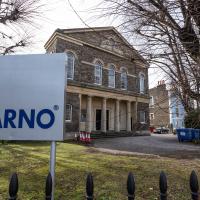
Apparently it's the offices of a shopfitters. According to the listing, which is so laden with architectural words I found it quite heavy to copy from Historic England's website:
Zion House and attached railings and gateways. Congregational chapel, now offices. 1830. For John Hare. Pennant stone rubble and limestone ashlar, slate roof. Open plan. Classical style. 2 storeys and basement; 5-window range. Portico of tetrastyle-in-antis cast-iron Tuscan columns, with a deep entablature returning at the ends; the pediment contains a louvred oculus supported by a wide blank panel with relief palmettes
Apparently the antae are the bits supporting the sides of the entranceway, and stylos is a column, so the supporting ends with the four columns in between are a tetrastyle-in-antis. I will now forget that before it appears in a Times cryptic.
I'm fairly sure I saw Louvred Oculus playing a gig at the Louisiana once.
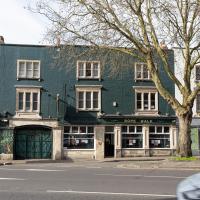
This place has both astoundingly good reviews and a gallery, apparently. According to the website, it's run by "Annie, a well-known celebrity on the Street Art scene".
I may have to pop in at some point, though I'm rarely at a loose end in this bit of town.
I couldn't find out why it's called the Rope Walk, but it does seem to be the starting point for the Blood and Butchery in Bedminster walking tour, so that might be a way of finding a local historian who knows...
I mostly went out to hang out with my friends Sarah and Vik in Bedminster, but along the way I thought I'd take a closer look at something a little nearer home: the last crossing point of the Rownham Ferry.
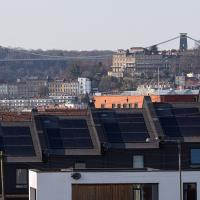
It's interesting to be able to look pretty much a mile back and see the familiar buildings of home. Descending from the top right in the distance we can just see the Observatory on Observatory Hill, then the end of Royal York Crescent, then the Paragon just eclipsing the suspension bridge, then below the bridge on the left there's Windsor Terrace and the more modern Windsor Court flats just visible behind the Bedminster foreground.
I noticed I had a few things on my "potential wanders" list that could all be done relatively close to home, and in a fairly straight line, so I set off at lunchtime to recreate a photo of a now-defunct pub, wander behind a Spar (which turned out to be more interesting than I'd expected, but I admit it's a low bar) and spend some time browsing in Dreadnought Books before coming home via a coffee from Spoke & Stringer, a little diversion up Gasworks Lane and a tiny bit of the Rownham Mead estate I'd somehow previously skipped.
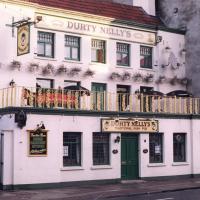
Uncredited apart from "from our archives" and undated, this photo appeared in this article on Hotwells in the Evening Post and made me want to re-create the same view today.
The pub had a few changes of name over time—in the Bristol Then and Now Facebook group people recall this being the Spring Gardens in the 1950s, 60s and 70s. Someone remembers it turning into Durty Nelly's in 1995, but I swear it was back to being the Spring Gardens again by the time I moved to the area in 1999. Then it spent some time as La Demi Lune, which you can see on Street View in 2008, and then by 2009 it's back to The Spring Garden (without the "s").
So, from what I can work out, this snap was probably taken in the 1990s, most likely between 1995 and 1999.
This pub—which did good food, and had an extensive garden at the back, from what I remember, when it was the Spring Gardens in the early 2000s—is rather more bland in looks today, as we'll see in the next picture.