Tagged: rim
Library, Bookshop, Coffee
03 Jul 2021
I was headed into town to return RA Gilbert's biography of AE Waite to the library and along the way I noticed that Dreadnought had finished their refurbishment, but wouldn't be open until midday. That left me some time to kill, so I bimbled around the old St Augustine's/Gaunt's area for a while, then headed up Park Street for a coffee and a snack to eat on Brandon Hill before heading home the way I'd came so I could pop in and buy a pamphlet on the Hot Well I'd been interested in for a while.
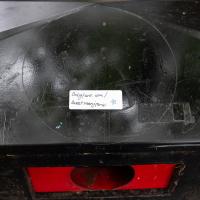
I wouldn't suggest following that link if you're at work, say, or if you don't know what OnlyFans is1. Maybe read the Wikipedia article instead.
1 If you type "onlyf" into my browser it autocompletes to the Only Fools and Horses wiki, which probably shows you how old and out of touch I am.
Autonomous Vehicle
14 Jul 2021
As it turned out, I didn't manage to get a coffee on my lunchtime coffee trip, as Imagine That were briefly shut down by a Covid-19 exposure notification (false alarm, it seems.) On the plus side, my trip was made worthwhile by spotting a couple of people from the University of Bath Mechanical Engineering Department testing an autonomous body-finding catamaran, which isn't a phrase I was ever expecting to write...
I recently indulged myself by buying a little piece of history. I've mentioned Samuel Loxton and featured and linked to his drawings before, often in the eminently browsable Loxton Collection albums that Bristol Libraries has on Flickr. So when I saw a Loxton drawing of Hotwells pop up on eBay, I decided to get myself a little treat.
I don't think there's any Loxton drawing that features the road I actually live in—it's not very visible from anywhere else, not being one of these Clifton terraces that's perched at the top of a hill, or anything like that, and it's invisible in most views of the area. However, this Loxton drawing, Hotwells, Looking across the river from near the Clifton Bridge station, is probably the closest near-miss I've seen.
I decided to wander out one morning and see if I could reproduce the picture, and also take a photo or two of what's now become of the Clifton Bridge Station, which is still just about discernible in places.
(Then on an even stranger whim I decided to check out a possible little cut-through from Cumberland Road to the harbourside I'd been eyeing up on my commute to work, so walked to Wapping Wharf for a croissant via this potential new route, but that bit's not quite as interesting...)
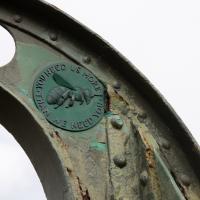
I'm afraid that this is a bit of a badly-curated wander, where I mostly just popped out to find out a little of the history of Underfall Yard and poke around the various open workshops, and, in hindsight, really didn't take pictures in any kind of coherent order. So there's a lot of pictures, but they don't really tell the story that, in hindsight, I seem to have been trying to tell, of the unusual electrical substation in Avon Crescent, the Bristol Electricity that predates the National Grid but is still in use, the history of the hydraulic power house... It's a bit of a mess.
But I suppose sometimes these wanders—always chronologically presented in the order I walked and took photos—simply will sometimes be a bit of a mess. Let's hope you still get something out of it, anyway...
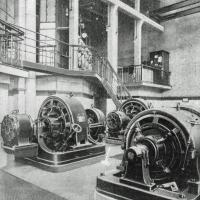
Via this Tweet and taken from KYP Bristol, showing the interior with a couple of Westinghouse rotary converters and a Peebles-La Cour motor converter, assuming this picture ties up roughly with this 1908 Institute of Mechanical Engineers' visit to works.
You can see a picture of similar Westinghouse converters to the two at the back in the Wikipedia rotary converter page and a Peebles converter that looks very similar to the one in the foreground on the cover of the Peebles motor converter catalogue in the sidebar of their entry in Grace's Guide. I'm guessing the additions on the ends of the Westinghouse converters were for different voltages? A rotary converter is basically a motor connected to a dynamo, so extra dynamos with different windings would give you different voltage outputs, I suppose, but I know very little about power generation.
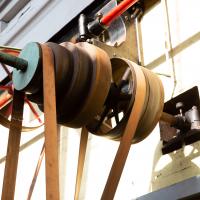
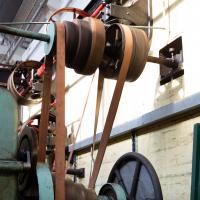
I guess the gearing is changed in the traditional way, by someone with a stick moving the belts across to the next diameters along. Apparently that used to be the emergency stop in the old days, too, some bloke poking at the belts with a pole until they fell off. Probably not ideal if it was to stop someone being sucked into the mechanism...
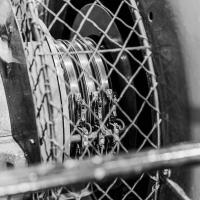
I presume they're the brushes and slip rings of the electric pump motor, though I'm not sure what kind of motor this is, to be honest.