Tagged: lawn
A Random New Year's Day Wander
01 Jan 2022
I picked a fairly arbitrary reason for a wander today. Really, I just wanted to do a New Year's Day wander just to get out of the house and to set a precedent for the year to come.
My ostensible reason was to investigate what looked like a road on my map that quartered the lawn in front of the Ashton Court mansion. As it turned out, this is just a muddy footpath/desire line similar to a half-dozen other tracks nearby, and must be some kind of bug or misclassification with the mapping system I'm using, but that's not important. What's important is that I went for a little walk on the first day of the year. As a bonus, I did happen to wander down a couple of sections of new footpath, so technically I broke some new ground too, which is nice.
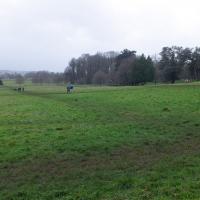
There were quite a lot of people about; I think a New Year's Day walk is still quite the tradition. Good.
I noticed I had a few things on my "potential wanders" list that could all be done relatively close to home, and in a fairly straight line, so I set off at lunchtime to recreate a photo of a now-defunct pub, wander behind a Spar (which turned out to be more interesting than I'd expected, but I admit it's a low bar) and spend some time browsing in Dreadnought Books before coming home via a coffee from Spoke & Stringer, a little diversion up Gasworks Lane and a tiny bit of the Rownham Mead estate I'd somehow previously skipped.
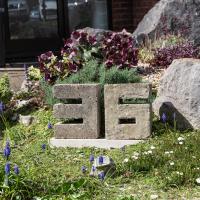
On my way home I popped through Rownham Mead estate and snapped a few things, starting with this house number that I've always enjoyed. This used to be my regular cut-through to the commuter ferry service back when I used to get the boat to work, so I'm very familiar with this little area.
As usual, the somewhat bland housing estate is elevating itself by means of the horticulture—I really do like the job their landscapers do in general, but most of the houses also seem to take a lot of pride in the individual gardens, too.
Ticking Off a Pocket of Paths in Leigh Woods
03 Jun 2022
I managed to go for a wander a while ago that was meant to finish off a little tangle of paths in Leigh Woods, or at the very least finish off my wandering of the Purple Path there. And I managed to miss doing either of those things through some kind of navigational incompetence.
Today I woke up with a bit of a headache, feeling a bit knackered as soon as I dragged myself out of bed, but at least with the energy to realise that I'd be better off (a) going for a walk in what looked likely to be the last of the Jubilee weekend sunshine than (b) moping around the flat until it started raining, at which point I could mope more thoroughly.
I had a look at my map, considered going to Ashton Court, but remembered that there was a music festival there today, and instead found these little leftovers of Leigh Woods and decided to have one more try at walking them.
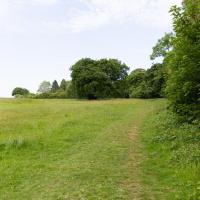
To the left is the edge of the golf course. I'm looking to wander along the edge and the behind the railway, which is behind those trees.
A Quick Swing Past Ashton Court
05 Jun 2022
Another day not dissimilar to my last wander: I'm feeling a bit tired and rather than just moping around the house I thought I'd find some tiny bit of somewhere that I'd not yet walked and get outdoors. This time I headed for the Tobacco Factory Market in Bedminster, as I often do, but went the long way around via Ashton Court Mansion as I knew there were some footpaths and a small section of road I'd not ticked off up there. Finishing all the Ashton Court footpaths will be quite a long job, but you've got to start somewhere...
I did feel rather better by the time I got home, and, pretty much astoundingly given the weather forecast, managed to avoid the rain completely.
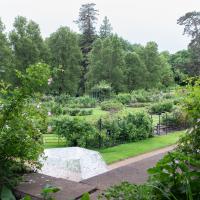
Alan Barber, late campaigner for public parks and green spaces, helped design this rose garden at Ashton Court, and it was dedicated to him in 2008.
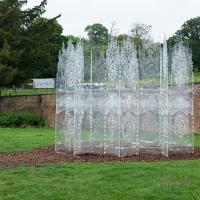
Trasparenza, by Andrea Greenlees, originally built for Burning Man in 2016. It has transparent benches inside, but it looked a bit of a tight squeeze, so I left the children of the family that arrived a couple of minutes later to it. They seemed to enjoy exploring. There's a view from the inside on Andrea's Instagram.
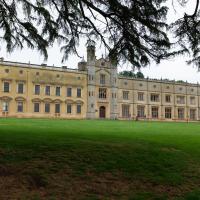
For looks, I prefer the side with the mullioned windows, but neither of them seems that satisfactory to me, architecturally-speaking. It's all a bit mis-matched and asymmetrical, with very odd spacing here and there.