Tagged: only
Baltic Wharf and Marina
04 Nov 2020
You never know what you'll find when you go for a walk in Bristol. This gorgeous Mustang was in the Marina car park. Nice. I also surprised myself by getting a good photo of The Hand (to give it its full title, Green Hand of a River God, by Vincent Woropay. Thanks, @mfimage!)
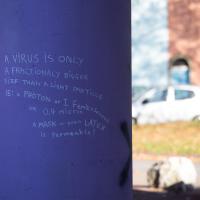
There seems to be a bit of a fad for scrawling vaguely scientific-sounding bollocks about viruses around here. A femtosecond isn't even a unit of size, and if latex was permeable to viruses, then condoms woudln't prevent STD transmission...
Also, of course, viruses don't generally travel alone. The size of breath droplets that would typically carry the Covid-19 virus, for example, is about 1 micron, which an N95 mask will filter out very well. Plus, you generally need to inhale a significant number of them—the "viral load" people talk about—to become infected.
Little Clifton Village Details
09 Nov 2020
I like The Paragon as a terrace, especially the bowed porches. On the other side of the road, a house attic has a stone lion surrounded by rocaille leaves, according to its listing.
I also love the detail of the arrows in the wrought iron of The Mall's balconies. Today I discovered Westfield place, a road I'd never encountered that runs up to the rear of the Coronation Tap. (It's a famous local cider pub, but I've only been in a couple of times. I'm more of a beer man.)
Rabbits, bad pedestrian signage and good coffee
13 Nov 2020
A quick trip with the aim of finding a better way to Greville Smyth park and a good coffee. Sadly I was stymied yet again with the former—it turns out that you do apparently have to take a strange loop around the houses (or at least around the roads) to get to Greville Smyth any way other than my normal route, unless you're prepared to vault some railings. It may be that the disused steps from where the skater kids hang out to the flyover above might once have led to a shorter route, but it's hard to tell. The geography in the area has always confused me.
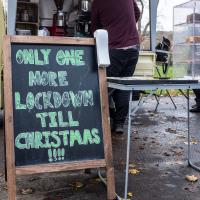
On the plus side, Rich, who runs Hopper Coffee from a Piaggio Ape does a great flat white and often has a good sign. (I collect cafe signs...)
Hotwells and Clifton/Clifton Village
14 Nov 2020
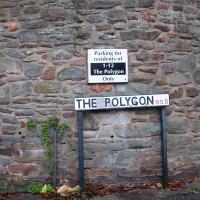
A local walk with my friend Lisa in tow, including a coffee from the cafe in the Clifton Observatory, where I have fond memories of experiencing my first camera obscura, and cake from Twelve in Clifton Village, one of my favourite recent finds for both food and flat whites.
Bedmo and Ashton Court
21 Nov 2020
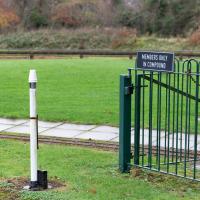
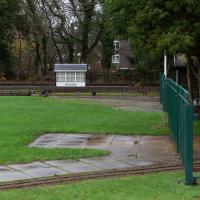
A rather more wide-ranging weekend wander with Sarah and Vik, taking in some mock Tudor bits of Bedmo (I should note that I've subsequently been corrected to "Bemmie", but I'm an outsider and have been calling it "Bedmo" for short for decades...), a chunk of Ashton, a path up Rownham Hill called Dead Badger's Bottom(!), The Ashton Court estate, a bit of the UWE campus at Bower Ashton, and some of the Festival Way path.
Avoiding the Accounts
26 Nov 2020
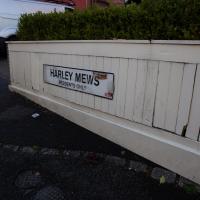
I took the day off my day job to do my accounts—or at least do enough bookkeeping to send them to my accountant. I hate doing the books. I woke up late, tired and with a headache and decided to bunk off for a walk around Cliftonwood, Clifton Village and Clifton instead, taking in a couple of good coffees along the way. Thanks, Foliage Café, and Twelve for the flat whites.
Ten O'Clock Shop and Can't Dance Coffee
30 Nov 2020
I had to return a faulty AirPod Pro to Apple (there's a first-world problem!) so I just took a quick trip up the hill to the nearest UPS drop-off point, The Ten O'Clock Shop, which is famously open until 11pm. Unfortunately it's a fairly cramped little place and neither of the staff were wearing masks, so I made it a very quick drop indeed and got out of there as quickly as I could.
I grabbed a quick coffee from Can't Dance, a stall that's—as of yesterday—in a tiny converted cargo container on the edge of Victoria Square; up until this week they were running from a little trike parked in the same place. Hopefully the new premises will let them see out the winter without worrying quite so much about the weather.
I tried to fit in a few extra streets from the surrounding area on my there and back, but that was basically my wander today: a quick little shopping trip.
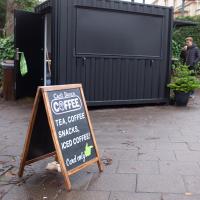
I'm not a great fan of their coffee, but that was based on a single try, so I should probably give them another go at some point. But there's so much coffee nearby that's pretty much guaranteed to be excellent—Twelve, Foliage, Spicer+Cole, to name but three—it's hard to take a chance.
More Cliftonwood
05 Dec 2020
Back to Cliftonwood for a wander that included some of the belle views of Bellevue Crescent and other bits of the easternmost part. Highlights included watching someone bump-starting an elderly Nissan Micra in the narrow confines of Bellevue Crescent.
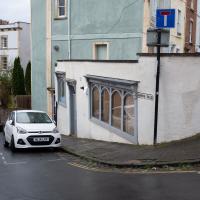
A "bright and airy self contained single storey Freehold studio / workshop (277 Sq Ft)". The floorplan shows that it's basically just a single room with tiny room with a loo and a sink inset, and nothing else. I suppose an enterprising hairdresser or nail technician might be able to make something of it.
Rainy Clifton
13 Dec 2020
A long walk around Cliftonwood and Clifton with my friend Lisa, taking in some of the 12 Days of Christmas display at Queens Parade, picking up a take-away coffee from Pinkmans of Park Street, and poking our heads up against the glass of SS Peter and Paul Catholic Cathedral.
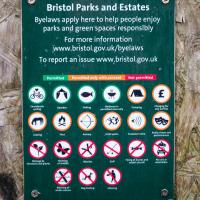
We wondered how often someone applied for consent to perform Archery on Brandon Hill.
Cliftonwood and Clifton Village Lunchtime Stroll
14 Dec 2020
The lunchtime walk has been feeling a bit of a chore lately, especially as I only have an hour and have to keep a mental watch out for my "bingo" point or risk being late back. Today I went for a deliberately brief local walk and got home in time to have lunch on my sofa rather than while I was back at work.
It's interesting filling in the gaps in my Clifton Village knowledge, especially starting to "see" the bits I can't see, the negative spaces. The size of both Fosseway Court and the Bishop's House gardens (check out the latter on Google Maps for an idea) are both something I've noticed by just getting to know the areas around them. I may also have to walk into the driveway of the very well-hidden Nuffield hospital to get an idea of how big it is.
None of those are anything compared to the trick of hiding the gargantuan public school that is Queen Elizabeth's Hospital so well that I keep on forgetting it's there, until a glimpse of it from somewhere like Lower Clifton Hill reminds me about it, of course...