Tagged: lived
Northern Clifton
16 Jan 2021
A raggedy wander with my friend Lisa, picking up a few stray streets and venturing only briefly onto Whiteladies Road, where it was too damn busy, given the current pandemic. We retreated fairly quickly. Found a couple of interesting back alleys, and got a very pointed "can I help you?" from a man who was working in his garage in one of the rather run-down garage areas behind some posh houses, and clearly didn't want us just wandering around there.
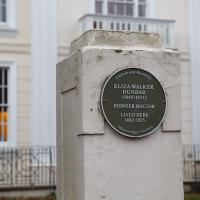
The first woman in the UK to qualify and work as a doctor, says Wikipedia. Among other things, she established The Read Dispensary for Women and Children in Hotwells, so I'll have to see if I can track down where that was. It might, of course, have been in the bit of Hotwells that was demolished to make way for the flyovers, though.
Oh! No, a quick check seems to show that it's the building on St George's Road that now houses Oryx Recruitment. I know the building well.
I bumped into my friend Lisa in town during yesterday's wander, and we decided to have a wander today, too. We managed quite a long ramble, starting up through Clifton and nipping down Park Row to investigate the two tower blocks I'd noticed popping up behind Park Street yesterday, then took in a few roads I'd not managed to get to before, including cutting through the grounds of Bristol Grammar School.
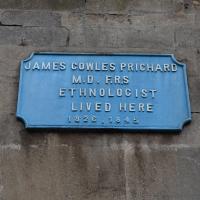
As well as ethnology, James Cowles Prichard was a psychiatric pioneer, serving as the—believe it or not—Commissioner for Lunacy, and was also the first person to define "senile dimentia" in the English language.
An Evening Wander to the Gallows
06 Apr 2021
I'd originally intended just to pop up to the area around Alma Road, where I'd missed a few streets on earlier wanders. It was such a nice evening, though, I decided to extend my walk up to the very top of Pembroke Road, just outside my one mile radius, to take a few snaps of something intriguing I'd found in my researches.
I've driven, walked and jogged past the little triangle of land at the top of Pembroke road a great deal in my time in Bristol, but I didn't know that it used to be the site of a gibbet, in fact that the road itself there used to be called Gallows Acre Lane. According to the Durdham Down history trail, by Francis Greenacre (an excellent name for a Downs researcher!) among other sources:
...it was below this quarry near the top of Pembroke Road, once called Gallows Acre Lane, that a gibbet stood. It was sometimes occupied by those who had committed robberies on the Downs and was last used in 1783 to hang Shenkin Protheroe for the murder of a drover. Stories quickly spread that he descended from the gibbet at midnight every night and stalked through Clifton. Such was the alarm that his body was cut down and buried.
Also very close to this little triangle of land was one of the gates of the extensive turnpike system...
Anyway. Along the way I encountered a wooden tortoise and a real squirrel, among other things. It was a good walk, and more light in the evenings means I can move my wanders out of the ticking countdown clock of work lunch-hours and be a bit more leisurely.
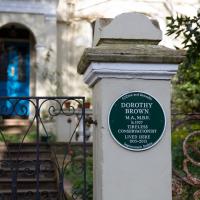
The Guardian's obit calls her "a saviour of historic Bristol".
At that time, there were 400 buildings in the city earmarked for demolition but Dorothy, who was instrumental in their listing, managed to save most of them, including the 18th-century Brunswick Square in St Paul's, via many public inquiries. Among her later successes, Dorothy helped to save the Clifton lido – dating from 1849, it is one of the oldest surviving lidos in Britain – which nearly succumbed to a developer's bulldozer in the late 1990s.
A London Wander in Southville
10 Apr 2021
There's a bit of Southville that I've been meaning to get to for some time, where the streets seem to take some strong inspiration from London. There's a Camden Road that crosses with an Islington Road, and a Dalston Road, even an Edgeware Road. For me these names are more evocative than the rather more exotic names I passed by to get there—Sydney Row or Hanover Place, say, because I've actually been to the places in London. The last time I was in Islington I saw Monkey Swallows the Universe play at The Angel, and I can't think of Camden without remembering a gondola trip with my friend Tara where a cheery youth played Beatles music for us on a saz...
I really liked this little area, with its mostly well-kept pretty houses and hints here and there of the creative side of the residents. It's arty and down-to-earth at the same time, and I wouldn't mind living there, I think.
On the way there I got the chance to walk through Underfall Yard for the first time in a while, and on the way back I had my first take-away hot food for many months, grabbing some crispy fried squid from the excellent Woky Ko at Wapping Wharf.
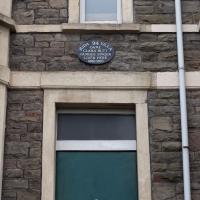
A famous contralto, apparently. Contralto Corner quotes Sir Thomas Beecham:
"On a clear day, you could have heard her across the English Channel"
...and notes that:
She gained her DBE as a result of the WWI concerts that she organized.
Bocye's Avenue Windows
19 May 2021
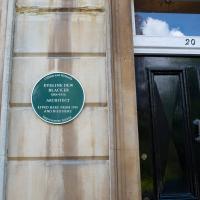
I just nipped up to Clifton Village to get a coffee, though I did manage to walk down a little alleyway I'd not really noticed before. Or perhaps I had noticed it and it looked private, but today I felt like wandering up its twenty or so feet anyway... The reflections in the shop windows on Boyce's Avenue gave me the idea to take a few snaps of them, so that's the majority of my small amount of snapping today.
The End of One Terrace and the Middle of Another
26 May 2021
Just a quick trip up to Clifton Village to enjoy a bit of sunshine and grab a coffee. No new roads, and only two pictures, but I did at least snap a plaque I'd missed related to some recent reading, and enjoy a quirky Clifton Village house.
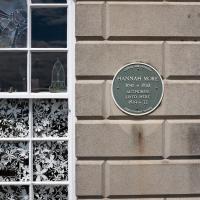
I recently finished Bristol Diamonds, by Emma Marshall, and Hannah More is one of the minor characters. I didn't know anything about her until I read her Wikipedia article, but she sounds fascinating. She was in the same generation of Bluestockings as Frances Burney, who coincidentally wrote the other historical novel featuring the Hot Well that I've read: Evelina.
Anyway. As I was looking her up, I discovered that I'd missed a plaque when I wandered down Windsor Terrace: she used to live at number 4. Lovely window treatment, too, perhaps to stop nosey people like me staring in while we're taking snaps of the plaque.
I managed to knock off a reasonable chunk of the roads I had left to walk around the University at the north-eastern extremity of my mile on this nice sunny walk. As well as being impressed by the number of big townhouses now occupied by various departments, I took some time on my way there to check out a war memorial, and some time on the way back to do a little extra wandering of Berkeley Square.
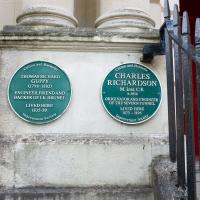
I've mentioned Sarah Guppy a few times; Thomas Richard was her son. Engineer's Walk has a page on him.
I'm not sure I've ever been through the Severn Tunnel. I should probably try it at some point, just for the experience.
A Long Wander Of Miscellany and Magick
08 Aug 2021
This was a wide-ranging wander. I started off crossing the river to Bedminster, to walk a single little cul-de-sac, Hardy Avenue, that I'd managed to miss on at least one previous walk. Then, pausing only to explore a few back alleyways, I headed for a few destinations related mostly by the Hughes family, who I've been researching a little as part of background for a possible novel, as several of them were involved in the Stella Matutina.
However, mostly it's the artistic side of the family I wanted to explore today, as that's where most of their public history lies (as you might expect, there's often not much in the public record about the workings of an occult organisation.) First I visited College Green, where the façade of the Catch 22 Fish & Chip shop still bears the work of Catherine Edith Hughes. Then I wandered up to the top of Park Street to pop into the Clifton Arts Club's annual exhibition, as Catherine, her half-brother Donald, his wife Hope and at least two other Hugheses were members. Donald was chairman for 40 solid years; Hope was Secretary for eight, and Ellard and Margaret Hughes, two more Hughes siblings, were members along with Catherine.
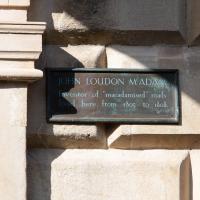
Finally I walked home with a small diversion to Berkeley Square, to confirm the location of Donald Hughes's house by checking for a particular plaque by the front door.
I must admit I'm not entirely sure where all this research is really leading me, but I'm finding it quite interesting to bump across the faint lines of history that link the Hermetic Order of the Golden Dawn, founded in 1888, to modern, quotidian Bristol.
Museum of the Moon, and a Bit of Redland
21 Aug 2021
Lisa and I mostly went out to have a look at Luke Jerram's Museum of the Moon as its tour hit Bristol Cathedral—I missed it when it was previously in town, at Wills Hall, I think—but we also took a trek up to Redland. Lisa's kind enough to indulge my strange current fascination with the Edwardian eccentrics that made up the Stella Matutina, so we swung by a couple of places with a vague connection to the Bristol branch of the organisation. Well, it was good walking, anyway...
As a stunning bonus, one of the picture's descriptions has more information than you'd probably want on the Bristol Port Railway and Pier's Clifton Extension Railway line, but I did happen to coincidentally write up this wander after reading about the extension line during my lunch hour at work today. It's a thrilling life, I tell you...
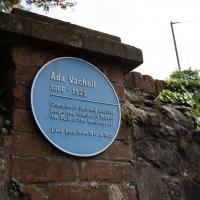
Can't resist a plaque. The original name of the organisation was "Guild of the Brave Poor Things", but that's Victorians for you.
Easter Monday Gardens and Flowers
18 Apr 2022
I didn't really set out with a theme of flowers and gardens in mind for this walk. I just fancied heading up to Clifton Village to get lunch. As it turned out, though, Spring was springing, so a minor theme emerged as I started off with the graveyard flowers of Hope Chapel and wandered up to see the beginnings of the new wildflower garden at Clifton Hill Meadow.
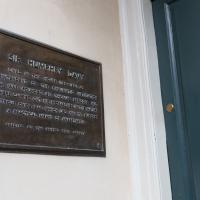
I first heard of Clerihews in the Times crossword: The Clerihew is:
a whimsical, four-line biographical poem invented by Edmund Clerihew Bentley.
The reason it's relevant to this plaque on a house just around the corner from mine is that the very first Clerihew was written about Sir Humphry Davy:
Sir Humphry Davy
Abominated gravy.
He lived in the odium
Of having discovered sodium.
(Sir Humphry is indeed credited with having been the first to isolate sodium, six years after moving out of this house...)