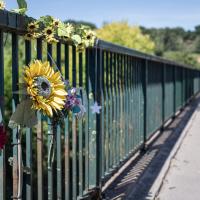
Tagged: memorial
Downs Wander
23 Feb 2021
Just a quick trip to knock off a path or two on Clifton Down. I'm not actually convinced I walked down the paths I was hoping to, but I suppose I'll see once I upload this and look at it on the map :)
Today's highlight turned out to be retrospective—looking up Gertrude Hermes' amazing wood engravings when I got home. (By complete coincidence, I was trying to discover the location of the Stella Matutina's former Hermes Lodge in Bristol as part of my researches last night...)
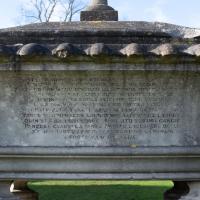
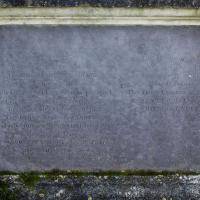
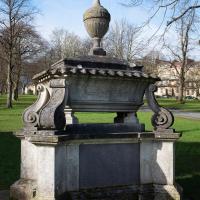
I managed to knock off a reasonable chunk of the roads I had left to walk around the University at the north-eastern extremity of my mile on this nice sunny walk. As well as being impressed by the number of big townhouses now occupied by various departments, I took some time on my way there to check out a war memorial, and some time on the way back to do a little extra wandering of Berkeley Square.
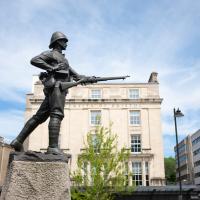
With a Lee-Metford rifle. The Lee Enfield was already in production when the Second Boer War started, but clearly this fella was still on the previous issue...
You'll notice he's also wearing puttees. They'd mostly died out as military wear by the end of WWII.
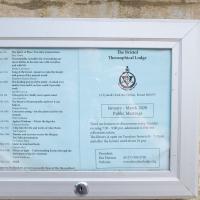
The Theosophical Society also lets its lodge be used by a variety of other organisations, including the Bristol Dowsers; a branch of Carlos Castaneda's Tensegrity folk (some of the videos of Tensegrity are quite something); a meditation group; and the local branch of the White Eagle Lodge, founded by a medium who received various teachings from the eponymous founder.
Given that those are the groups who openly practise there, I can only imagine the list of occult factions who use the rooms on other days...
Since setting up a search for Hotwells on eBay I've mostly managed to restrain myself from buying much (or in one case, was outbid, luckily for my finances.) However, I couldn't resist a 1902 flyer for a singalong at the Terrett Memorial Hall, which would have stood five minutes' walk from my flat, overlooking Howard's Lock.
I've found out a fair bit about this non-denominational seaman's mission, including tracking down both a Loxton drawing and an aerial photo of it. The main thing that's eluded me, ironically enough, is finding out who Terrett was, so as a Memorial Hall it didn't do a very good job 😀.
EDIT: Ah! Did a little more digging and found that the Bristol Archives has a Bristol Dock Company document on file called "William Terrett, Esq.; corresp. etc. re proposed erection of a Mission Hall at Cumberland Basin, 1892", so that might be worth a look once the Archives are properly open again. Given that:
Sarah Terrett died suddenly on 25 November 1889, aged 53, after speaking at a meeting of the White Ribbon Army, the temperance organization she had founded in 1878. Following her death many people sent letters of sympathy to her bereaved husband, William. One of these, from the Rev. W. F. James, a minister of the Bible Christians, makes for especially interesting reading. The Bible Christian denomination, to which Sarah and William belonged, was one of the smaller Methodist connexions, and had its heartland in rural Devon, the area where she had grown up. James recalled the hospitality he enjoyed when visiting the Terretts’ home, Church House, in Bedminster, south Bristol...
...I wonder if William Terrett built the hall in memory of his late wife. They were clearly just the kind of temperance movement people who would've founded a seaman's mission to get people together to have a nice non-alcoholic singsong rather than a night out on the tiles.
Anyway. This walk to grab a coffee from Hopper Coffee in Greville Smyth Park was mostly an excuse to post the leaflet, a few other things I found related to it, and some pictures of how the site looks now. I would suggest that the present day is not an improvement.
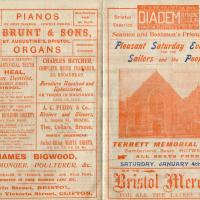
This was my random eBay purchase. I had no idea that the Terrett Memorial Hall had ever existed until I saw this leaflet up for sale.
There's some information on the hall on the Places of Worship database; as you can guess from the title of the leaflet it was basically a seaman's mission, with the aim "to promote the social, moral and religious welfare of sailors and provide sleeping accomodation for seamen, also free beds for destitute seafarers"
My favourite random thing on this leaflet is probably that the Surgeon Dentist is called Mr Heal.
A wander to knock off a couple of bits around Clifton Park that I'd missed out on previous excursions. This one took in the drinking fountain near Sion Hill and explained a little of how the Seven Years War, which ended in 1763, still has some history on display near Manilla Road.
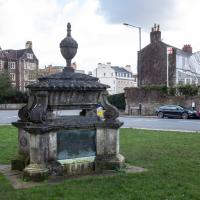
This sarcophagus surmounted by an urn is a 1767 memorial to the dead of the Seven Years War.
Leading off the far side of the roundabout in the background is Manilla Road, former site of Manilla Hall, built by General Sir William Draper, whose victories include capture of Manilla City in 1762. This cenotaph and the adjoining obelisk to Pitt used to stand in the grounds there.
Coffee, Coronation and Clift House Road
28 May 2021
Another dash to Greville Smyth Park for a coffee from Rich at Hopper, but at least this time I managed to divert a bit and knock off a small section of Cumberland Road I'd managed to miss on previous excursions. Along the way I muse on a strange residence in between a warehouse and a tannery, and wonder if the Mayor might be deliberately letting the Cumberland Road Flyover area go to seed...
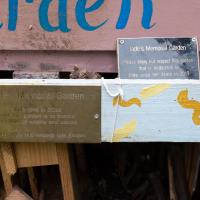
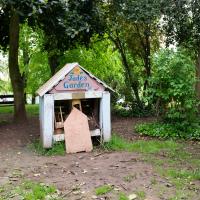
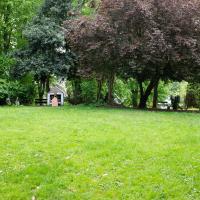
I'm in the habit of going over to the Tobacco Factory Market on a Sunday. I think I've walked all the routes around that way, but as a Plimsoll Bridge swing let me cross the road to the far side of Brunel Way on my return journey and I took a couple of photos of the brownfield development at the old Ashton Gate Depot site I thought I'd call it a Wander and pop some photos up.
The End of a Private Road
27 Oct 2020
One of the homes in Windsor Terrace went on the market for £2,000,000 a few years back. This is the closest I've been to it, right at the end of the private road. Presumably they're okay with people wandering down the road if there's a blue plaque to be seen at the far end?
Both the plaque to Edward St John Daniel and the other photo I took (in these early walks I was mostly walking, rather than mostly taking photographs) have interesting stories of a rise and fall associated with them in the first Google hits I found. Daniel was indeed the youngest recipient of the VC, but was stripped of the medal by Queen Victoria herself in 1861, following conviction for desertion and evading court martial. Lubetkin is probably most famous for designing the penguin pool at London Zoo, which was closed 17 years ago, after the micro-abrasions in the penguins' feet caused by the concrete led to them developing an infection with the charming name "bumblefoot".
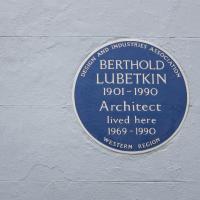
Designer of, among other things, the London Zoo penguin pool, and Highpoint, described by Corbusier as "This beautiful building .... at Highgate is an achievement of the first rank", and I like Corbusier's ideas, having read about them in How to Make a Home, I think, so that was what caught my eye on the Wikipedia page.
Little Clifton Village Details
09 Nov 2020
I like The Paragon as a terrace, especially the bowed porches. On the other side of the road, a house attic has a stone lion surrounded by rocaille leaves, according to its listing.
I also love the detail of the arrows in the wrought iron of The Mall's balconies. Today I discovered Westfield place, a road I'd never encountered that runs up to the rear of the Coronation Tap. (It's a famous local cider pub, but I've only been in a couple of times. I'm more of a beer man.)
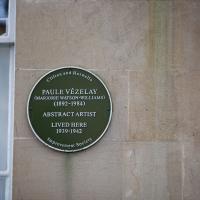
I'm not entirely clear how a Bristolian called Marjorie Watson-Williams ends up moving to Paris, changing her name to Paule Vézelay, and becoming a famous painter of the abstract school, but it must have been quite a fun ride, surely...
She returned to Bristol when war broke out and apparently spent the first few years in Rodney Place.
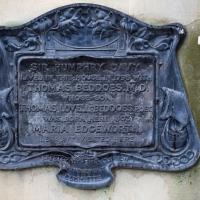
I was particularly intrigued by "MARIA EDGEWORTH his aunt visited here". It's this Maria Edgeworth, a prolific writer, apparently. "She was the second child of Richard Lovell Edgeworth (who eventually fathered 22 children by four wives)", so I imagine Thomas Beddoes had quite a few aunts...
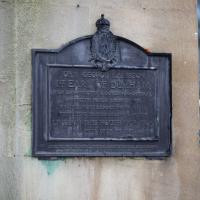
Outside the Zone
01 Nov 2020
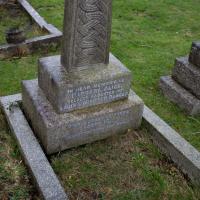
This started as a little local walk with my friend Lisa, but when we randomly met my friends Sarah and Vik at Ashton Court, turned into joining them for a very long wander out to Abbots Leigh Pool. Most of this was well outside my one-mile radius but it was a lovely walk.
Dowry Square Jaunt
16 Nov 2020
A quick lunchtime jaunt to Dowry Square, which is very close to me but, being effectively a cul-de-sac as well as a square, I've probably only circumnavigated a couple of times in the last couple of decades.
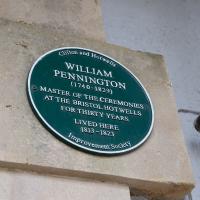
From The Bristol Hotwell, by Vincent Waite:
The Bristol Hotwell was, of course, much smaller than the neighbouring spa of Bath, and it was in no sense a rival but rather a supplementary cure, for many people combined visits to the two resorts. After 1785 the Hotwell imitated Bath by appointing a Master of Ceremonies, "William Pennington Esquire," who wore a gold medallion strung on a blue ribbon to emphasise the dignity of his office. In order to preserve decorum in the public entertainments he issued the following regulations:
- That a certain row of seats be set apart at the upper end of the room for ladies of precedence and foreigners of fashion.
- That every lady who has a right of precedence deliver her card to the Master of Ceremonies on her entering the room.
- That no gentleman appear with a sword or with spurs in these rooms, or on a ball night, in boots.
- That on ball nights when minuets are danced, ladies who intend dancing there will sit in a front row for the convenience of being taken out and returning to their places.
- That on all occasions ladies are admitted to these rooms in hats, not excepting the balls given to the Master of the Ceremonies.
- That the subscription balls will begin as soon as possible after 7 o'clock and conclude at 11, on account of the health of the company.
- It is earnestly requested that when a lady has gone down the dance she will be so polite as not to retire till it is concluded.
I daresay if you look around the pavements nearby you'll find some evidence of people still enjoying the effects of nitrous oxide. #whippets