01 May 2021
I didn't get to all the little leftover streets around the northeastern part of my area in today's wander, but I definitely knocked a few off the list, plus Lisa and I enjoyed the walk, and didn't get rained on too badly. We spotted the hotting-up of Wisteria season, checked out Birdcage Walk (both old and new), ventured onto the wrong side of the tracks1 and generally enjoyed the architecture.
1 Well, technically we probably shouldn't have been on the grounds of those retirement flats, but nobody started chasing us around the garden with a Zimmer frame
There's some fascinating stuff on Victoria Square here, including a lot of jumping-off points for deeper research. The description of the bombings during the war is amazing.
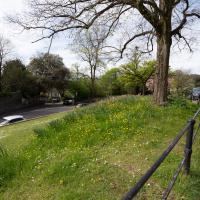
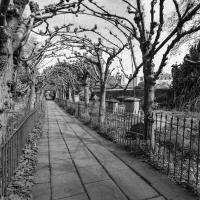
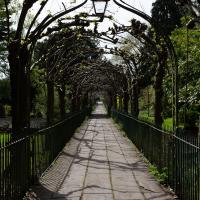
This is the path that used to be known as Birdcage Walk—up until the war it was lined with tall railings—but most people now use that name for the corridor made by the pleached lime trees in St Andrew's Churchyard, just a stone's throw away. I suppose that's the one that most resembles a bird cage today. Here's a Vaughan Collection photo of what it looked like before the war.
Adjacent on the left (Merchant's Road) side would have been the church of St James the Apostle, which survived the war but was demolished for flats in the seventies.
Clifton's so posh that even the bird baths around here are listed historic structures. Mid nineteenth-century, limestone ashlar. Just like many of the houses.
06 May 2021
I'm meant to be taking a little break from this project, but in my Victoria Square researches after my last walk I noticed a curiosity I wanted to investigate. The community layer on Know Your Place has a single photograph captioned, "The remains of an 'underpass' in Victoria Square".
Looking back through the maps, I could see that there really did used to be an underpass across what used to be Birdcage Walk. I can only guess that it was there to join the two halves of the square's private garden that used to be separated by tall railings that were taken away during WWII. Maybe it was a landscaping curiosity, maybe it was just to save them having to un-lock and re-lock two gates and risk mixing with the hoi polloi on the public path in the middle...
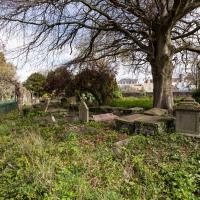
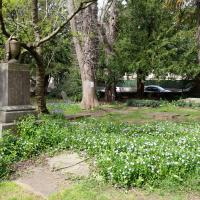
Anyway. Intrigued, I popped up to Clifton Village this lunchtime for a post-voting coffee, and on the way examined the remains of the underpass—still there, but only if you know what you're looking for, I'd say—and also visited a tiny little road with a cottage and a townhouse I'd never seen before, just off Clifton Hill, and got distracted by wandering the little garden with the war memorial in St Andrew's churchyard just because the gate happened to be open.
EDIT: Aha! Found this snippet when I was researching something completely different, of course. From the ever-helpful CHIS website:
When there were railings all round the garden and down the central path, in order that the children could play together in either garden there was a tunnel for them to go through. This was filled in during the 1970s but almost at the south east end of the path if one looks over the low wall the top of the arches can still be seen.
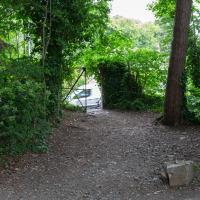
I hadn't realised, from the other end, that this little alley was part of the churchyard rather than a way through into a private back garden; it looked as though it might pop up in the Bishop's House, and you don't want to disturb a bishop. When I worked out it just led through to the main church area I decided to walk it just for completeness, looping around and out through the memorial garden again.
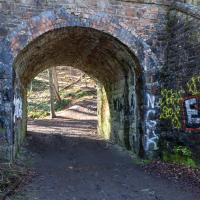
I'm assuming this used to be an arched tunnel entrance. It's in the right place, anyway. This is on the north side, looking south
The more I research it, the more I find that Hotwells had far better transport links back in Victorian and Edwardian times than it has today. Along with buses that went to more useful places than the City Centre, there were trams, the funicular up to Clifton, the landing stage for paddle steamer services and two railway stations all within easy walking distance of me.
Today I took a day off work as preparation for doing the bookkeeping for my tax return1, and took a wander along to the site of what would have been my nearest station, Hotwells (or Clifton, as it started out in life), nestled in the shadow of the suspension bridge, the Bristol terminus of the Bristol Port Railway and Pier.
From there I wandered down the Portway, following the original line, until I got to the area around Sneyd Park Junction, where the tunnel from the slightly later Clifton Extension Railway joined up with this originally-isolated BPR line. Then I headed up to Clifton through the "goat gully" at Walcombe Slade, seeing the few above-ground bits of evidence of the tunnel (which is still in regular use) along the way.
It was a lovely day, and a good walk, and it was interesting to daydream of the times when I could have walked a few minutes from my flat down to Dowry Parade, caught a short tram ride to Hotwells Stations, and then headed from there to Avonmouth, perhaps even to board a transatlantic passenger service. The completion of the Clifton Extension Railway that linked the Avonmouth station with Temple Meads made relatively direct transatlantic travel from London via Bristol possible, with passengers travelling up from Paddington to Temple Meads, on to Avonmouth on the Clifton Extension Railway and Port Railway and Pier line, then perhaps catching a Cambpell's paddle steamer—which sometimes acted as tenders for large steamers—to a larger ship that was headed out for Canada, say.
1 I've learned that the best approach is to take two days off and deliberately do something that's not my bookkeeping on the first day, as otherwise I just inevitably end up procrastinating and feeling guilty on the first day no matter what. I have an odd brain, but at least I'm learning strategies for dealing with its strange ways as I get older...
2 Information mostly gleaned from Colin Maggs' The Bristol Port Railway & Pier and the Clifton Extension Railway, The Oakwood Press, 1975.
If I hadn't seen the photos and maps I'd have had no clue that there was once a busy railway station here, with three tracks, a platform, a ticket office, a turntable, a station master's house and so on. The last train would have been, I think, on 19 September 1921.
Hotwells Halt, the extension platform put in just north, on the other side of the first tunnel, survived until 1922, but after that everything would have changed for the Portway.
Not everything was lost, though. The rest of the line was effectively saved by the fact that it joined up to the main rail network (and didn't need to be completely obliterated to make room for the road.)
The joining to the mainline was achieved by the Clifton Extension Railway, which included a tunnel from Clifton Down to Sea Mills, the next station along from Hotwells Halt, and the closest surviving Bristol Port Railway station to Bristol.
The CER line is still in use, and we'll be taking a route that checks in on the tunnel in a few pics from here...
So, along with the horizontal shaft that comes out rather unattractively in the side of the quarry below, there are two other air shafts for the tunnel. This one marks the spot where this path up Walcombe Slade crosses directly above the dead-straight Clifton Extension Railway tunnel running from left to right in the depths of the rock below.
It doesn't look quite contemporary to the 1870s railway tunnel, does it? That's because it was rebuilt with concrete blocks in 1950. I do like the top cover, though. I'm sure it could've been just a boring flat grille.
03 Dec 2021
On my last wander, to Bower Ashton, I was intending to knock Blackmoors Lane off my list "to-do" list, but got a bit diverted. I also took a little look into the history of the Gridiron, once a cheaper alternative to dry dock that was nestled just south of North Entrance Lock.
Today I had to go to send a parcel off somewhere, so I decided on going to the North Street Post Office via Blackmoors Lane. I didn't have much intention of anything else, but as luck would have it I walked out both at low tide and also as some lockkeepers seemed to be having a bit of a training session, and one of the more senior people was (a) happy to answer a few random questions on the Gridiron and (b) actually knew a lot about it, as Gridiron maintenance had been one of his jobs, more than twenty years ago...
Opposite Country Gates, which is the rather aspirational name for the office block there.
Out of sight to my right is Ashton Park School, which accounts for quite a few things that look like roads on the map, but which aren't public and which I'm not going to wander down.
This is about halfway along the Gridiron. You'd sluice water back and forth from this point to rinse the silt off the Gridiron as part of its regular maintenance. This was still being done until around the year 2000, when it apparently became more trouble/cost than it was worth for the dwindling number of boats using it.
I was just about starting to feel better—the antibiotics seemed to have kicked in for my dental issues, and it had been some days since I'd left the house, and I was at last starting to get itchy feet. So, a wander. But where? Well, there were a few industrial bits near Winterstoke Road in the Ashton/Ashton Vale areas of Bristol that needed walking. I knew they were likely to be quite, well, unattractive, frankly. So why not do them while I wasn't feeling exactly 100% myself? Maybe it would fit my mood. Hopefully you're also in the mood for a bit of post-industrial wasteland, for that's what some of this feels like...
Then, at the last minute, I thought again about the Bristol International Exhibition—I've got a book about it on the way now—and that gave me another goal, which could just about be said to be in the same direction, and I decided to walk significantly further than my normal 1-mile limit and try recreating another historical photo...
Sadly I don't know much about the Ashton area; it's just on the edges of my mile and I rarely have cause to go there. It's brimming with history, I'm sure: the whole South Bristol area rapidly developed from farmland to coal mines to factories to its current interesting mixture of suburbs and industrial work over the last few hundred years. As a more working class area less attention was paid to it by historians, at least historically-speaking, than the Georgian heights of Clifton, and much of it has been knocked down and reinvented rather than listed and preserved. I see here and there some of this lack is being addressed, but I'm afraid I'll be very light on the history myself on this wander, as most of my usual sources aren't throwing up their normal reams of information as when I point them at Clifton, Hotwells or the old city.
Presumably there's a good reason it's called Greenmarsh Lane, adjacent to Gores Marsh Park. A lot of the names in the area suggest some rather marshy heritage. I'm guessing this drainage is part of what stops it being quite so marshy in the modern day.
In fact, gosh: here's a picture of it during the flood in 1968. The great flood of 1968 apparently killed seven people, and it's worth clicking through to the Evening Post site to take a look at the picture gallery.
These floods were one of the key reasons for the building of the Malago Storm Water Interceptor, whose outfall we've seen in an earlier wander.
This is near the view I'm trying to recreate. Here are the fringes of Bedminster Down.