Tagged: street-light
I noticed I had a few things on my "potential wanders" list that could all be done relatively close to home, and in a fairly straight line, so I set off at lunchtime to recreate a photo of a now-defunct pub, wander behind a Spar (which turned out to be more interesting than I'd expected, but I admit it's a low bar) and spend some time browsing in Dreadnought Books before coming home via a coffee from Spoke & Stringer, a little diversion up Gasworks Lane and a tiny bit of the Rownham Mead estate I'd somehow previously skipped.
A Swing of the Plimsoll Bridge
24 Apr 2022
I was originally going to head over to the Ashton area to see if I'd missed any bits around the football stadium—and also to grab some lunch from the Tobacco Factory Market—but in the end I got a little distracted by having accidentally chosen exactly the right time to see the Plimsoll Bridge swing on one of the first busy days of Spring, where a lot of pleasure trips tend to head out down the Avon (and possibly the New Cut) from Hotwells.
In the end I mostly snapped that, and just a couple of photos from the Ashton area where I grabbed some lunch but didn't do any new exploring.
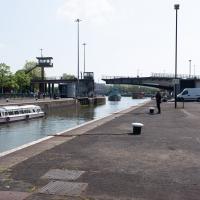
The Plimsoll Bridge is definitely not the oldest swinger in town. In fact, it may be the youngest swinger in town. I think the only other functioning swing bridges on the floating harbour (side-to-side rather than up-down like Redcliffe Bascule) are Junction Bridge (hidden in this picture, it's on the far side of the Cumberland Basin, carrying Merchants Road) and Prince Street Bridge, built in 1925 and 1879 respectively. The Plimsoll Bridge is mid-1960s.
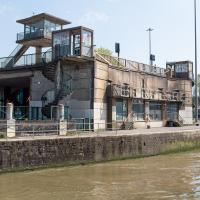
You don't often see this view of the brutalist bridge abutment, because the bridge itself is normally blocking and overshadowing the view here. Excuse me while I take far too many photos of it to be healthy.
I've always particularly liked the spiral staircases and the control tower, which looks like it's escaped from a prison camp.
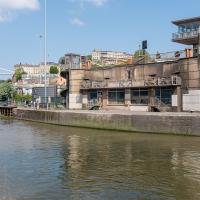
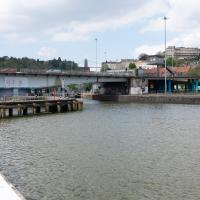
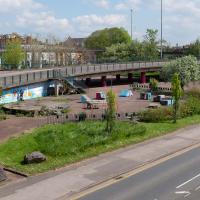
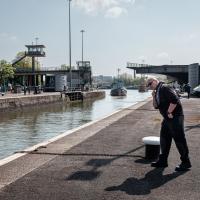
Can't spot any music or a cafe in this photo? I don't blame you. But, if you look mid-left, you'll see a circular concrete plinth where the cafe used to stand near the children's playground in the heyday of the Cumberland Basin. And behind it is what caught my ear as I was crossing the lock gates—a saxophonist is practising his scales.
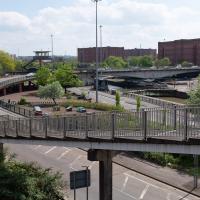
I've come across practising musicians in this area before. Presumably they've come away from home to avoid annoying the neighbours (or the rest of the family!) The traffic noise covers even unmuted brass quite well—by the time I was at the other end of the footbridge, on the far side of the flyover, I could barely hear him.
A Quick Swing Past Ashton Court
05 Jun 2022
Another day not dissimilar to my last wander: I'm feeling a bit tired and rather than just moping around the house I thought I'd find some tiny bit of somewhere that I'd not yet walked and get outdoors. This time I headed for the Tobacco Factory Market in Bedminster, as I often do, but went the long way around via Ashton Court Mansion as I knew there were some footpaths and a small section of road I'd not ticked off up there. Finishing all the Ashton Court footpaths will be quite a long job, but you've got to start somewhere...
I did feel rather better by the time I got home, and, pretty much astoundingly given the weather forecast, managed to avoid the rain completely.
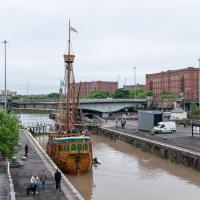
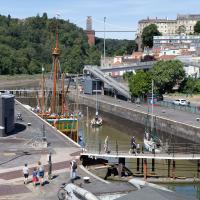
Fairly typical Bristol scene here, as the traffic is held up for a bridge swing caused by a replica of a 15th century caravel.
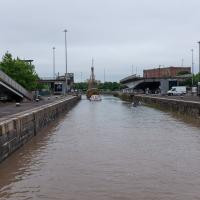
I'd normally walk over those open lock gates she's just sailed through, but it's easy enough to walk down to the gates at the river end.
I've been pretty awful at reading so far this year, apparently averaging about one book per month. That's a far cry from 2019, say, where I got through 41 books in the year. Today's wander was prompted by my rubbish reading, as I needed to go hand back some books to the library, because I'd managed to renew them so many times that I hit the limit on renewals. Oops. Several of them were still unread.
So, off to the Central Library for me, tail between my legs. On the way there I did my best to recreate a historical photo of Dowry Square; while I was in the area I walked under the adjacent Norman arch and poked around behind the Cathedral, and I also had a little diversion to the city centre and came back along the south side of the river, hitting some trouble with the lock gates as I finally crossed the harbour back towards home.
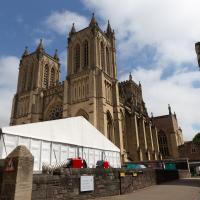
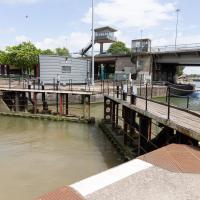
While I was taking the last few photos I'd been hearing the two-tone alarm signal of a bridge swing, so I knew something would be going on at the lock when I got here. This time, though, I got more than I bargained for.
I was coming up to cross at these lock gates like normal when I saw that the lock keeper operating the hydraulics was having some difficulties. Sure enough, after a few attempts at closing the gates, it became apparent that they just weren't having any of it. They were getting this close to closing and then jamming.
I'm in the habit of going over to the Tobacco Factory Market on a Sunday. I think I've walked all the routes around that way, but as a Plimsoll Bridge swing let me cross the road to the far side of Brunel Way on my return journey and I took a couple of photos of the brownfield development at the old Ashton Gate Depot site I thought I'd call it a Wander and pop some photos up.
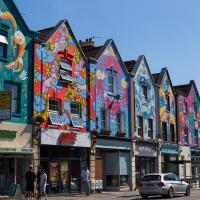
The street art is still looking good, but one of these properties has been turned into such low-end multiple-occupancy accommodation that it got into the Bristol Post this week with pictures of one tiny room with a shower alongside the bed serving as the sole room per person, with a toilet shared between four "studio rooms". I suppose this is actually better than the student accommodation I had in my first year at Warwick, but at least that was actually on campus...
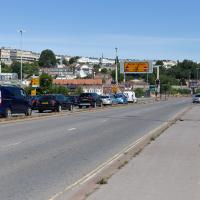
Now, what's actually meant to happen at this point is that all the traffic follows the giant flashing ALL TRAFFIC sign pointing to the exit ramp on the left. Then they go down the ramp, along a short stretch of road, cross the harbour at Merchants Road bridge (officially Junction Swing Bridge, in fact), join the Hotwell Road and continue on their merry way, without any cause for delay.
This never actually seems to happen, and a queue just forms here. Today this particularly annoyed the driver of a Waitrose van, presumably late for a delivery and stuck behind what he clearly thought were a line of idiots that he hooted angrily at for quite some time, to as much effect as you'd imagine.
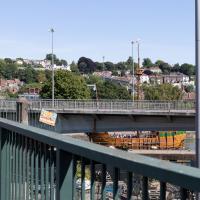
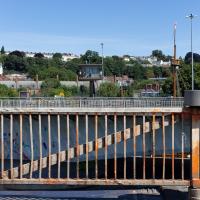
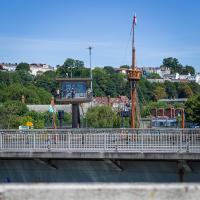
One of the things I like about Bristol is the strange contrasts. Here we have two crow's nests. The first is the Cumberland Basin Flyover System's Plimsoll Bridge control room, used to give the swing bridge operator a good view of the whole area surrounding the bridge. The second is the reason for the swing, the crow's nest on the tall mast of the replica of John Cabot's Matthew, as it passes through into Entrance Lock.
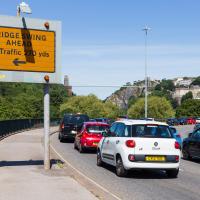
They really couldn't make it much clearer that drivers are meant to nip off down the off ramp up ahead and take Junction Swing Bridge instead. But if anyone ever does I've not seen it. I don't think I've ever been caught in the queue here as a driver, but then I don't do much driving.
Nipping Up the Zig Zag to the Shops
19 Aug 2023
It's been a long while since I did one of these walks.
I'm thinking of finishing up the project by walking one or two last bits of road, thus being able to declare with all honesty that I've done my best to walk every public road within my mile (and quite a few alleyways besides.) As a prelude, and just because I felt like it, I decided to drag out the camera and GPS on this little wander to the local shops.
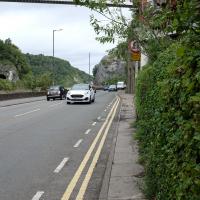
The Hotwell Road really needs more facilities for pedestrians. I spotted plenty of other walkers just on my brief trip along this short section, but all of us were being forced out to share the road with the busy traffic or prevented from crossing to the safer side and back as we made our way.
Thin pavements and a lack of crossings really show how much the car is king in this bit of Bristol, despite the gorgeous landscape.
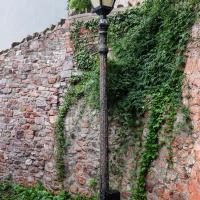
One of many exemplars of the sorry state of the historic cast iron lamp posts of Clifton Village. I get the feeling that the Council wish they'd all just rust away so that they can be replaced by cheap ugly lighting rather than needing any kind of maintenance.
On that somewhat sour note, I headed home before the few spots of rain I felt became anything more severe.