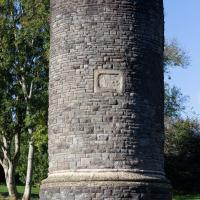
Tagged: brickwork
A Long Wander Of Miscellany and Magick
08 Aug 2021
This was a wide-ranging wander. I started off crossing the river to Bedminster, to walk a single little cul-de-sac, Hardy Avenue, that I'd managed to miss on at least one previous walk. Then, pausing only to explore a few back alleyways, I headed for a few destinations related mostly by the Hughes family, who I've been researching a little as part of background for a possible novel, as several of them were involved in the Stella Matutina.
However, mostly it's the artistic side of the family I wanted to explore today, as that's where most of their public history lies (as you might expect, there's often not much in the public record about the workings of an occult organisation.) First I visited College Green, where the façade of the Catch 22 Fish & Chip shop still bears the work of Catherine Edith Hughes. Then I wandered up to the top of Park Street to pop into the Clifton Arts Club's annual exhibition, as Catherine, her half-brother Donald, his wife Hope and at least two other Hugheses were members. Donald was chairman for 40 solid years; Hope was Secretary for eight, and Ellard and Margaret Hughes, two more Hughes siblings, were members along with Catherine.
Finally I walked home with a small diversion to Berkeley Square, to confirm the location of Donald Hughes's house by checking for a particular plaque by the front door.
I must admit I'm not entirely sure where all this research is really leading me, but I'm finding it quite interesting to bump across the faint lines of history that link the Hermetic Order of the Golden Dawn, founded in 1888, to modern, quotidian Bristol.
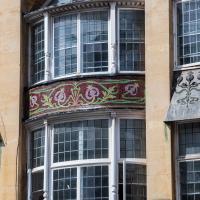
As I mentioned, these pomegranates were made by Catherine Hughes, daughter of the estate agent who commissioned the cafe.
The Hughes name is one to conjure with. I'm specifically interested in the Hughes family as I've been researching the Golden Dawn1 for a novel, and at least three Hugheses were members of its later offshoot, the Stella Matutina. Catherine Hughes (Lux Orta Est), who made these tiled pomegranates was, I believe, the first Imperatrix of the No. 28 Bristol Hermes Temple of the Stella Matutina, running it to begin with from her home at St Vincent's Studio, Redland, just off the top of Whiteladies Road.
We'll be hearing a bit more about some other members of the Hughes family in a little bit, as I decided to turn this wander into a bit of a magical excursion, for fun and research and because of handy timing and geographical coincidence.
I don't know if these pomegranates from 1904 predate Catherine Hughes's interest in magic per se, but they were made years before she joined the Stella Matutina, in early 1908, so I can't say that they were created by a practising magician!
1 No, not the Greek nutters. The British Victorian, er, eccentrics.
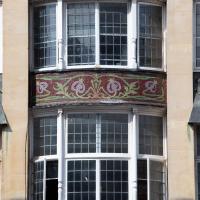
The side window canopies are copper, as you can probably tell by the green streaks below them.
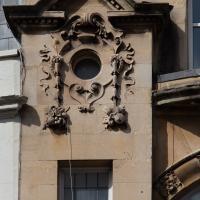
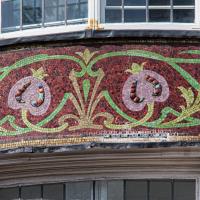
Must've taken some time to put together. And done with some skill, to still look so good nearly 120 years later.
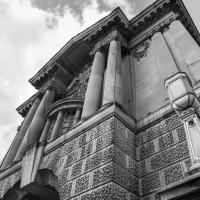
City Museum and Art Gallery. Though when it was donated by Henry Wills (you can just see The Gift of... in the inscription) it was just The Bristol City Art Gallery.
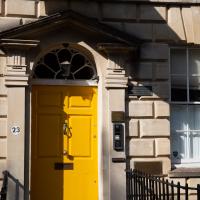
Here's a startling coincidence. When I came to Berkeley Square last time, to see if I could sense somehow where the Stella Matutina vault had been stored, I had no idea which house might have contained it. I did, however, joke that I was attracted to number 23 because of the number of the house and the colour of the door.
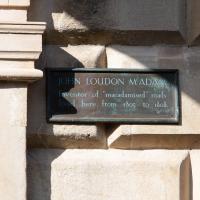
I've since found out that Donald Hughes lived in Berkeley Square, and was likely to have been the person who stored the vault after the temple became dormant in the 1950s (I think this may have been following his wife Hope's tragic death here in 1951.) And I also found out (in some communications of the Bristol-Hannover twinning committee, improbably) that he had a plaque to John Loudon McAdam fitted to his house when he lived there, in tribute to this illustrious former occupant.
And... What's that I see, just to the right of the door?
Yes. This was Donald Hughes's house, and likely the last resting place of the vault of the Bristol Hermes Temple.
Museum of the Moon, and a Bit of Redland
21 Aug 2021
Lisa and I mostly went out to have a look at Luke Jerram's Museum of the Moon as its tour hit Bristol Cathedral—I missed it when it was previously in town, at Wills Hall, I think—but we also took a trek up to Redland. Lisa's kind enough to indulge my strange current fascination with the Edwardian eccentrics that made up the Stella Matutina, so we swung by a couple of places with a vague connection to the Bristol branch of the organisation. Well, it was good walking, anyway...
As a stunning bonus, one of the picture's descriptions has more information than you'd probably want on the Bristol Port Railway and Pier's Clifton Extension Railway line, but I did happen to coincidentally write up this wander after reading about the extension line during my lunch hour at work today. It's a thrilling life, I tell you...
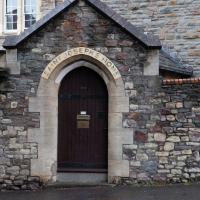
"They afterwards built, in connexion with their convent, an asylum for the reception of about one hundred sick and aged poor, means for the maintenance of whom they obtained by soliciting alms from door to door"
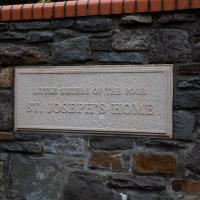
More from ChurchDB:
"The order was founded by St Jeanne Jugan, after she rescued two poverty-stricken elderly women from the streets of Paris during the French Revolution. The Sisters' work continues today, in providing care for the elderly - for an account of this, see the article Celebrating the Little Sisters with big hearts published in the Bristol Post on 15th October 2012, reporting on the celebration of 150 years of their work."
And even more on Wikipedia, of course...
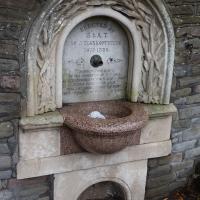
I was surprised to find that "thank-offering" is actually in Chambers' dictionary, and not at all surprised to find it means exactly what you'd expect.
The inscription is from Psalm 114:
Tremble, thou earth, at the presence of the Lord, at the presence of the God of Jacob; Which turned the rock into a standing water, the flint into a fountain of waters.
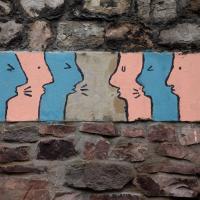
I had no idea who had done this when I snapped it, but on a later wander I found this bit of street art only a few hundred yards from my front door which seems to confirm the artist as @maybepaints.
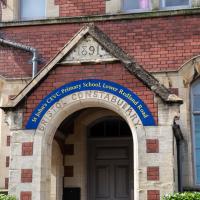
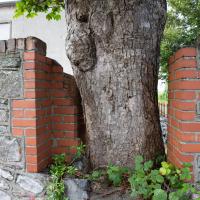
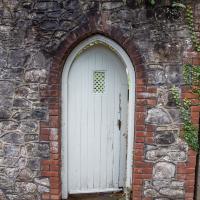
Mostly the Metal Animals of a Clifton Garden
30 Aug 2021
Lisa and I went for a longish walk, but I didn't take many photos. Mostly we just wandered and nattered. Unusually, my target was outside my 1-mile radius on Burlington Road in Redland, where I snapped quite a few photos of the collection of artistic animals by Julian Warren. This was mostly to provide a fairly arbitrary destination for a roundabout walk in Clifton...
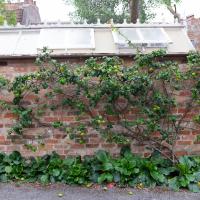
I don't know enough about fruit trees to know what this was, but I can tell you that the fruit was apple-ish and very sharp indeed.
Unusual to see an espalier on a north-facing wall. This one faces the little car park behind Freeland Place
A Morning of Research and a Cafe in a Castle
25 Sep 2021
I needed to pop to the library, as they'd kindly dug a book out of the reserve store at the B Bond warehouse for me and emailed me to let me know it was ready. So, I took a little trip to town, straight down the Hotwell Road, and spent a few hours reading before stretching my legs with a walk to a new cafe in the actual castle (or remnants thereof, anyway) of Castle Park, before heading back home down the other side of the harbour. As well as books and coffee, I bumped into a remote-controlled pirate ship, which isn't something you see every day, even in Bristol.
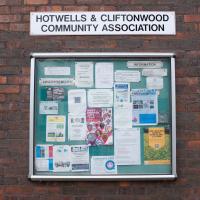
The sign about the wildflower meadow on Clifton Hill Bank is part of the consultation I mentioned the other day.
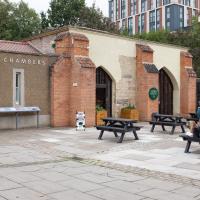
The chambers were apparently once the entrance to the castle's great hall. Historic England has this section of the castle at 13-14th century
I was interested to see it, but a little underwhelmed, if I'm honest. A fairly bland interior and a perfectly adequate flat white—not much "wow" factor.
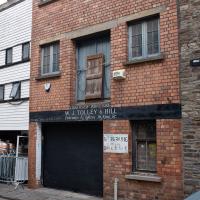
Rear of King Street. I would say "interesting frontage", but presumably this is interesting backage.
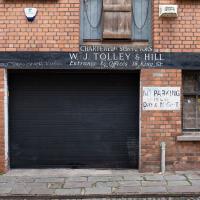
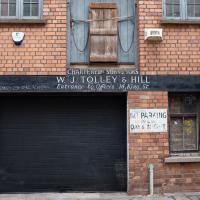
It's bad enough that the terrace opposite was demolished, without some hurriedly-qualified HGV reversing into the new1 buildings on this side...
1 I suppose "new" is relative. But on most of the maps I've been looking at recently these flats don't exist yet. I think the earlier buildings included a smithy and at one stage what looks like a tap-room, the Stork Tap, for the larger Stork pub that used to occupy what's now Stork House on the main road below. You basically couldn't move in Hotwells without falling into a pub throughout most of its history. The modern-day suburb seems positively teetotal in comparison...
I recently indulged myself by buying a little piece of history. I've mentioned Samuel Loxton and featured and linked to his drawings before, often in the eminently browsable Loxton Collection albums that Bristol Libraries has on Flickr. So when I saw a Loxton drawing of Hotwells pop up on eBay, I decided to get myself a little treat.
I don't think there's any Loxton drawing that features the road I actually live in—it's not very visible from anywhere else, not being one of these Clifton terraces that's perched at the top of a hill, or anything like that, and it's invisible in most views of the area. However, this Loxton drawing, Hotwells, Looking across the river from near the Clifton Bridge station, is probably the closest near-miss I've seen.
I decided to wander out one morning and see if I could reproduce the picture, and also take a photo or two of what's now become of the Clifton Bridge Station, which is still just about discernible in places.
(Then on an even stranger whim I decided to check out a possible little cut-through from Cumberland Road to the harbourside I'd been eyeing up on my commute to work, so walked to Wapping Wharf for a croissant via this potential new route, but that bit's not quite as interesting...)
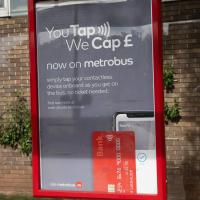
I don't actually know what "we cap £" means. I do know that it always seemed irritating that the Metrobus worked by having to buy a ticket in advance at fiddly little machines next to the stops, and that being able to just buy a ticket by tapping a card once you were on the bus would seem wildly futuristic if I hadn't had a Oyster card decades ago in London...
Having just tried to read the 2,500-ish word explanation of Tap & Cap, I'm still not sure exactly how to use it, but hopefully it at least means that Bristol bus drivers will no longer swear at you if you don't happen to have exactly the right change sorted out in advance...
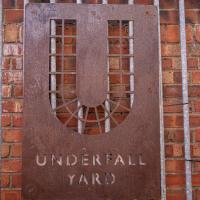
I'm afraid that this is a bit of a badly-curated wander, where I mostly just popped out to find out a little of the history of Underfall Yard and poke around the various open workshops, and, in hindsight, really didn't take pictures in any kind of coherent order. So there's a lot of pictures, but they don't really tell the story that, in hindsight, I seem to have been trying to tell, of the unusual electrical substation in Avon Crescent, the Bristol Electricity that predates the National Grid but is still in use, the history of the hydraulic power house... It's a bit of a mess.
But I suppose sometimes these wanders—always chronologically presented in the order I walked and took photos—simply will sometimes be a bit of a mess. Let's hope you still get something out of it, anyway...
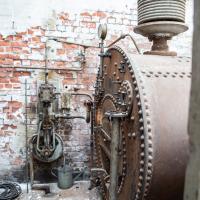
Insert your own joke here. This little room at the end of the workshop housed the boiler and the steam engine from when every single bit of large equipment ran from the belt drive system. It must have been absolutely awful to work in.
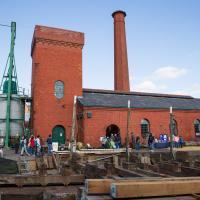
I've really taken all these photos in the wrong order, haven't I? This is an overview of the last many shots. The visitor centre is the right hand side of the building. The chimney behind is for the boiler that was inside in the days of steam. In the roof above the visitor centre was the header tank. The pump room we were in is where the open door is between the visitor centre part and the accumulator tower, on the left-hand end. Inside the tower is the old accumulator, and on the end of the building is the newer external accumulator, which as you can see has now descended fully to the ground as the hydraulic power has dissipated.
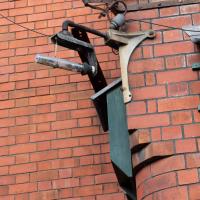
A little electrical detail on the Power House. Apparently it's not worked for some years, sadly.
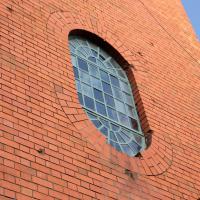
Can you guess? Yes, the Power House was obviously something of a target during the war. It was strafed by the Luftwaffe at one point.
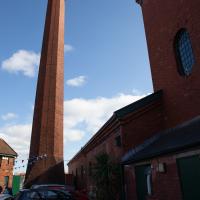
Before the pumps were converted to electricity, this chimney would have been pouring smoke out pretty much 24x7, as I understand it, from the boiler in the main building to the right. It's a pleasant little visitor centre now, with a nice cafe at the back. When this was a working dock I can only imagine that it must have been like hell on earth inside.
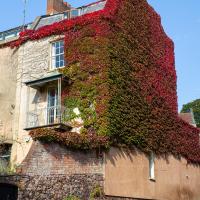
I can rarely resist snapping this house on the end of Freeland Place at this time of year, especially when the sun's catching both of the ivy-covered sides (well, Boston ivy, anyway; parthenocissus tricuspidata, I think.)
Fresh Fields
17 Oct 2021
For the first time in a while, I had the time and energy to go further afield and knock off some new roads from my "to do" list. I headed through the first Hotwells Festival to Ashton and Bedminster to cross off a few of the suburban roads south of North Street.
First, though, I decided to try to reproduce an old photo of the now-demolished Rownham Hotel just around the corner from where I live...
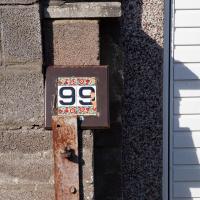
And I was right, the alleyway didn't really lead anywhere apart from people's garages and back gates, but at least 99 Smyth Road had a nice decorative number on the garage to look at.
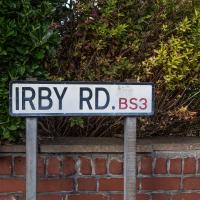
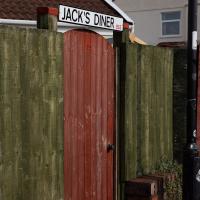
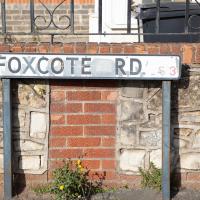
I presume a foxcote is like a dovecote, only for foxes. Nice to imagine them all there in their array of little foxholes.
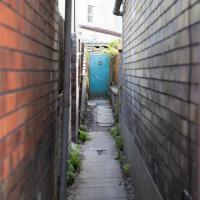
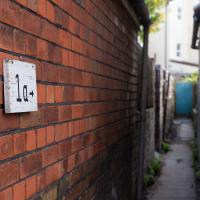
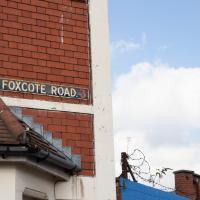
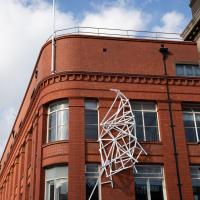
Thanks to Bristol24/7 I know this is a sculpture called Right to Climb by Walid Siti.
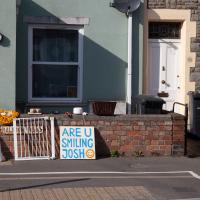
A Wide Angle View
30 Oct 2021
I had an unsuccessful wander last week, on Tuesday afternoon: my GPS died within about five minutes of leaving the house, and I didn't notice, plus I found hardly anything I'd been looking for. On the plus side, as I was wandering around Park Street I decided to nip into London Camera Exchange on the offchance they had a secondhand Canon 17-40mm lens. I've been thinking of buying one for around a year, I think.
Long story short: not only did they have one, but due to a mistake with their price labelling which they kindly honoured, I now have a shiny new (to me) wide-angle lens and it cost me less than £300, which is a very good price for one of these in good condition (and including a lens hood.)
So, rather than try to salvage Tuesday's walk, here's a walk where I basically just bimbled up to Clifton Village for a coffee and wandered around taking photos of as many wide views as I could find. I took a lot more photos than these seventeen, but as you might expect, a new lens takes some practice getting used to, so most of them ended up in the "outtakes" pile.
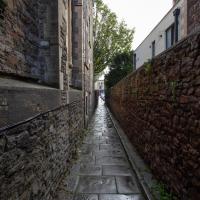
One of several odd short-cuts and alternative routes I worked out to vary my commute to work, when work was at the top of Whiteladies Road.
Ticking Off a Few Streets in Bedminster
31 Oct 2021
There were only a few streets left to wander in the more residential bit of Bedminster, so I thought I should target those today. The streets themselves weren't that notable, though Balfour Road has a contrasting mix of old and new housing. I tried to snap a few more interesting things along the way there and back, snapping all three of the familiar bond warehouses, nipping onto North Street to find some new street art, and finding a few pumpkins for good measure. It is hallowe'en, after all...
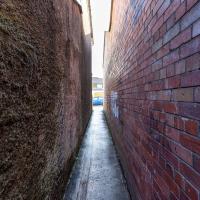
The more I research it, the more I find that Hotwells had far better transport links back in Victorian and Edwardian times than it has today. Along with buses that went to more useful places than the City Centre, there were trams, the funicular up to Clifton, the landing stage for paddle steamer services and two railway stations all within easy walking distance of me.
Today I took a day off work as preparation for doing the bookkeeping for my tax return1, and took a wander along to the site of what would have been my nearest station, Hotwells (or Clifton, as it started out in life), nestled in the shadow of the suspension bridge, the Bristol terminus of the Bristol Port Railway and Pier.
From there I wandered down the Portway, following the original line, until I got to the area around Sneyd Park Junction, where the tunnel from the slightly later Clifton Extension Railway joined up with this originally-isolated BPR line. Then I headed up to Clifton through the "goat gully" at Walcombe Slade, seeing the few above-ground bits of evidence of the tunnel (which is still in regular use) along the way.
It was a lovely day, and a good walk, and it was interesting to daydream of the times when I could have walked a few minutes from my flat down to Dowry Parade, caught a short tram ride to Hotwells Stations, and then headed from there to Avonmouth, perhaps even to board a transatlantic passenger service. The completion of the Clifton Extension Railway that linked the Avonmouth station with Temple Meads made relatively direct transatlantic travel from London via Bristol possible, with passengers travelling up from Paddington to Temple Meads, on to Avonmouth on the Clifton Extension Railway and Port Railway and Pier line, then perhaps catching a Cambpell's paddle steamer—which sometimes acted as tenders for large steamers—to a larger ship that was headed out for Canada, say.
1 I've learned that the best approach is to take two days off and deliberately do something that's not my bookkeeping on the first day, as otherwise I just inevitably end up procrastinating and feeling guilty on the first day no matter what. I have an odd brain, but at least I'm learning strategies for dealing with its strange ways as I get older...
2 Information mostly gleaned from Colin Maggs' The Bristol Port Railway & Pier and the Clifton Extension Railway, The Oakwood Press, 1975.
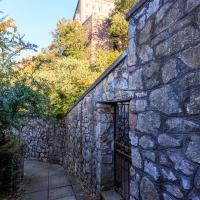
I'm pretty sure from looking at some maps that this is the gate that would have led to Prince's Lane, if it were still passable.
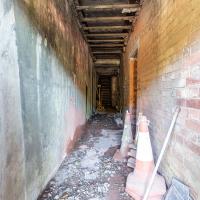
I didn't go inside, just shot through the gate with a steady hand. I have been in there, though, on one of the open day tours.
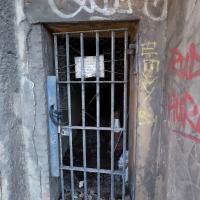
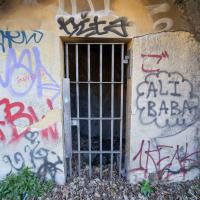
From The Bristol Hotwell, by Vincent Waite, ISSN 1362 7759, Bristol Branch of the Historical Association, 2002 reprint.
...in 1867 the new Pump Room was in turn demolished so that Hotwell Point could be removed and river navigation made safer. Thus the spring was lost after a long and eventful history. After much public agitation and complaining in the local press the spring was enclosed and piped to a small grotto hollowed out in the rock. Here a pump was set up in 1877 and an attendant provided by the Bristol Docks committee. In 1880 Dr. Griffin wrote a warning letter to the newspapers claiming that his analysis of this pump water proved that it was not from the original spring which in any case was too far away to retain its correct temperature. Yet up to 1913 the pump was still in use, and sometimes supplied as many as 350 persons a day. Then the long-threatened pollution of the water by the river became too obvious to be ignored and the pump was closed. The entrance, blocked up by a small wooden door, can still be seen in Hotwells Road near the Suspension Bridge.
The wooden door is no longer here, but this is definitely the place.
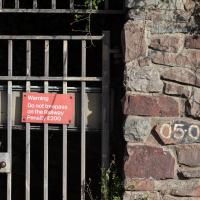
Yup, this is an access gate for the railway folk, presumably an easy route to this end of the tunnel. It's possible there's somewhere public to snap the tunnel from—there's a bridge further out of town toward Sea Mills, and there's a chance you could see the tunnel from there, but today's walk is already quite long enough, thank you.
From here the Clifton Extension Railway (from 1877) would have joined up with the line from Hotwells (completed twelve years earlier) at Sneyd Park Junction, a few hundred feet further out of town, and then proceeded to Sea Mills and beyond, terminating at Avonmouth. That bit of the line still runs; it's only the bit from Hotwells to here that was pulled up to make room for the Portway road, making Sneyd Park Junction no longer a junction.
Here a little fact I like: when the Bristol Port Railway ran out to Avonmouth from both Clifton Down station at the high far end of the tunnel near Whiteladies Road, and also from Hotwells, they offered a special splilt return ticket that let you walk down the hill from your home to Hotwells, take the train out to Avonmouth, then return to Clifton Down instead, so you could walk down the hill to home rather than walking back up. A lot of the dockworkers took this option, and it gladdens me to find that even these hardy folk were so put off by the hills of Bristol that they went for the lazy option!