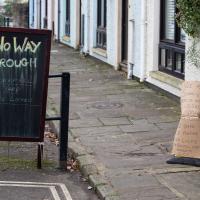
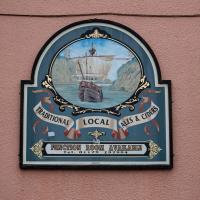
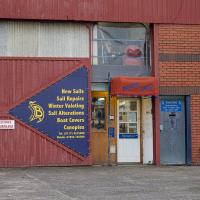
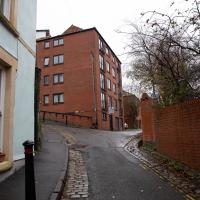
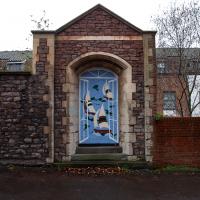
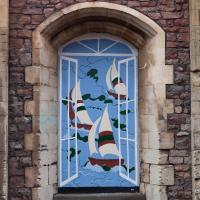
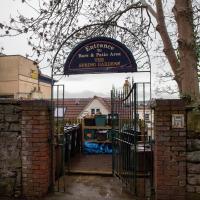
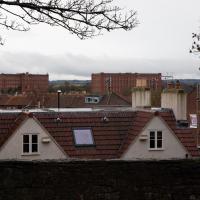
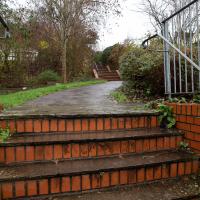
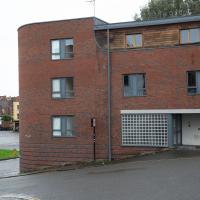
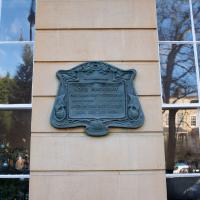
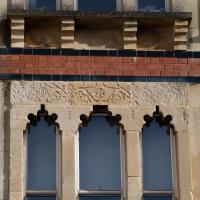
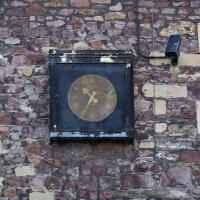
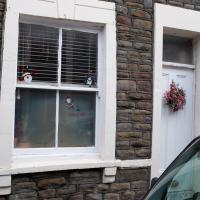
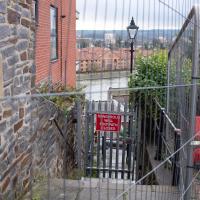
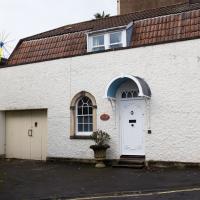
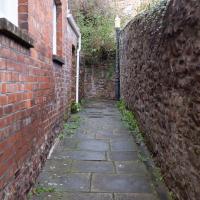
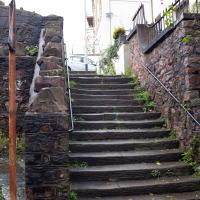
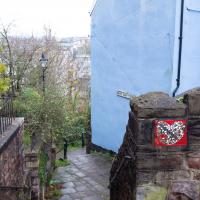
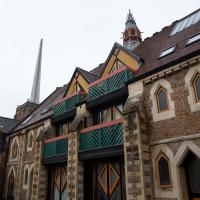
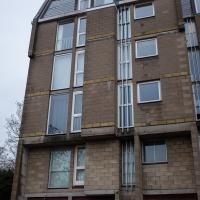
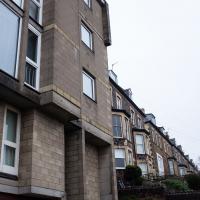
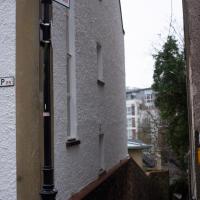
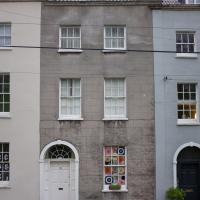
I headed to Bedminster to do a crossword with my support bubble today. On the way I delved into a couple of bits of Hotwells history, first of all snapping a "now" shot to go with a historical photo of Holy Trinity I happened across recently, and second of all to snap the Britannia Buildings.
The Britannia Buildings are a little strip of offices on a corner of the Hotwell Road. They've mostly been the headquarters of a cleaning company for years, but I've often wondered what this distinctive curve of offices, its ground floor standing proudly out from the upper floors, used to be. Well, after my last wander, where I poked about the landing stage just down the road, I found out! Researching the paddleboat company P&A Campbell I came across this nugget in The A-Z of Curious Bristol, by Maurice Fells (£):
The firm of P & A Campbell was the main steamer operator in the Bristol Channel, with its local headquarters in offices close to the Hotwells pier and overlooking the harbour at the Cumberland Basin. Campbell's named their offices Britannia Buildings, after one of the ships in their White Funnel Fleet.
So! Turns out the Britannia Buildings were named after a paddle steamer—you can see some pictures of Britannia here.
In related news, I've now bought three of Maurice Fells' local history books, and they were hand-delivered by the author on Sunday, a half-hour after I ordered them online (through a message exchange on Nextdoor!) Not even Amazon Prime has managed to deliver me anything that quickly...
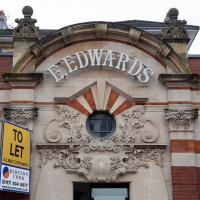
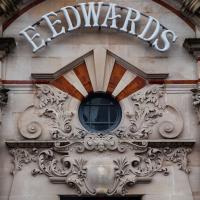
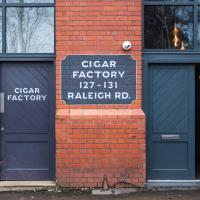
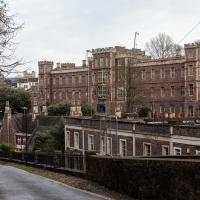
Once the Imperial Tobacco building, now a part of Ashton Gate Primary School. A change for the better, I think.
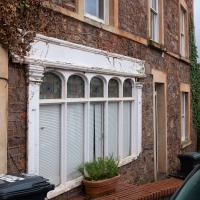
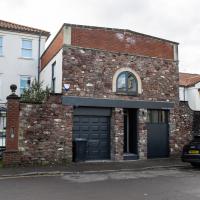
It's odd that someone seems to have renovated this building in such a way that the ground floor looks newer than the upper floors.
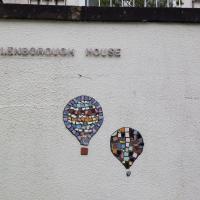
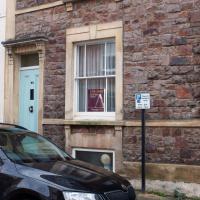
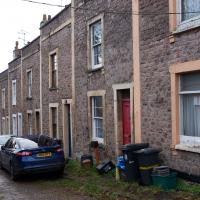
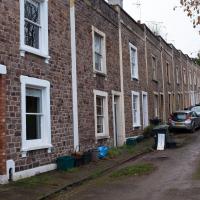
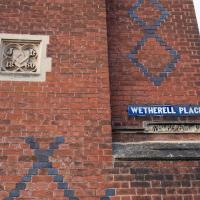
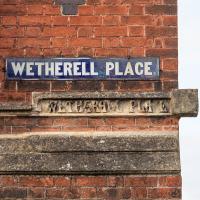
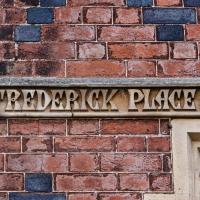
Many of the houses of the Victorian terraces of Bedminster bear names, and I really like noticing them as I wander past.
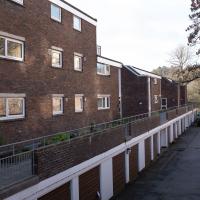
I couldn't find any historical reason why this surgery on the ground floor of a 1960s tower block has an entrance that looks like this. Might be one to ask my more local friends about. I'm guessing this was here on the site when they built the tower block and they wanted to keep it, but it's only a guess.
I got interested in Bristol's medieval water supplies after poking around near Jacobs Wells Road and Brandon Hill. It was during that research I found out about a pipe that's still there today, and, as far as I know, still actually functioning, that was originally commissioned by Carmelite monks in the 13th century. They wanted a supply of spring water from Brandon Hill to their priory on the site of what's now the Bristol Beacon—Colston Hall, as-was. It was created around 1267, and later, in 1376, extended generously with an extra "feather" pipe to St John's On The Wall, giving the pipework its modern name of "St John's Conduit".
St John's on the Wall is still there, guarding the remaining city gate at the end of Broad Street, and the outlet tap area was recently refurbished. It doesn't run continuously now, like it did when I first moved to Bristol and worked at the end of Broad Street, in the Everard Building, but I believe the pipe still functions. One day I'd like to see that tap running...
There are a few links on the web about the pipe, but by far the best thing to do is to watch this short and fascinating 1970s TV documentary called The Hidden Source, which has some footage of the actual pipe and also lots of fantastic general footage of Bristol in the seventies.
On my walk today I was actually just going to the building society in town, but I decided to trace some of the route of the Carmelite pipe, including visiting streets it runs under, like Park Street, Christmas Street, and, of course, Pipe Lane. I also went a bit out of my way to check out St James' Priory, the oldest building in Bristol, seeing as it was just around the corner from the building society.
There are far too many pictures from this walk, and my feet are now quite sore, because it was a long one. But I enjoyed it.
It's the home of the Avon Wildlife Trust now, but back in the day it was Brandon Hill Police Station. It's marked on maps as recent as the 1950s Bristol Town Plans. An interesting tidbit from Bristol Then and Now on Facebook:
One of the first police stations in Bristol, it was opened in 1836 - policemen from the station used the building housing the Jacob's Well as a bicycle store and many old bicycle lamp batteries were found in excavating the small entrance to the mikveh. The Police Station closed in 1967 and it is now the base of Avon Wildlife Trust.
I was tempted to investigate, just to see if it still seemed to be in use as a private entrance to Brandon HIll, from presumably either QEH or possible the Field House at the end of John Carr's Terrace, but I knew I had a lot more walking to do, so didn't divert...
It's a museum in the form of a well-preseved Georgian house with appropriate fixtures and fittings. Well worth a visit, and when we can go back, I plan to. The thing I remember most is the grandfather clock, and the rest of my memory of the place is fairly scant, because it's been a long time.
Believe it or not, this little pavement marker says "St John's Conduit" and marks the still-functional Carmelite water pipe that was built in 1267 to bring water from a spring near the top of Park Street to the Priory where Bristol Beacon now stands, with a "feather" branch added later (1376) to bring water to St John's church. Source: Bristol's Fascinating Fountains, Temple Local History Group
28 Jan 2021
With very little photography, and no new streets. Still, I did manage to buy milk at the "Simple Cow" vending machine—and "simple" is very definitely false advertising; it took me bloody ages to work out how to use the thing—and snap the new ACER/SEPR piece down in Cumberland Piazza.
This was just a little car park, presumably for the house behind? Probably going to be turned into half a dozed bijou flats, or something...
31 Jan 2021
I just nipped out to post a blood test (not Covid-related) and check that my car was okay, because I've not driven it for weeks. I was just going to walk up to Clifton Village, but I spotted the opportunity to re-park the car on my street rather than up the hill around the corner where it was, so instead I got in, intending just to move a hundred metres, but it turned over slowly before it started, and then warned me that the battery was very low and I should go for a long drive to recharge it.
So, I did my best, zipping up the A4018 to the motorway junction and back again, dropping off my blood at a postbox along the way, and while I did that, it started snowing. I noticed it was low tide, too, so when I got back home I headed back out again, this time on foot and with a camera so I could see if I could find any evidence of the Hot Well steaming.
I saw not a single sign of the Hot Well steaming, but it was quite a nice quick outing and I enjoyed my brief walk in the snow. Iike Hinton Lane, too, and while it's all old ground I was re-treading, I did at least get a picture or two with a bit of snow and some of the cold winter atmosphere of the trip, I think.
24 Jan 2021
I started this wander with my "support bubble" Sarah and Vik, after Sarah texted me to say "SNOW!" We parted ways on the towpath and I headed up into the bit of Leigh Woods that's not actually the woods—the village-like part in between Leigh Woods and Ashton Court, where I'd noticed on a map a church I'd not seen before. I found St Mary the Virgin and quite a few other things I'd never experienced, despite having walked nearby them many, many times over many years, including a castellated Victorian water tower that's been turned into a house...
Between them, the old signs on the left and right pillar say ROWNHAM LODGE, but the modern metal sign says Rownham House. Are these the gates for both, or has it changed names?
Or is this a narthex? I'm not too up on my church terminology. Anyway. This is the main entrance to St Mary the Virgin, Church Road, Leigh Woods, currently vicared by Rev. Dr Hester Jones, built 1891, designed by John Medland.
As with many pretty things in Bristol, the church was partially funded by money from booze and fags (via the church website):
At 4pm on 1st November 1890 a meeting was called at the home of Mr John Harvey (Harvey’s Wine). A committee of nine men with business acumen and money was formed including Thomas Davey (Franklin Davey Tobacco Co later subsumed into Imperial Tobacco), Mr Edward Swann (an influential solicitor and banker and on very good terms with the Bishop of Bath & Wells), Mr William Garnett, Mr Hoskens Lowe (timber importer) and Mr John Russell Harvey (John Harvey’s son) and Mr E Burrow Hill (the son of Charles Hill, shipbuilder) who became the committee’s secretaries. By the end of the month sufficient funds had been pledged and, with land given by the Leigh Woods Land Company, to proceed to plans.
16 Jan 2021
A raggedy wander with my friend Lisa, picking up a few stray streets and venturing only briefly onto Whiteladies Road, where it was too damn busy, given the current pandemic. We retreated fairly quickly. Found a couple of interesting back alleys, and got a very pointed "can I help you?" from a man who was working in his garage in one of the rather run-down garage areas behind some posh houses, and clearly didn't want us just wandering around there.
Oddly, this is a little crescent that two-thirds Coddrington Place and one-third Belgrave Place, it seems
15 Apr 2021
Just a quick trip to Imagine That for a flat white and a date ball (they're really nice), snapping the general sights along the way. No new roads, as has rapidly become the default on my lunchtime wanders, but as I'm in the routine of this project it almost seems strange not to pop my wanders up on the site.
14 Apr 2021
Apart from a lovely coffee and a slice of Victoria sponge from Twelve, there weren't any new sights on this little lunchtime jaunt except for a slightly better look at the long raised extension at the back of the St Vincent's Rocks Hotel, where I at least got to see the arches it's raised up on. I also got a fair bit of exercise by walking up the Zig Zag to get there, and saw far more people out than I have in months, what with the lockdown having just been significantly lifted. As I walked past The Mall pub they were turning people away from their already-full garden, and the (outdoor) cafe tables were pretty full up.
I only found out that this was a raised extension when I read the listing after snapping the last photo. Today I ventured as close as I could and got to glimpse a bit of the rather nice support arches.
I'm guessing there used to be a grand front door, but then later the hotel annexed the building and didn't need it any more? But it's only surmise.
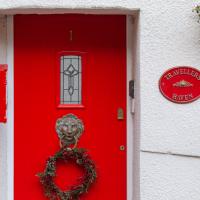
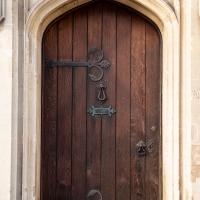
Maybe I'm starting a knocker fixation after last weekend's walk. Interesting that it's mounted on a Maltese cross. I wonder if it was a holiday souvenir?
11 Apr 2021
My friend Lisa joined me again, this time for a long wander through "Bemmie". In fact, I tweeted recently using "Bedmo" as my abbreviation for Bedminster, and apparently there's something of a culture war going on. From what I can glean, the longer-term residents call it "Bemmie" and consider "Bedmo" a name made up by hipster gentrifiers.
I had no idea, but then I didn't grow up around here, and I don't live in Bedminster, and I'm not a hipster. I'm not sure I've ever gentrified anywhere, either; Hotwells was already quite gentrified by the time I arrived. I probably just lowered the tone a bit.
Anyway. Lisa and I entered Bemmie by the traditional toll gate (though actually you'd only have paid if you were coming from the Long Ashton direction, not merely nipping across from Hotwells) and then almost literally combed the streets to knock several new roads off my list of targets. Along the way we saw lots of street art, as you'd expect, and admired the area's panoply of gorgeous knockers.
We'll see a Cromwell House in a minute. Clearly they're New Model Army fans around here. Nice path.
Normally when you're looking at a date on the side of a building in Bristol it's a little further in the past. It's interesting to see one so recent. I wonder if in a hundred years time people will stand here thinking about the dim and distant past.
Dartmouth Mews is basically a tiny square with a little terrace down two opposite sides, built very much to match the character of the existing little Victorian houses around here.
06 Apr 2021
I'd originally intended just to pop up to the area around Alma Road, where I'd missed a few streets on earlier wanders. It was such a nice evening, though, I decided to extend my walk up to the very top of Pembroke Road, just outside my one mile radius, to take a few snaps of something intriguing I'd found in my researches.
I've driven, walked and jogged past the little triangle of land at the top of Pembroke road a great deal in my time in Bristol, but I didn't know that it used to be the site of a gibbet, in fact that the road itself there used to be called Gallows Acre Lane. According to the Durdham Down history trail, by Francis Greenacre (an excellent name for a Downs researcher!) among other sources:
...it was below this quarry near the top of Pembroke Road, once called Gallows Acre Lane, that a gibbet stood. It was sometimes occupied by those who had committed robberies on the Downs and was last used in 1783 to hang Shenkin Protheroe for the murder of a drover. Stories quickly spread that he descended from the gibbet at midnight every night and stalked through Clifton. Such was the alarm that his body was cut down and buried.
Also very close to this little triangle of land was one of the gates of the extensive turnpike system...
Anyway. Along the way I encountered a wooden tortoise and a real squirrel, among other things. It was a good walk, and more light in the evenings means I can move my wanders out of the ticking countdown clock of work lunch-hours and be a bit more leisurely.
The late, great Maggie Shapland was a familiar feature to anyone interested in historical industry in Bristol.
I think the first time I saw her was on an Open Doors Day for the Clifton Rocks railway, the disused funicular from the Avon Gorge Hotel down to near the landing stage in Hotwells, and the last time was when she was helping to restore Brunel's Other Bridge at Howard's Lock.
Both times I think she'd driven there in one or other of the classic cars she maintained. Sometimes when the garage door here was open on the way past you could sneak a look at the collection.
The last thing I saw her drive was this Moss kit car.
An amazing person by all accounts, I never knew that we shared the profession of "Database Consultant"...
Although the low sun was a bit annoying for some photos (and for walking directly towards) it did bring out some of Clifton's features very well.
This is now Alma Church.
According to the ever-useful churchdb:
It was founded in 1871 as a daughter church of Bethesda Chapel in Great George Street, Brandon Hill, and was called "Clifton Bethesda" to distinguish it.
I didn't remember noticing the original Bethesda Chapel on Great George Street and apparently I didn't miss it—it seems from churchdb that it was hit by a bomb during WWII and later demolished. The KYP map from after the war shows its outline on the corner of Charlotte Street South, tagged "Ruin", and there's a picture of it. It's back to being grassland on Brandon Hill now, pretty much exactly where this earlier photo was taken.
Bethesda Chapel was founded by George Müller, one of the founders of the Plymouth Brethren, and director of Ashley Down orphanage, looking after more than ten thousand orphans in his lifetime.
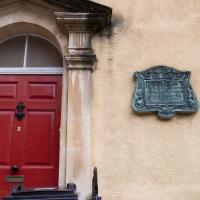
I wonder if this is another street that's been renumbered. It's 45 Apsley Road, but I guess this particular terrace (see next pic) might have had standalone numbering in the past.
There's some fantastic verbiage in the listing:
A symmetrical front has the middle set forward, quoins, and sill and lintel bands, recessed party wall with quoins, and overhanging eaves. Openings have semicircular arches with alternate sandstone and limestone voussoirs, hoodmoulds, foliate springers and plate-glass sashes.
Personally, I just rather like the front door.