Tagged: roof
Lunchtime Reproduction (of an old photo...)
17 Jan 2022
This was basically the quick lunchtime jaunt I tried to do at the beginning of January, only this time I actually managed to get to roughly the viewpoint I'd been hoping for to recreate a historical photo of the Bristol International Exhibition.
I did this walk about a month ago, but I've been a bit poorly and not really up to doing much in my spare time, and it's taken me this long to even face processing even these few photos. Hopefully normal service will be resumed at some point and I can carry on trying to walk any roads and paths that I need to do to make this project feel complete...
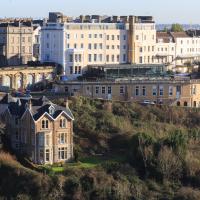
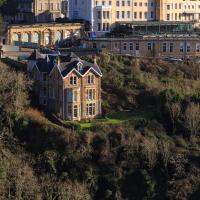
Just think, I could upgrade to a flat just up the hill from me, with an extra bedroom, for only about three quarters of a million quid...
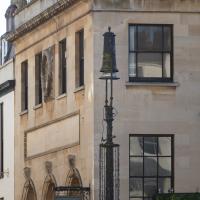
From Electric Arc Lamps in Bristol, by Peter Lamb, a supplement to the Histelec News, August 1997:
In looking at old photographs of late Victorian or early Edwardian scenes, many of you may have noticed very decorative street lights gracing the foregrounds. These lamp standards had long cylindrical shapes above the lamp, which distinguished them as being electric arc lamps. You may have wondered, like me, what was inside these housings. These cylinders, known colloquially at the turn of the century as “chimneys” were not chimneys at all, but housed the complex mechanisms regulating the carbon electrodes. Only two lamp standards of this distinctive design remain as street furniture on the Bristol streets and these are situated at The Mall, Clifton Village.
Given the long cylindrical shape and the fact it's on the Mall, pretty sure this must be one of the last two electric arc lamps still standing, or possibly the last one, as I couldn't find the other one.
EDIT: Having asked on Next Door, where there've been a few threads about historic lamp restoration, it seems the other one used to stand at the end of West Mall, not far away, was taken away for restoration a long time ago, and has yet to reappear.
There's another Bristol connection too, with Sir Humphrey Davy, as the article continues:
Sir Humphrey Davey is credited with inventing the first arc lamp, when he demonstrated his invention at the Royal Institution in 1810. It was powered by batteries and used charcoal elements enclosed in a vacuum. The vacuum allowed a longer arc with a much higher voltage. It was some years later (1844) that the principle was further developed by a Frenchman by the name of Foucault. He used carbons from the retorts of a gasworks, which were more durable. Thomas Wright devised the first arc lamp which involved adjustment of the carbons automatically as they burnt away, and W.C.Staite used an electric current for the regulation of the carbons. Foucault responded in 1858 by producing his regulating lamp.
(Yes, that is Foucault of Foucault's Pendulum fame.)
Lunchtime Cliftonwood Wander
18 Jan 2022
Another workday, another quick lunchtime trip to get me out of the house. This time my flimsy pretext is a tiny bit of Clifton Vale Close that I'd apparently not walked, and the fact that although I'd walked down Church Lane at least once before I still hadn't taken a single photo of it. Really I just fancied a mosey through Cliftonwood in the sunshine, with the promise of a coffee from Clifton Village at the top of the hill.
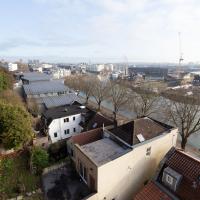
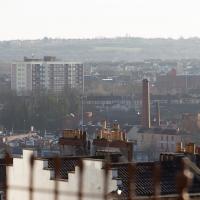
The spire of St Mary Redcliffe, just left of centre on the horizon, is about the same location as the office I work in, at least a few days a week. I took the job half on the basis of the location meaning a lovely commute down one side or other of the harbour. And then a week after I started the first Covid-19 lockdown kicked in and I didn't get to do the commute again for many months.
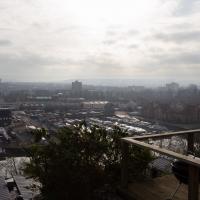
You have to zoom way in to see it, and know what you're looking for, but having just done that I can tell you that one of my other favourite lunchtime walk destinations is sitting down there in the little access road between the marina car park and the clock tower of the former Charles Hill offices: Imagine That, who sell coffee from their cute little converted horsebox.
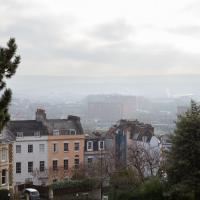
Bedminster Trip for New Walking Shoes
26 Feb 2022
I needed to buy new walking shoes—my old ones were squeaking and it was driving me up the wall—so I ordered some for collection from Taunton Leisure on East Street in Bedminster, and decided to make picking them up an official wander.
I didn't cover any new ground within my mile, but I did take advantage of the trip to take in a few interesting things just outside my normal radius, mostly New Gaol-related. Along the way there are a couple of sanitation-related diversions, including a visit to a rare manhole cover. You can hardly wait, I can tell!
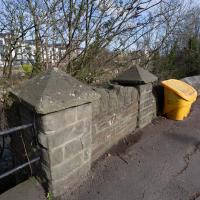
Presumably this was the entrance to the stairs down to the ferry, long ago bricked up. There certainly seems to be a stairway behind it, though it's hard to tell for sure...
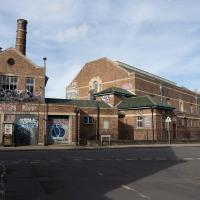
The Bristol South Swimming Pool. I'm not sure I've ever been inside any of Bristol's public swimming pools, though I did once use the University pool for an off-season; they do a cheap pass for when the students mostly aren't around.
I mostly went out to hang out with my friends Sarah and Vik in Bedminster, but along the way I thought I'd take a closer look at something a little nearer home: the last crossing point of the Rownham Ferry.
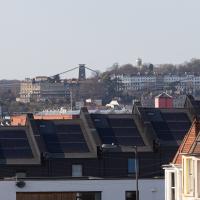
A sign of the times: all the new build homes of Balfour Road have solar panels on top. I bet they're grateful of that, given the current energy price crisis.
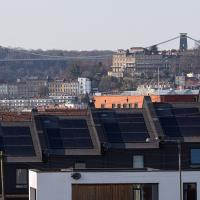
It's interesting to be able to look pretty much a mile back and see the familiar buildings of home. Descending from the top right in the distance we can just see the Observatory on Observatory Hill, then the end of Royal York Crescent, then the Paragon just eclipsing the suspension bridge, then below the bridge on the left there's Windsor Terrace and the more modern Windsor Court flats just visible behind the Bedminster foreground.
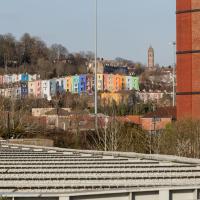
Getting back to the Rownham Ferry, the Ashton Avenue Bridge is one of the reasons it was closed. On the excellent Bristol City Docks website you can find a photo called "Rownham Ferry c1906 with Ashton Avenue Bridge nearly built.".
As you'll see in that photo, at low tide the Rownham Ferry was basically just a bridge made out of boats, so it probably still seemed a quick shortcut compared to walking all the way to Ashton Avenue Bridge. I imagine the foot traffic gradually migrated to the new bridge as the ferry was a more daunting prospect at high tide, from what I can gather. Also, the combined road/rail bridge would have allowed people to get the train across the river, rather than stopping at Clifton Bridge Station and using the ferry, I think.
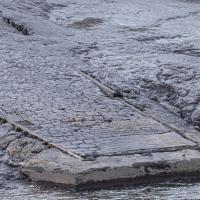
Looks like the stones at the bottom corner were replaced with some simple poured concrete with grip lines drawn across it at some point.
I noticed I had a few things on my "potential wanders" list that could all be done relatively close to home, and in a fairly straight line, so I set off at lunchtime to recreate a photo of a now-defunct pub, wander behind a Spar (which turned out to be more interesting than I'd expected, but I admit it's a low bar) and spend some time browsing in Dreadnought Books before coming home via a coffee from Spoke & Stringer, a little diversion up Gasworks Lane and a tiny bit of the Rownham Mead estate I'd somehow previously skipped.
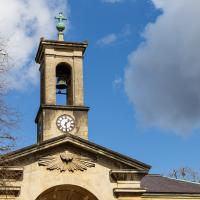
And we'll end on a high note, as Holy Trinity's belfry was looking particularly eye-catching today. The clock's right, too, which is rare in a public clock these days. The bell is back to ringing during the daytime at the moment. It was turned off temporarily during the pandemic as some locals were complaining of losing sleep to it, as it used to ring all night, but the church did some work after running a small campaign for donations to make the timing mechanism more flexible, and now it rings on the hour during the day but is silent during the small hours, at least. It sometimes reminds me that it's time for me to jump on a Teams call when I'm working from home. I find its regular bonging a reassuring Hotwells presence.
Easter Monday Gardens and Flowers
18 Apr 2022
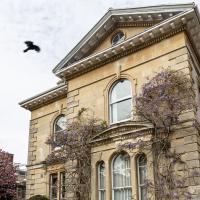
I didn't really set out with a theme of flowers and gardens in mind for this walk. I just fancied heading up to Clifton Village to get lunch. As it turned out, though, Spring was springing, so a minor theme emerged as I started off with the graveyard flowers of Hope Chapel and wandered up to see the beginnings of the new wildflower garden at Clifton Hill Meadow.
Ticking Off a Pocket of Paths in Leigh Woods
03 Jun 2022
I managed to go for a wander a while ago that was meant to finish off a little tangle of paths in Leigh Woods, or at the very least finish off my wandering of the Purple Path there. And I managed to miss doing either of those things through some kind of navigational incompetence.
Today I woke up with a bit of a headache, feeling a bit knackered as soon as I dragged myself out of bed, but at least with the energy to realise that I'd be better off (a) going for a walk in what looked likely to be the last of the Jubilee weekend sunshine than (b) moping around the flat until it started raining, at which point I could mope more thoroughly.
I had a look at my map, considered going to Ashton Court, but remembered that there was a music festival there today, and instead found these little leftovers of Leigh Woods and decided to have one more try at walking them.
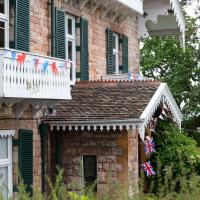
Having started in the woods, this is the first hint of the Jubilee celebrations I've seen, on the alpine chalet-style house near the Suspension Bridge.
A Quick Swing Past Ashton Court
05 Jun 2022
Another day not dissimilar to my last wander: I'm feeling a bit tired and rather than just moping around the house I thought I'd find some tiny bit of somewhere that I'd not yet walked and get outdoors. This time I headed for the Tobacco Factory Market in Bedminster, as I often do, but went the long way around via Ashton Court Mansion as I knew there were some footpaths and a small section of road I'd not ticked off up there. Finishing all the Ashton Court footpaths will be quite a long job, but you've got to start somewhere...
I did feel rather better by the time I got home, and, pretty much astoundingly given the weather forecast, managed to avoid the rain completely.
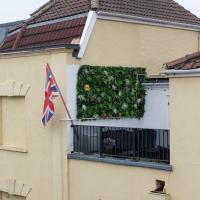
First hint of Jubilee-related decorations on this rather odd balcony at the bottom of Granby Hill. The other decoration on this building is a peeing "KEEP YOU JOB KEEP THE POUND" sticker in the next window along that looks like it dates from the 1990s.
I've been pretty awful at reading so far this year, apparently averaging about one book per month. That's a far cry from 2019, say, where I got through 41 books in the year. Today's wander was prompted by my rubbish reading, as I needed to go hand back some books to the library, because I'd managed to renew them so many times that I hit the limit on renewals. Oops. Several of them were still unread.
So, off to the Central Library for me, tail between my legs. On the way there I did my best to recreate a historical photo of Dowry Square; while I was in the area I walked under the adjacent Norman arch and poked around behind the Cathedral, and I also had a little diversion to the city centre and came back along the south side of the river, hitting some trouble with the lock gates as I finally crossed the harbour back towards home.
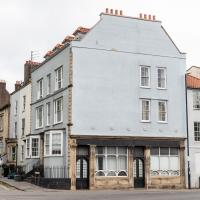
Nowadays known as York House, and apparently offices, this was originally built by George Tully, like a lot of the rest of the square.
According to this Heritage Statement about No. 10 by Mark Hines Architects he started building in 1723, imagining accommodation houses for Hotwells visitors, but later built this large hotel and other buildings like the Clifton Dispensary at No 12 as the spa became more popular and the square evolved into a centre of medicine. I'm a little confused by that claim as the York Hotel went up c. 1780, according to the listing, when Tully had been dead for ten years, but perhaps it means he planned it before he died.
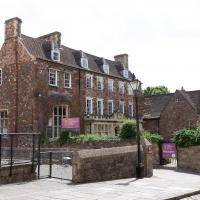
The Bristol Cathedral School has seen some controversy over the years, especially after it was given permission in 2013 for the Primary School to take over some of the Central Library. They turfed out some of the archives, which is presumably why I need to wait a week when I order an old book from the library, as someone now has to hoof it down to the B Bond warehouse to fetch it for me, rather than just downstairs.
Founded in 1140, dissolved and then re-founded by Henry VIII in 1542 after he dissolved the monastery, it's only very recently become a City Academy. It is allegedly non-selective these days, but my guess would be that its pupils' parents are significantly posher and richer than others in the local catchment area.
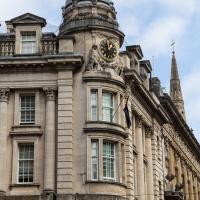
A fairly wrong clock, given that I took this at about 12:40. This used to be the Midland Bank.
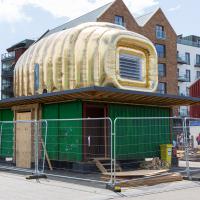
I'm in the habit of going over to the Tobacco Factory Market on a Sunday. I think I've walked all the routes around that way, but as a Plimsoll Bridge swing let me cross the road to the far side of Brunel Way on my return journey and I took a couple of photos of the brownfield development at the old Ashton Gate Depot site I thought I'd call it a Wander and pop some photos up.
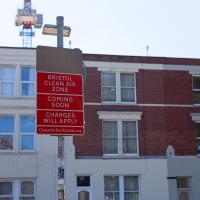
The Clean Air Zone is being introduced later this year (currently they say 28 November 2022, but I think it's already been delayed twice.)
The scheme will see charges instituted for certain vehicles entering parts of the city, especially older diesel cars. This is to encourage people to change these older cars or find alternative routes or modes of transport. Apparently there are grants and loans available for upgrades on offer to private citizens and businesses.
This should only have positive effects for me, as I live just inside the zone, and I drive a recentish petrol car with an efficient and not-so-pollutey engine. In a perfect world, therefore, this scheme means my area might eventually start meeting the government's standards for air quality. This Bristol 24/7 article has some good info, including an estimate that there are currently 300 premature deaths per year from traffic-related air pollution in the proposed Bristol zone.