Tagged: shade
In Which We Begin and End with Love
05 Mar 2022
I had a lot to get done around the house, so as soon as I heard there might be a shiny new piece of street art near me, under the Cumberland Basin flyovers, I immediately decided that was all the excuse I needed to set off on a round-the-harbour lunchtime walk to get some fresh air and see if I could spot it. So, here's a circular wander that takes in graffiti, boats, wildlife and graffiti again...
Leigh Woods Purple Path
12 Mar 2022
There's a few tracks in Leigh Woods that lie within my mile and show up on my map but that I've not walked yet, so I decided to take one of my traditional big long walks through the woods on this nice crisp sunny morning.
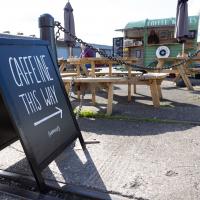
For years—decades, even—I've been doing a similar route from my place, along the towpath to the far woods entrance, up the hill for a varied walk on one of the marked tracks and then across the Suspension Bridge to Clifton Village for a coffee-based reward. It's my default "long walk", really, and I almost always enjoy it. Today, at last, spring actually seemed to be springing, which made for some extra positivity...
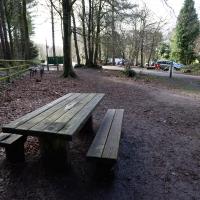
It's not my favourite bench, but it'll do. And it's a decent distance away from the mediocre cafe in the car park that seems to need to run a generator all the time. Maybe they should hook it up to that abandoned electric pole, at least it would be quieter.
I'd mind less if they did a decent flat white #firstworldproblems, but they don't. Their cakes are decent, though.
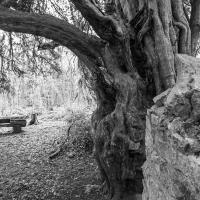
One of my two favourite trees in the woods, the other being the giant redwood in the Leigh Court arboretum area.
A Coffee and a Curve
27 Mar 2022
I wanted to have a wander along to the Tobacco Factory Market for some shopping, and checking the map for any leftover nearby streets I noticed a tiny curve of road on the way into the modern flats at Paxton Drive that it didn't look like I'd walked down before. I wouldn't take me too far out of my way, so I decided to head there first and then across to North Street to get my groceries and a coffee...
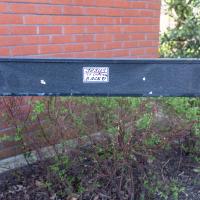
Well, I hope he's bringing the sign he nicked from this end of Paxton Drive with him.
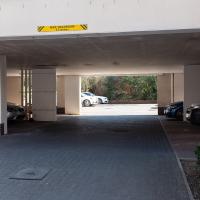
It looks on the map like there are little side streets off Paxton Drive. There really aren't, just these little car parking areas. Hence I didn't walk down any of them.
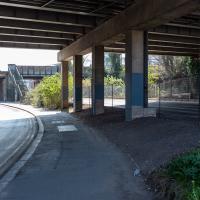
Easter Monday Gardens and Flowers
18 Apr 2022
I didn't really set out with a theme of flowers and gardens in mind for this walk. I just fancied heading up to Clifton Village to get lunch. As it turned out, though, Spring was springing, so a minor theme emerged as I started off with the graveyard flowers of Hope Chapel and wandered up to see the beginnings of the new wildflower garden at Clifton Hill Meadow.
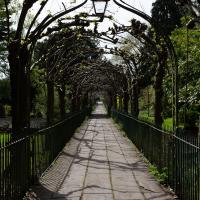
Ticking Off a Pocket of Paths in Leigh Woods
03 Jun 2022
I managed to go for a wander a while ago that was meant to finish off a little tangle of paths in Leigh Woods, or at the very least finish off my wandering of the Purple Path there. And I managed to miss doing either of those things through some kind of navigational incompetence.
Today I woke up with a bit of a headache, feeling a bit knackered as soon as I dragged myself out of bed, but at least with the energy to realise that I'd be better off (a) going for a walk in what looked likely to be the last of the Jubilee weekend sunshine than (b) moping around the flat until it started raining, at which point I could mope more thoroughly.
I had a look at my map, considered going to Ashton Court, but remembered that there was a music festival there today, and instead found these little leftovers of Leigh Woods and decided to have one more try at walking them.
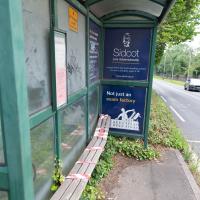
I imagine the delighted customer who emplaced the previous missive on the end of the shelter had stood here for a significant portion of their life. Well, that's often how I end up feeling while waiting for a bus in Bristol.
Sidcot School, advertised at the end there, is one of only seven Quaker-run schools in England, founded 1699, situated in the Mendips. A fee-charging school, they do of course have a network of their own minibus services—ten routes in total—to ferry the kids there and back, so they probably don't have to wait for First to turn up.
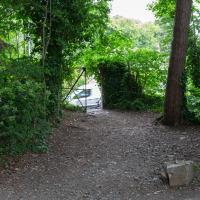
Time to exit Ashton Court and head for my main target at Leigh Woods.
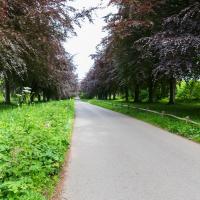
I rarely come in this way to Leigh Woods—it's basically the car entrance, and I almost always walk here. On those few occasions I've driven here, I've mostly parked on North Road near my usual pedestrian entrance through sheer habit, rather than driving in and using the official car park that's actually in the woods.
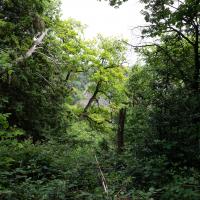
There's a viewpoint "Quarry 5 Viewpoint" marked somewhere along here on OpenStreetMap. I think pretty much all the viewpoints on this stretch have gradually been overcome by forest growth. Here you can just make out the cliffs on the far side of the gorge through trees.
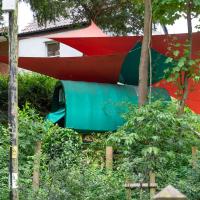
Opposite the exit from Leigh Woods on North Road.
This may be an example of the rule that if a scrap of land in the South West sits unused for long enough, a twee AirBnb rental will spontaneously pop up on it.
I've been pretty awful at reading so far this year, apparently averaging about one book per month. That's a far cry from 2019, say, where I got through 41 books in the year. Today's wander was prompted by my rubbish reading, as I needed to go hand back some books to the library, because I'd managed to renew them so many times that I hit the limit on renewals. Oops. Several of them were still unread.
So, off to the Central Library for me, tail between my legs. On the way there I did my best to recreate a historical photo of Dowry Square; while I was in the area I walked under the adjacent Norman arch and poked around behind the Cathedral, and I also had a little diversion to the city centre and came back along the south side of the river, hitting some trouble with the lock gates as I finally crossed the harbour back towards home.
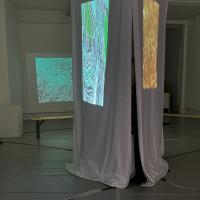
Again, more of a "record shot" for me, which probably looks rather unimpressive to anyone who didn't see the exhibition in person. It was music and projections of video art which I found fascinating and hypnotic, and was a lovely five or ten minutes' of escape from the bustling outside world.