Tagged: wall
Lunchtime Reproduction (of an old photo...)
17 Jan 2022
This was basically the quick lunchtime jaunt I tried to do at the beginning of January, only this time I actually managed to get to roughly the viewpoint I'd been hoping for to recreate a historical photo of the Bristol International Exhibition.
I did this walk about a month ago, but I've been a bit poorly and not really up to doing much in my spare time, and it's taken me this long to even face processing even these few photos. Hopefully normal service will be resumed at some point and I can carry on trying to walk any roads and paths that I need to do to make this project feel complete...
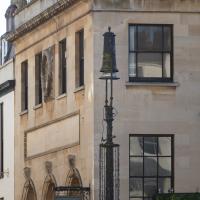
From Electric Arc Lamps in Bristol, by Peter Lamb, a supplement to the Histelec News, August 1997:
In looking at old photographs of late Victorian or early Edwardian scenes, many of you may have noticed very decorative street lights gracing the foregrounds. These lamp standards had long cylindrical shapes above the lamp, which distinguished them as being electric arc lamps. You may have wondered, like me, what was inside these housings. These cylinders, known colloquially at the turn of the century as “chimneys” were not chimneys at all, but housed the complex mechanisms regulating the carbon electrodes. Only two lamp standards of this distinctive design remain as street furniture on the Bristol streets and these are situated at The Mall, Clifton Village.
Given the long cylindrical shape and the fact it's on the Mall, pretty sure this must be one of the last two electric arc lamps still standing, or possibly the last one, as I couldn't find the other one.
EDIT: Having asked on Next Door, where there've been a few threads about historic lamp restoration, it seems the other one used to stand at the end of West Mall, not far away, was taken away for restoration a long time ago, and has yet to reappear.
There's another Bristol connection too, with Sir Humphrey Davy, as the article continues:
Sir Humphrey Davey is credited with inventing the first arc lamp, when he demonstrated his invention at the Royal Institution in 1810. It was powered by batteries and used charcoal elements enclosed in a vacuum. The vacuum allowed a longer arc with a much higher voltage. It was some years later (1844) that the principle was further developed by a Frenchman by the name of Foucault. He used carbons from the retorts of a gasworks, which were more durable. Thomas Wright devised the first arc lamp which involved adjustment of the carbons automatically as they burnt away, and W.C.Staite used an electric current for the regulation of the carbons. Foucault responded in 1858 by producing his regulating lamp.
(Yes, that is Foucault of Foucault's Pendulum fame.)
Lunchtime Cliftonwood Wander
18 Jan 2022
Another workday, another quick lunchtime trip to get me out of the house. This time my flimsy pretext is a tiny bit of Clifton Vale Close that I'd apparently not walked, and the fact that although I'd walked down Church Lane at least once before I still hadn't taken a single photo of it. Really I just fancied a mosey through Cliftonwood in the sunshine, with the promise of a coffee from Clifton Village at the top of the hill.
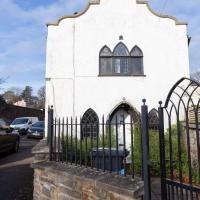
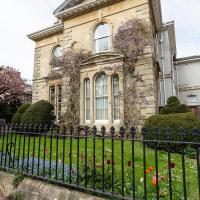
Mid-to-late 18th century, in the "gothick" style according to the listing. I approve of their spelling. This is definitely the right listing, as here's exactly what we see:
Symmetrical end has an elaborate Dutch gable with a 2-centred arched doorway with panelled door, and matching windows each side with lattice leaded lights. Above is a tripartite window with 2-centred arched heads, central casement with interlacing upper glazing bars and blind outer ones.
Bedminster Trip for New Walking Shoes
26 Feb 2022
I needed to buy new walking shoes—my old ones were squeaking and it was driving me up the wall—so I ordered some for collection from Taunton Leisure on East Street in Bedminster, and decided to make picking them up an official wander.
I didn't cover any new ground within my mile, but I did take advantage of the trip to take in a few interesting things just outside my normal radius, mostly New Gaol-related. Along the way there are a couple of sanitation-related diversions, including a visit to a rare manhole cover. You can hardly wait, I can tell!
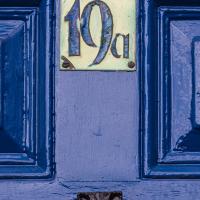

Hadn't spotted this one before. It's hidden away a little, tucked inside the entrance to the disused public toilets under the ramp for one of the Cumberland Basin flyovers.
You can pretty much take the word "disused" for read when it comes to public toilets in Bristol. Protesters recently wrote an open letter to the council demanding the re-opening of some of the many closed toilets.
The lack of access to public toilets in Bristol is not simply inconvenient – it raises issues of equality, and of dignity. Lack of toilets has led to the use of public spaces as substitute toilets – effectively open sewers in our city
As someone whose main form of exercise is walking through the city, I've definitely noticed the decreasing availability of public loos over the years. I can only imagine that my need for them will increase as the years go by...
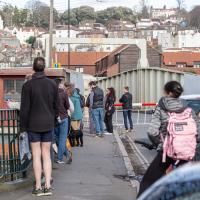
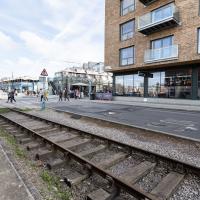
At the end of the tracks is the engine shed built into the end of the M Shed museum.
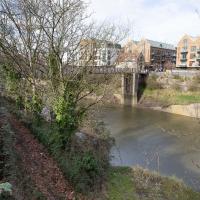
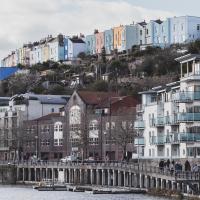
The old ferry crossing, the newer 1930s bridge that replaced it, and the shiny new flats and shops of Wapping Wharf on the far side.
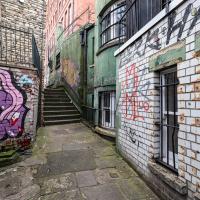
The Thomas Crapper manhole is at the bottom of the steps there. It's not exactly a salubrious location, as you can see.
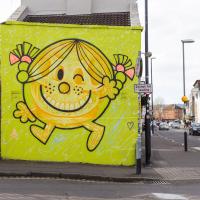
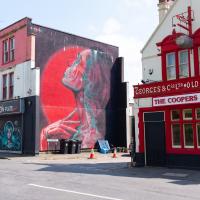
This is Little Miss Sunshine, by Will Blood. Apparently the visible skeleton is something of a theme.
In Which We Begin and End with Love
05 Mar 2022
I had a lot to get done around the house, so as soon as I heard there might be a shiny new piece of street art near me, under the Cumberland Basin flyovers, I immediately decided that was all the excuse I needed to set off on a round-the-harbour lunchtime walk to get some fresh air and see if I could spot it. So, here's a circular wander that takes in graffiti, boats, wildlife and graffiti again...
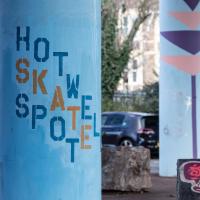
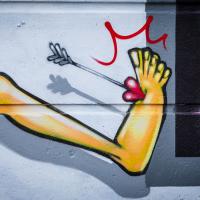
I mostly went out to hang out with my friends Sarah and Vik in Bedminster, but along the way I thought I'd take a closer look at something a little nearer home: the last crossing point of the Rownham Ferry.
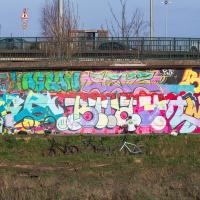
Much as I admire Sylvia Crowe's ambitious vision of her landscaping of the area the more I hear of it, I'm firmly in the camp who thinks the concrete now just looks grim and virtually anything improves it. I mean, it's not my cup of tea, but at least it brightens the dinginess up a bit.
A Coffee and a Curve
27 Mar 2022
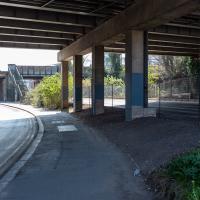
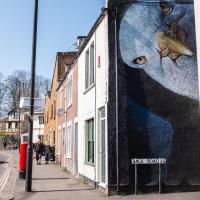
I wanted to have a wander along to the Tobacco Factory Market for some shopping, and checking the map for any leftover nearby streets I noticed a tiny curve of road on the way into the modern flats at Paxton Drive that it didn't look like I'd walked down before. I wouldn't take me too far out of my way, so I decided to head there first and then across to North Street to get my groceries and a coffee...
Easter Monday Gardens and Flowers
18 Apr 2022
I didn't really set out with a theme of flowers and gardens in mind for this walk. I just fancied heading up to Clifton Village to get lunch. As it turned out, though, Spring was springing, so a minor theme emerged as I started off with the graveyard flowers of Hope Chapel and wandered up to see the beginnings of the new wildflower garden at Clifton Hill Meadow.
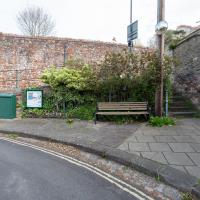
Strategically-placed grit box, because this tight blind (hence the mirror) zig-zag is hard enough work without a sheet of ice on the corner on a winter morning.
A Swing of the Plimsoll Bridge
24 Apr 2022
I was originally going to head over to the Ashton area to see if I'd missed any bits around the football stadium—and also to grab some lunch from the Tobacco Factory Market—but in the end I got a little distracted by having accidentally chosen exactly the right time to see the Plimsoll Bridge swing on one of the first busy days of Spring, where a lot of pleasure trips tend to head out down the Avon (and possibly the New Cut) from Hotwells.
In the end I mostly snapped that, and just a couple of photos from the Ashton area where I grabbed some lunch but didn't do any new exploring.
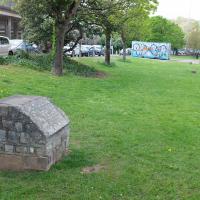
This is a plaque to the Cumberland Basin Stabilisation Works, completed in 1991, about which I can find virtually nothing on the internet. The face is too crumbled to read all the words, but I seem to remember that it's a lot more legible at certain times of year/day when the sunlight slants across its face. I'll keep an eye out for a better photo opportunity.
In the meantime, there's a picture of this entire area being resurfaced while the basin is drained and dredged on this selection of 1991 photos on the Evening Post site, which I'm assuming might have been part of this project.
A Quick Swing Past Ashton Court
05 Jun 2022
Another day not dissimilar to my last wander: I'm feeling a bit tired and rather than just moping around the house I thought I'd find some tiny bit of somewhere that I'd not yet walked and get outdoors. This time I headed for the Tobacco Factory Market in Bedminster, as I often do, but went the long way around via Ashton Court Mansion as I knew there were some footpaths and a small section of road I'd not ticked off up there. Finishing all the Ashton Court footpaths will be quite a long job, but you've got to start somewhere...
I did feel rather better by the time I got home, and, pretty much astoundingly given the weather forecast, managed to avoid the rain completely.
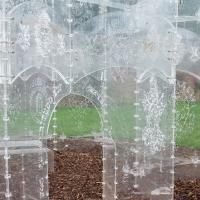
I think the Latin edging the doorway is "Pulchritudo Est Aliquid Incorporeum": "Beauty is an incorporeal thing", near as I can make out.
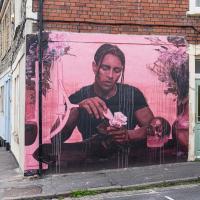
The technique that Ant Carver used for this piece, called "Love Me/Love Not", is intriguing. I recommend reading the write-up on the always-informative Natural Adventures.
I've been pretty awful at reading so far this year, apparently averaging about one book per month. That's a far cry from 2019, say, where I got through 41 books in the year. Today's wander was prompted by my rubbish reading, as I needed to go hand back some books to the library, because I'd managed to renew them so many times that I hit the limit on renewals. Oops. Several of them were still unread.
So, off to the Central Library for me, tail between my legs. On the way there I did my best to recreate a historical photo of Dowry Square; while I was in the area I walked under the adjacent Norman arch and poked around behind the Cathedral, and I also had a little diversion to the city centre and came back along the south side of the river, hitting some trouble with the lock gates as I finally crossed the harbour back towards home.
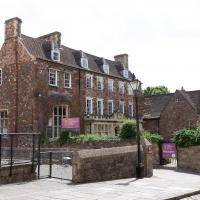
The Bristol Cathedral School has seen some controversy over the years, especially after it was given permission in 2013 for the Primary School to take over some of the Central Library. They turfed out some of the archives, which is presumably why I need to wait a week when I order an old book from the library, as someone now has to hoof it down to the B Bond warehouse to fetch it for me, rather than just downstairs.
Founded in 1140, dissolved and then re-founded by Henry VIII in 1542 after he dissolved the monastery, it's only very recently become a City Academy. It is allegedly non-selective these days, but my guess would be that its pupils' parents are significantly posher and richer than others in the local catchment area.