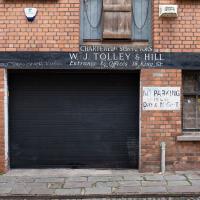
Tagged: facade
Lunchtime Zig Zag Climb
13 Jul 2021
A snappy little trip up the Zig Zag to the shops. It's a steep old route, the Zig Zag, going from just over river level to about the height of the suspension bridge (101 metres) in a compact switchback of a footpath.
I was too busy struggling to breathe to take many snaps of the actual Zig Zag (I've been trying to make it up all the way without stopping the last few times, but I've not quite managed it yet). I did at least take a few snaps either side on this quick lunchtime jaunt to fetch coffee (Coffee #1) and a sarnie (Parsons) from Clifton Village...
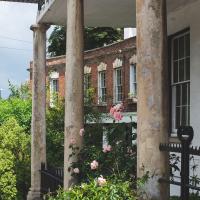
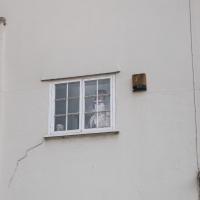
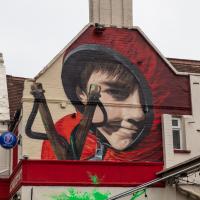
I will always enjoy the fact that Brunel looks out from this window. Have I ever noticed the smaller figure in the lower-left corner? Maybe it's new...
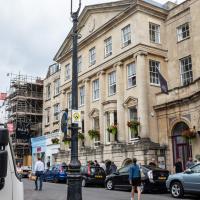
One of many fine old lamp posts in Clifton Village. The late, great Maggie Shapland apparently used to keep an eagle eye on them and make sure they were returned if they were ever carted off for repair. The Clifton Club lurks grandly in the background.
Although you may immediately think "gas lamp", here's an extract from Electric Arc Lamps in Bristol by Peter Lamb, published as a supplement to the Histelec News, newsletter of the Western Power Electricity Historical Society:
In looking at old photographs of late Victorian or early Edwardian scenes, many of you may have noticed very decorative street lights gracing the foregrounds. These lamp standards had long cylindrical shapes above the lamp, which distinguished them as being electric arc lamps. You may have wondered, like me, what was inside these housings. These cylinders, known colloquially at the turn of the century as “chimneys” were not chimneys at all, but housed the complex mechanisms regulating the carbon electrodes. Only two lamp standards of this distinctive design remain as street furniture on the Bristol streets and these are situated at The Mall, Clifton Village.
Autonomous Vehicle
14 Jul 2021
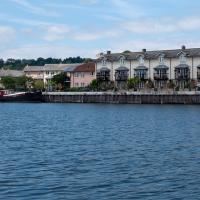
As it turned out, I didn't manage to get a coffee on my lunchtime coffee trip, as Imagine That were briefly shut down by a Covid-19 exposure notification (false alarm, it seems.) On the plus side, my trip was made worthwhile by spotting a couple of people from the University of Bath Mechanical Engineering Department testing an autonomous body-finding catamaran, which isn't a phrase I was ever expecting to write...
Pastures New!
17 Jul 2021
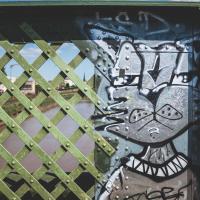
Okay, not much in the way of actual pasture to be had in Bedminster these days, like most of Bristol, but I did take advantage of the current rather toasty weather in Bristol to go and sit under a tree in Greville Smyth Park to read a book for a while before firing up the GPS and taking a little detour around some back streets of Ashton and Bedminster rather than going straight to Coffee #1 for an espresso frappé. This is the first walk in a while where I've actually crossed off an entire new street (the frankly unexciting Carrington Road) as well as exploring a couple of back alleys, just because they were there, really. Along the way I spotted a few examples of graffiti of various qualities, including a live work-in-progress by SNUB23 on Ashton Road and the finished Six Sisters project on North Street.
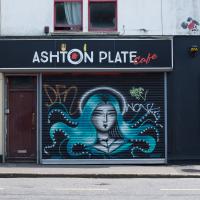
By all accounts a fine cafe in the greasy spoon archetype. Top right you can see a little tribute to Ashton Gate football stadium, a stone's throw away. Currently the stadium is being used as a Covid-19 vaccination centre.
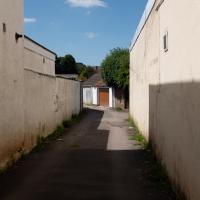
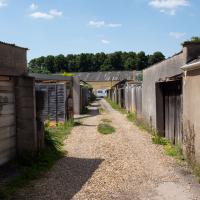
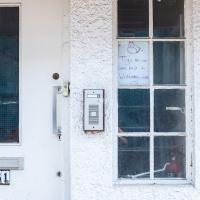
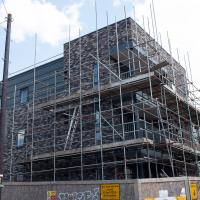
According to Google Street View, a few years ago this was just a modest corner house. I imagine someone's made a tidy profit.

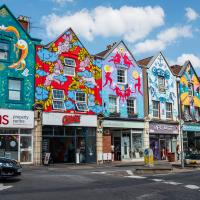
This was a work in progress last time I passed. Now all Six Sisters of this female-led graffiti project are finished and fair glowing in the sunshine.
A Journey to the Far East
25 Jul 2021
The far east of the intersection of my one-mile radius and Bedminster, anyway. I was feeling a bit tired this morning, so I motivated myself to get out of the door by imagining one of Mokoko's almond croissants. That got me on my way, and I wandered across to Bedminster, through Greville Smyth Park, along most of the length of North Street (looking out for new Upfest 75-pieces-in-75-days artwork as I went) and then onto some new roads at the far end.
I only wanted to knock a few streets off my "to do" list, but by the time I'd diverted here and there to check out various bits of graffiti and other attractions and come back via the aforementioned purveyors of Bristol's finest croissants, I'd walked 7.4km. Not bad for someone who woke up tired, and at least I've done something with my day. I'm very glad the weather broke (we had tremendous thunderstorms yesterday), even if some of the pictures might've looked better with a blue sky. I was getting fed up with walking around in 29°C heat...
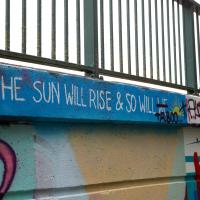
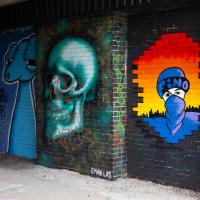
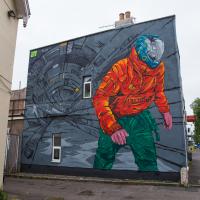
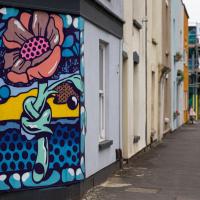
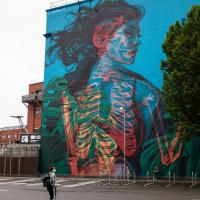
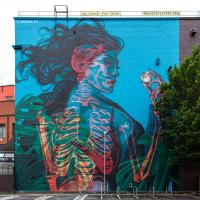
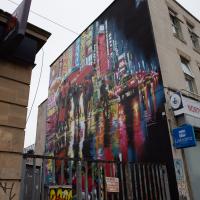
I don't normally edit photos to the extent of doing perspective correction, but I thought it would be interesting to see this piece straight-on.
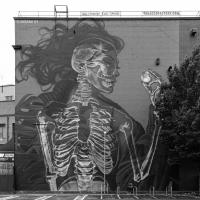
Green Squares and Secret Gardens
31 Jul 2021
At the end of July I went to have a look around some of the private gardens opened up by the annual Green Squares and Secret Gardens event. Sadly it was compressed into a single day this year, for various Covid-related reasons, it seems, so I didn't get to poke around too many places. I went to:
- A talk by the oldest resident of Victoria Square
- The St Vincent's Rocks Hotel garden
- The Paragon garden
- Cornwallis Crescent gardens, both east and west
- The Polygon garden
And snapped a few things in between, too. It was a lovely day—a bit too hot, if anything—and it was interesting to get into a few places I'd only ever seen from the outside, especially The Paragon and Cornwallis gardens, which are the least visible to passing strangers of all of them.
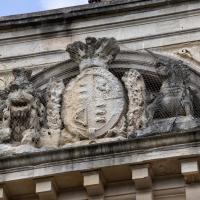
Nobody's quite sure why the Royal coat of arms appears here. Nobody royal appears to have given permission for it, and Victoria, as far as anyone can work out, never stayed here.
The weather appears to have been kinder to the unicorn than the lion.
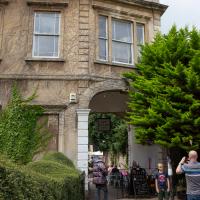
You can just about see the profile of Queen Victoria in the keystone; apparently it's the same image as used on the Penny Black.
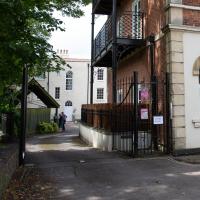
I've been wanting to go through these gates for a while; you can only get tantalising glimpses of the listed extension from the bit of grass adjacent.
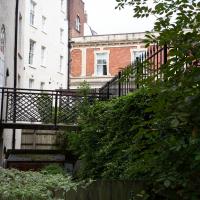
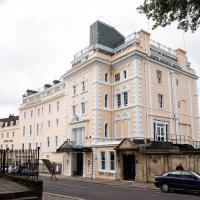
Freshly painted, with the scaffolding only recently removed, and looking rather lovely. To its right is the old entrance to the earlier Hotwell pump house that used to stand down on the Hotwell Road, and just to the right of that is the entrance to the Clfiton Rocks Railway. Behind all that is the site of the original Clifton Spa pump room, a grand "long room" that was later used as a cinema and then a ball room. I wonder if there are any plans to renovate it? It was still disused, last I heard, but that was a long time ago, when I peeped through from a Rocks Railway open day....
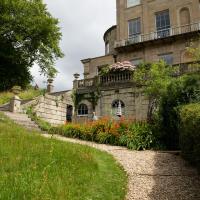
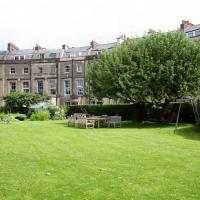
The Paragon feels quite odd to me, because this is the side where all the front doors are, but it definitely feels like the back of the terrace. Not sure why.
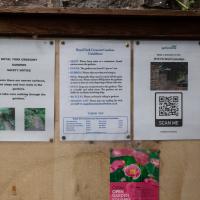
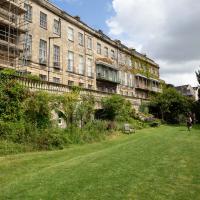
And on to another garden! This is the upper part of one half of Cornwallis Crescent, which for my money has to have the best combination of size and privacy of all the Clifton communal gardens. It's big and rambling and runs the entire length of Cornwallis Crescent, and is mostly bordered by high walls, with the entrance gates in the alley above the Polygon not giving much away.
A Long Wander Of Miscellany and Magick
08 Aug 2021
This was a wide-ranging wander. I started off crossing the river to Bedminster, to walk a single little cul-de-sac, Hardy Avenue, that I'd managed to miss on at least one previous walk. Then, pausing only to explore a few back alleyways, I headed for a few destinations related mostly by the Hughes family, who I've been researching a little as part of background for a possible novel, as several of them were involved in the Stella Matutina.
However, mostly it's the artistic side of the family I wanted to explore today, as that's where most of their public history lies (as you might expect, there's often not much in the public record about the workings of an occult organisation.) First I visited College Green, where the façade of the Catch 22 Fish & Chip shop still bears the work of Catherine Edith Hughes. Then I wandered up to the top of Park Street to pop into the Clifton Arts Club's annual exhibition, as Catherine, her half-brother Donald, his wife Hope and at least two other Hugheses were members. Donald was chairman for 40 solid years; Hope was Secretary for eight, and Ellard and Margaret Hughes, two more Hughes siblings, were members along with Catherine.
Finally I walked home with a small diversion to Berkeley Square, to confirm the location of Donald Hughes's house by checking for a particular plaque by the front door.
I must admit I'm not entirely sure where all this research is really leading me, but I'm finding it quite interesting to bump across the faint lines of history that link the Hermetic Order of the Golden Dawn, founded in 1888, to modern, quotidian Bristol.
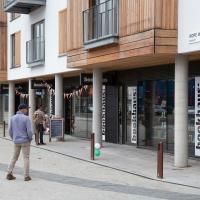
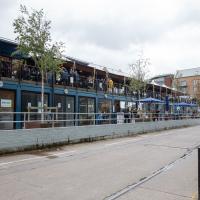
The extra strip of modular shops and eateries at Wapping Wharf seems to be doing quite well.
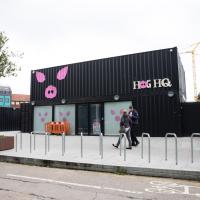
The logo tells me that this is related to Pigsty, the pig-related food place on the end of Cargo 1. And apparently I'm right—this is The Jolly Hog HQ, and The Jolly Hog—butchers, and sausage specialists—own and run the Pigsty. I hadn't realised that they were such a big business.
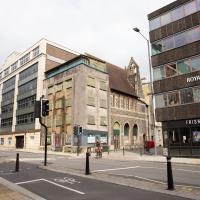
The rather derelict looking building on the corner of Prince Street and Royal Oak Avenue was at one point a Seaman's Mission & Instutue, and more recently an evangelilcal church of some kind. It was damaged during the war and seems to now be some kind of Frankenstein's monster of architecture with an odd modern frontage. The rather more together-looking (but still, frankly, unattractive!) building to the left is Prince House.
Edit to add: (19 June 2022): Know Your Place has just tweeted some amazing photos of the chapel interior (here's some more) that have just been added to the Community Layer on their incredibly useful website.
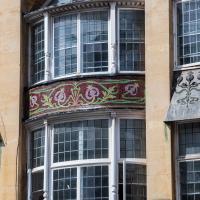
As I mentioned, these pomegranates were made by Catherine Hughes, daughter of the estate agent who commissioned the cafe.
The Hughes name is one to conjure with. I'm specifically interested in the Hughes family as I've been researching the Golden Dawn1 for a novel, and at least three Hugheses were members of its later offshoot, the Stella Matutina. Catherine Hughes (Lux Orta Est), who made these tiled pomegranates was, I believe, the first Imperatrix of the No. 28 Bristol Hermes Temple of the Stella Matutina, running it to begin with from her home at St Vincent's Studio, Redland, just off the top of Whiteladies Road.
We'll be hearing a bit more about some other members of the Hughes family in a little bit, as I decided to turn this wander into a bit of a magical excursion, for fun and research and because of handy timing and geographical coincidence.
I don't know if these pomegranates from 1904 predate Catherine Hughes's interest in magic per se, but they were made years before she joined the Stella Matutina, in early 1908, so I can't say that they were created by a practising magician!
1 No, not the Greek nutters. The British Victorian, er, eccentrics.
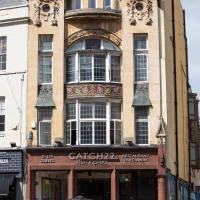
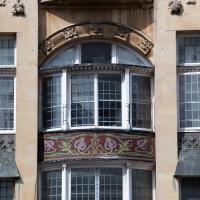
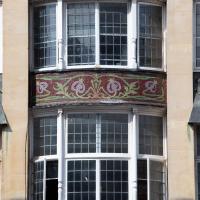
The side window canopies are copper, as you can probably tell by the green streaks below them.
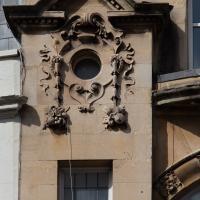
Museum of the Moon, and a Bit of Redland
21 Aug 2021
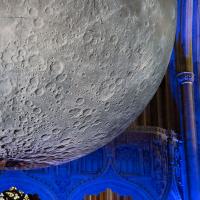
Lisa and I mostly went out to have a look at Luke Jerram's Museum of the Moon as its tour hit Bristol Cathedral—I missed it when it was previously in town, at Wills Hall, I think—but we also took a trek up to Redland. Lisa's kind enough to indulge my strange current fascination with the Edwardian eccentrics that made up the Stella Matutina, so we swung by a couple of places with a vague connection to the Bristol branch of the organisation. Well, it was good walking, anyway...
As a stunning bonus, one of the picture's descriptions has more information than you'd probably want on the Bristol Port Railway and Pier's Clifton Extension Railway line, but I did happen to coincidentally write up this wander after reading about the extension line during my lunch hour at work today. It's a thrilling life, I tell you...
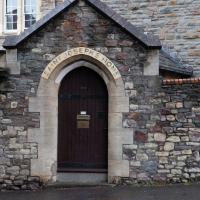
"They afterwards built, in connexion with their convent, an asylum for the reception of about one hundred sick and aged poor, means for the maintenance of whom they obtained by soliciting alms from door to door"
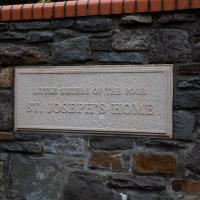
More from ChurchDB:
"The order was founded by St Jeanne Jugan, after she rescued two poverty-stricken elderly women from the streets of Paris during the French Revolution. The Sisters' work continues today, in providing care for the elderly - for an account of this, see the article Celebrating the Little Sisters with big hearts published in the Bristol Post on 15th October 2012, reporting on the celebration of 150 years of their work."
And even more on Wikipedia, of course...
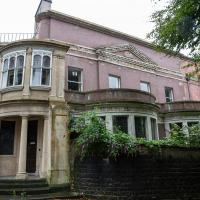
Formerly a house, now a nurses' home, according to Historic England. Seems to add up, as it appears to now be on the grounds of the Bristol Homeopathic Hospital, which is "being used as the student health service for Bristol University"
On the left of the door is the service wing, apparently. It's a sprawling old place, and seems very awkwardly shoehorned into this corner. It looks from old maps like it was backing onto a quarry for a while, before that was filled in and the homeopathic hospital was built there.
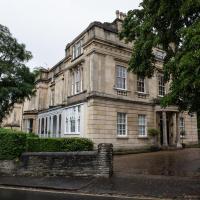
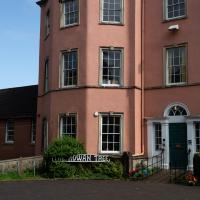
Yes, I'm back on the magical research. According to RA Gilbert's Golden Dawn Companion, this was one of the meeting places of the Hermes Temple of the Stella Matutina. I'm guessing one of the members lived there, but I'm not sure who. I'd probably need to cross-check the census records with the membership rolls, and the latter are quite patchy, anyway.
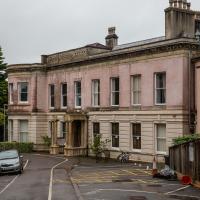
Cotham House seems to make more architectural sense from the back. Maybe this was originally the front?
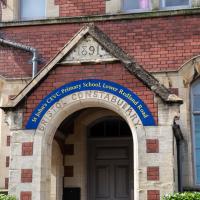
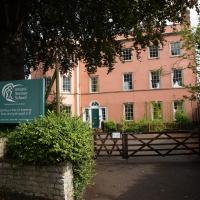
I don't know if there's any connection between the Bristol Hermes Temple and the Bristol Steiner School specifically, but I know that at least one of the Temple Chiefs met Rudolf Steiner and became quite enamoured of anthroposophy, so it's interesting that the school is so close to where Catherine Hughes, one of the first three chiefs, used to live, just down the road from here.
Mostly the Metal Animals of a Clifton Garden
30 Aug 2021
Lisa and I went for a longish walk, but I didn't take many photos. Mostly we just wandered and nattered. Unusually, my target was outside my 1-mile radius on Burlington Road in Redland, where I snapped quite a few photos of the collection of artistic animals by Julian Warren. This was mostly to provide a fairly arbitrary destination for a roundabout walk in Clifton...
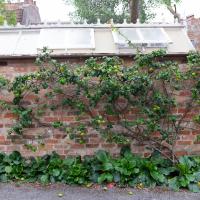
I don't know enough about fruit trees to know what this was, but I can tell you that the fruit was apple-ish and very sharp indeed.
Unusual to see an espalier on a north-facing wall. This one faces the little car park behind Freeland Place
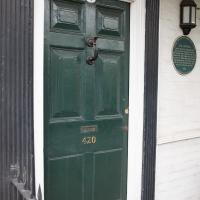
More dual numbering. I was curious, as I think the first couple of houses of the Colonnade were demolished at some point, so I wanted to see whether (a) the old numbers were there at all, rather than just the new Hotwell Road numbers, and (b) if they maybe started at number 3...
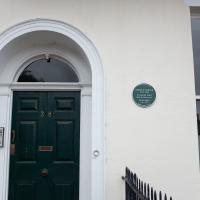
Since I found out that Angela Carter used to live around here, I've read The Bloody Chamber, and it was bloody brilliant.
Shiny New Hope
24 Sep 2021
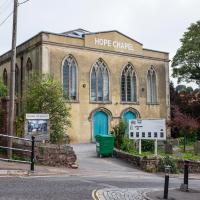
A quick lunchtime jaunt to Clifton Village. Along the way I admired the new sign on Hope Chapel and added to my tsundoku collection.
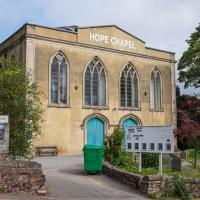
The scaffolding is down and there's a nice new sign (reminiscent of a historical one, I think,but I can't find the photo at the moment because Know Your Place Bristol is down) and you can just see the newly-installed solar panels on the roof behind it.
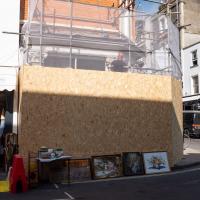
There's a mason at work on the carved pilaster tops on the frontage of the old Coventry (and before then, Stroud and Swindon) Building Society. They've moved everything to a central branch in town in the interests of efficiency, so now I have to go to bloody Broadmead to do anything.
(Yes, I actually went into town to get a cheque out of the building society just the other day, in 2021. I know I should chuck this old-fashioned malarkey in for a shiny electronic account, but it's for the management committee of the house I live in, so there's complexity and inertia involved...)
A Morning of Research and a Cafe in a Castle
25 Sep 2021
I needed to pop to the library, as they'd kindly dug a book out of the reserve store at the B Bond warehouse for me and emailed me to let me know it was ready. So, I took a little trip to town, straight down the Hotwell Road, and spent a few hours reading before stretching my legs with a walk to a new cafe in the actual castle (or remnants thereof, anyway) of Castle Park, before heading back home down the other side of the harbour. As well as books and coffee, I bumped into a remote-controlled pirate ship, which isn't something you see every day, even in Bristol.
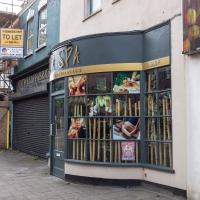
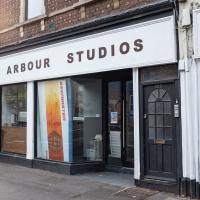
It's nice to see a new business open up on this stretch of the Hotwell Road. Since Asia Channel disappeared (and took with it my favourite local source of crispy beef) and the Hotwells Pine folks retired, it's all been looking a bit tatty.
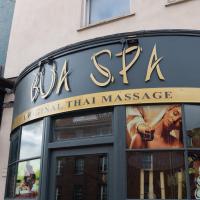
This place has already garnered several good reviews from locals on Nextdoor and Google Reviews. I must try it at some point.
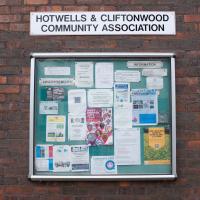
The sign about the wildflower meadow on Clifton Hill Bank is part of the consultation I mentioned the other day.
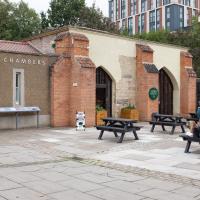
The chambers were apparently once the entrance to the castle's great hall. Historic England has this section of the castle at 13-14th century
I was interested to see it, but a little underwhelmed, if I'm honest. A fairly bland interior and a perfectly adequate flat white—not much "wow" factor.