Tagged: facade
The Gridiron and Bower Ashton Part Two
03 Dec 2021
On my last wander, to Bower Ashton, I was intending to knock Blackmoors Lane off my list "to-do" list, but got a bit diverted. I also took a little look into the history of the Gridiron, once a cheaper alternative to dry dock that was nestled just south of North Entrance Lock.
Today I had to go to send a parcel off somewhere, so I decided on going to the North Street Post Office via Blackmoors Lane. I didn't have much intention of anything else, but as luck would have it I walked out both at low tide and also as some lockkeepers seemed to be having a bit of a training session, and one of the more senior people was (a) happy to answer a few random questions on the Gridiron and (b) actually knew a lot about it, as Gridiron maintenance had been one of his jobs, more than twenty years ago...
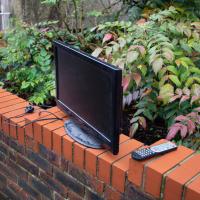
Interesting to see a flatscreen TV left out in the traditional "please take this away for free" place, even if it is only a little Alba.
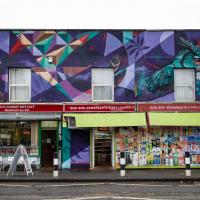
I've snapped this before; it just looked particularly attractive today. Al's Tikka Grill has some rave reviews on TripAdvisor. Maybe I'll give it a try one day.
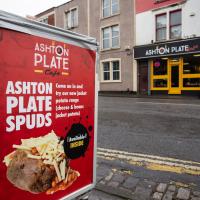
Dear fellow photographers: If you're going to take a picture like this, you could at least whack the potato through the microwave first, so it at least looks like once in its life it's been warm enough to melt cheese.
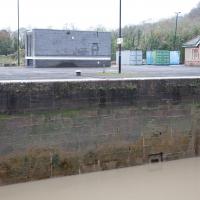
You can see how this sluice channel entrance in the side of the Entrance Lock wall is about level with the control wheel we saw on the far side—if you look closely, you can see it immediately to the left of and behind the modern building in the background. Given what the lockkeeper described to me, I'm confident that this is where the water for sluicing the Gridion clean of silt came from—they fill Entrance lock, then open the sluice to carry water—which must be under reasonable pressure with a full lock—across to the far side where the Gridiron is, washing off the accumulated silt.
Clever, these Bristol engineers: no actual pumping required. Just tides and gravity.
And that's the last of my musing on the Gridiron. I'm not sure why I became so fascinated by a giant Victorian boat-sieve, but I did!
A Door, a Square, a Few Night Shots
04 Dec 2021
I didn't take many pictures on this quite long wander, partly because Lisa and I wandered across to Bedminster via Bower Ashton, which I've snapped quite a lot of on the last couple of walks, and also because we lost the light fairly quickly, though spending a half-hour drinking mulled wine in the Ashton might have had a little to do with that...
Before we left Hotwells I wanted to visit a door I'd heard about on Cornwallis Crescent and also take a little look at a couple of houses in Dowry Square to consider the 1960s regeneration of Hotwells.
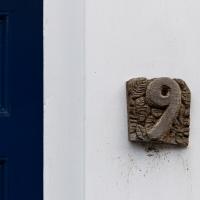
Not the front door we were looking for, but I like the hand-carved digit at 9 Cornwallis Crescent.
I have snapped this section of Cornwallis Crescent before, but apparently only en bloc.
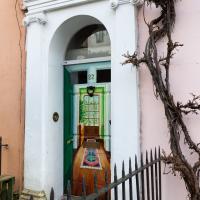
When it's three doors in one! Apparently this door has had this trompe-l'œil effect since the summer, but the vine was only recently cut back, which might explain why I've not noticed it before...
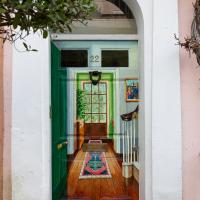
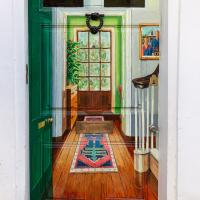
Favourite detail: the American Gothic style family portrait. (Though I'm guessing it depicts the husband and wife of the family, as opposed to father and daughter, like the original...)
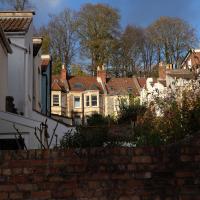
A glimpse of Cornwallis Avenue across the back gardens between St Vincent's Road and Dowry Road.
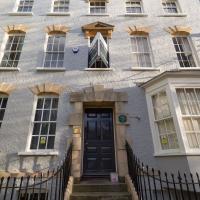
It's currently set up as a set of separate serviced offices. If you're interested in buying the freehold, they're looking for offers in excess of £1m.
As well as being the former home of Master of Ceremonies of the Hot Well, William Pennington, it was for a while The Hotwells Nursery and School for Mothers. Later it looks like it turned into Social Services' Hotwells Day Nursery, if the footage in this BBC documentary, starting at around the 20-minute mark.
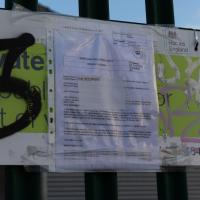
It was this notice that finally let me figure out that this strip of land was called Ashton Gate Depot and find out a bit more about it.
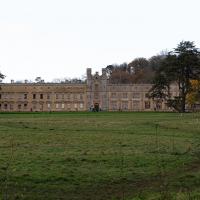
Site of a manor house since the 11th Century. Last time I was in there it was also with Lisa, my companion for this walk, as a team of storytellers from Red Rope Theatre read us ghost stories just before Halloween. It was excellent.
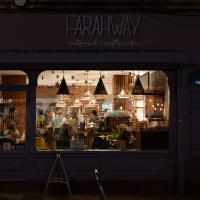
Speaking of gentrification, I doubt you've have seen an arts & crafts cafe on North Street twenty years go.
A Water-Based Wander
11 Dec 2021
I woke up on this Saturday with a headache, feeling like I'd not slept at all. As well as that, I'm still in some pain from the wisdom tooth extraction I had a few weeks ago. I moped about the flat for a while and then decided that the best thing to do was to force myself out on at least a small walk to get some fresh air and coffee.
Was there anywhere I could walk locally that I'd never been? Actually, yes! Although it's not a road, and I didn't walk it, there is actually one route that I've not travelled so far in my wanders. And it even had coffee near its far end...
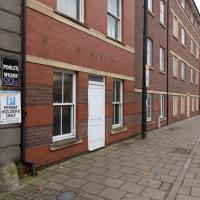
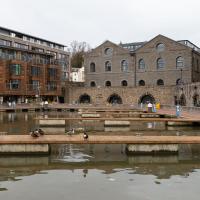
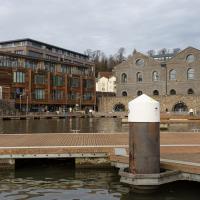
...but you can't tell that it's not a house from the Hotwell Road. I wonder how many times I've walked past the windows and front door and not realised that they're just the frontage of the car park?
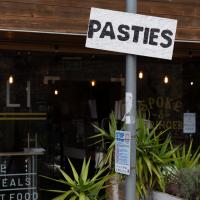
I love the way Spoke & Stringer's deli window with it predictably-hipster type choices and logo are somewhat put into perspective by their wonky big-arse OSB sign with PASTIES daubed on it.
There is a time for fancy marketing, and a time to just shout "GET YER PASTIES 'ERE" at the top of your signage.
A Constitutional to Burwalls and Back
21 Dec 2021
The recent lack of posts here is mostly due to my feeling very run down following having a couple of wisdom teeth extracted. Having had an emergency appointment yesterday1, hopefully I'll be on the mend now, though it does mean I'm on the kind of antibiotics where you can't touch alcohol for the whole of the Christmas period. I have tried to keep myself a little distracted from the pain by working on the nuts and bolts of this website—you should notice that the front page loads rather faster now than it used to, and that there's a shiny new statistics page that I'll probably be continuing to work on. Oh, and you should find that the tags below the photos are now clickable and will take you to a page of all other wanders that have photos with the same tag.
Today I felt like I needed to drag myself out of the house, but I didn't want to go too far, and I needed to get to the Post Office up in Clifton Village to post a Christmas card (spoiler for my parents: it's going to be late. Sorry.) As luck would have it, idly looking at the map I spotted that I'd missed off a section of Burwalls Road in the past, and that's basically one of the long-ways-round to Clifton Village, crossing the river to Rownham and walking up the hill on the Somerset side before coming back across the Suspension Bridge.
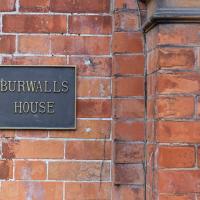
As I was heading for Burwalls Road I decided to make Burwalls itself the focal point of the walk, but unfortunately the mansion grounds are private and the place is hard to snap. Still, at least it gave me a destination. Burwalls was the mansion built by Bristol press magnate Joseph Leech, who I've mentioned before after buying a vintage book he wrote on a previous wander. There's a good article about the house on House and Heritage which has some photos from angles I couldn't ever get to. (Well, maybe with a drone, but it seems like the kind of area where they may be kitted out for clay pigeon shooting, so I probably wouldn't risk it.)
1 My dentist admitted that she probably needed to keep her internal monologue a bit more internal after we started the appointment with her staring into my mouth and immediately saying, "oh, *that's* weird." These are words one doesn't want to hear from a medical professional.
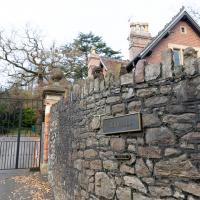
Maybe if I'd got interested in this project before the university sold the place, I'd have been able to pop in and have a look around. Still, I can't blame them; when the estate was on the market in 2012 it was Bristol's most expensive house, valued at £5m, according to the Daily Mail.
That was for the main house and the old stables and lodge, which have been converted to the housing we're looking at. Given that by 2017, just a single one of the five aforementioned lateral apartments in the main manor house was on the market for £1.5, I think the developers probably did quite well...
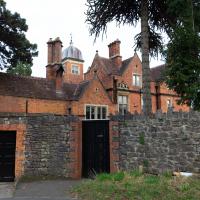
Our first close-up sight. Sadly the main building is disappointingly hard to take a photo of. Still, I suppose if I'd just bought a flat for one-and-a-half million quid I'd probably not want some plebe with a camera being nosy around the place.
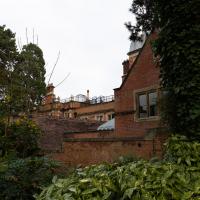
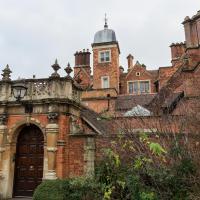
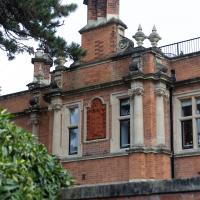
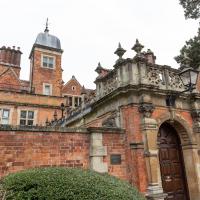
The manor was originally built by Joseph Leech, a fascinating man who was owner of the Bristol Times. Among other fun things, he used to be the "Bristol Church-goer", publishing an anonymous and apparently quite funny column as a "mystery shopper"-style reviewer of church services.
There's a bit more about him on my blog, prompted by my buying a lovely old book by him in a secondhand shop on a previous wander.
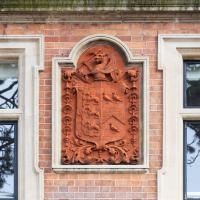
Joseph Leech doesn't appear to have had a coat of arms, and it's not the University of Bristol's (they were another former owner), but I struck lucky with my third guess: the Wills family crest apparently features three martlets around a chevron, as on the right, and three wyverns, as on the left... Can't find anything that's exactly like this one, but them I'm not exactly au fait with heraldry.
George Wills, of the Wills Tobacco family, was Burwalls' owner after Joseph Leech.
I was just about starting to feel better—the antibiotics seemed to have kicked in for my dental issues, and it had been some days since I'd left the house, and I was at last starting to get itchy feet. So, a wander. But where? Well, there were a few industrial bits near Winterstoke Road in the Ashton/Ashton Vale areas of Bristol that needed walking. I knew they were likely to be quite, well, unattractive, frankly. So why not do them while I wasn't feeling exactly 100% myself? Maybe it would fit my mood. Hopefully you're also in the mood for a bit of post-industrial wasteland, for that's what some of this feels like...
Then, at the last minute, I thought again about the Bristol International Exhibition—I've got a book about it on the way now—and that gave me another goal, which could just about be said to be in the same direction, and I decided to walk significantly further than my normal 1-mile limit and try recreating another historical photo...
Sadly I don't know much about the Ashton area; it's just on the edges of my mile and I rarely have cause to go there. It's brimming with history, I'm sure: the whole South Bristol area rapidly developed from farmland to coal mines to factories to its current interesting mixture of suburbs and industrial work over the last few hundred years. As a more working class area less attention was paid to it by historians, at least historically-speaking, than the Georgian heights of Clifton, and much of it has been knocked down and reinvented rather than listed and preserved. I see here and there some of this lack is being addressed, but I'm afraid I'll be very light on the history myself on this wander, as most of my usual sources aren't throwing up their normal reams of information as when I point them at Clifton, Hotwells or the old city.
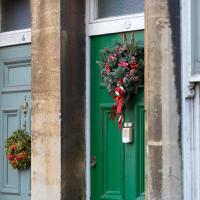
I think the whole of (admittedly-short) Albemarle Terrace had wreathes on the doors. Nice.
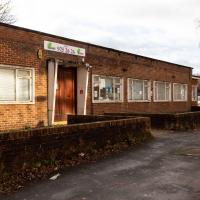
Here's a working office that I'd heard of: V Cars are one of Bristol's biggest cab firms, and the only one whose phone number I have memorised. On my first trip in one, back in 1999 (in a differently-named, earlier incarnation, I think), the driver said to remember the number as "Christmas Day, Boxing Day, Boxing Day". Most (all?) central Bristol phone numbers were prefixed with a 9 back then, so you just needed to add 25, 26, 26...
There was even a cab dispatcher at work behind the window, from what I could see. It reminded me of my childhood, when my mum worked as a dispatcher at Radio Cars in Ilford.
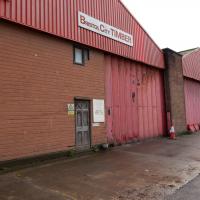
I do at least appreciate the fact that Bristol City Timber has a traditional wooden front door.
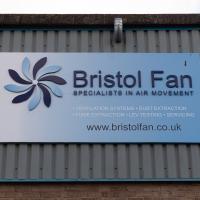
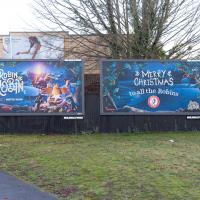
The plethora of advertising billboards in this area is depressingly predictable, but at least this advertising is both local and well-thought-out. Local heroes Aardman Animation are advertising their new feature Robin Robin on the left, but have a related Christmas message to the "Robins", whose stadium is just around the corner. Bristol City apparently earned the nickname by playing in a strip with a red top and white shorts.
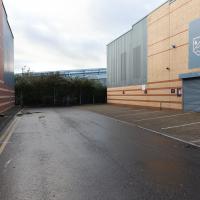
I may have been speaking too soon when I said that earlier picture was the arse-end of nowhere. This is the delightful end of East Court, which I think is actually a public road and therefore on my list of roads to walk. Rarely have I been so unexcited to see the end of a cul-de-sac.
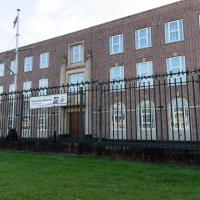
If one tried to conjure an image from just the phrase "HMS Flying Fox", this probably isn't what would spring to mind, is it? It's not a ship, it's not flying, and it's not a fox, for starters.
Royal Navy Reserves HQ for Wales & South West of England, I think it says on the sign at the far end.
Note the Egyptian kings on pillars at the top of the pilasters bracing the doorway. No earthly clue what they're doing there. As usual, Bristol's historical sources seem to peter out south of the river.
Wikipedia says on Egyptian Revival Architecture:
By the end of the 19th century, the style had very nearly disappeared, but in 1922 with Howard Carter's discovery of Tutankhamun's tomb the style underwent a dramatic revival it was used particularly for cinema architecture and sometimes for factory buildings.
...and given the surroundings it wouldn't entirely surprise me to find that this was originally a factory, at least, though the 1940 date in between the Egyptians suggests they were a little late with the styling.
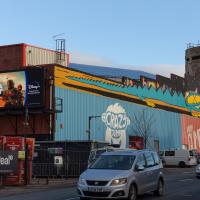
Redpoint climbing centre. Used to be an art deco cinema, apparently. At the far end you can see a sop to that in the style of the CAFE BAR sign. It looks rather swanky and modern inside from the pics on their website.
At this end of the building is a giant digital advertising board. I'm with Adblock Bristol on this one, but then I've never been a fan of public advertising.
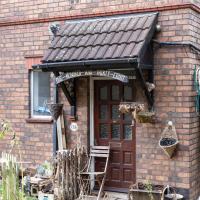
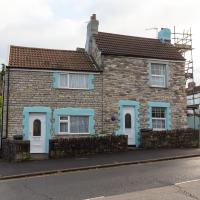
I imagine the view was rather less industrial back then, though perhaps not: quite a lot of the scene from the front windows would have been open-cast collieries, thinking about it...
A Random New Year's Day Wander
01 Jan 2022
I picked a fairly arbitrary reason for a wander today. Really, I just wanted to do a New Year's Day wander just to get out of the house and to set a precedent for the year to come.
My ostensible reason was to investigate what looked like a road on my map that quartered the lawn in front of the Ashton Court mansion. As it turned out, this is just a muddy footpath/desire line similar to a half-dozen other tracks nearby, and must be some kind of bug or misclassification with the mapping system I'm using, but that's not important. What's important is that I went for a little walk on the first day of the year. As a bonus, I did happen to wander down a couple of sections of new footpath, so technically I broke some new ground too, which is nice.
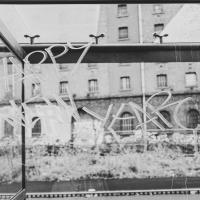
It didn't take long for someone to scrawl the sentiments of the season on a bus shelter.
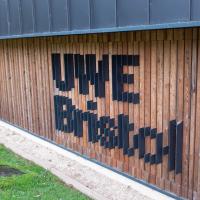
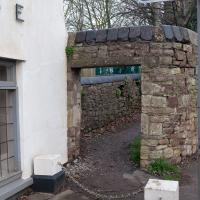
I don't think I noticed this when passing the Ashton pub the last couple of times, but this time a family emerged from it as I was walking in the other direction. It doesn't lead anywhere spectacular, but it was a footpath I'd managed to miss, and the start of it is pleasingly intriguing, at least.
Near and Far
05 Jan 2022
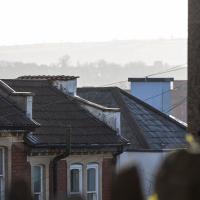
I took advantage of a rare recent day where it wasn't tipping down with rain to get away from my desk on a lunchtime workday and head up to Clifton Village. I'd hoped to snap a reproduction of historical photo which I'd worked out had been taken from the Suspension Bridge, but the gods were not smiling on me. Still, taking only a nice long lens with me worked out very well as the lovely haze of the day made more distant views quite dramatic...
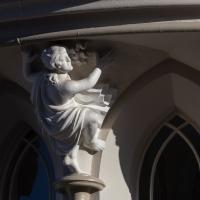
I swear this caryatid must've been modelled on Stephen Fry. This is St Vincent's Priory, a very strange building on Sion Hill that's just been renovated. Next time I pop up I'll try and get a photo of it looking clean and shiny now the scaffolding's down, but I only took a telephoto lens with me on this trip.
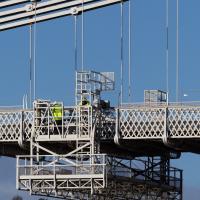
If I'd really considered it, the fact that there was a bloke in high vis standing on the bit of the bridge I wanted to take a photograph of might have warned me what was going to happen...
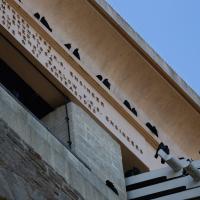
Quick Clifton Jaunt Finishing with Southville
09 Jan 2022
It's been pretty dismal recently, weather-wise, so when Sarah called up to say that she and Vik had just left the swimming pool at the student union building up in Clifton, and would I like to join them for a trip to the Last Bookshop, also known as The £3 Bookshop, for reasons you can probably deduce, I leapt at the chance.
Not many photos on this walk, but I did manage to get down a little road I'd never been to before, basically just the access road to a car park at a block of flats, but it was on the map looking all tempting, so I figured I'd knock it off the list as we were passing.
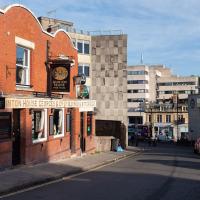
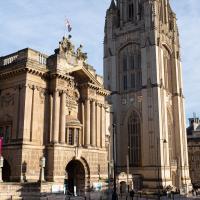
The museum and the Wills Memorial looking resplendent. Behind me on this chilly morning was someone sleeping in a doorway under a quilt, with a plastic suitcase presumably containing their entirely worldly possessions. It's a place of contrasts, Clifton.
Lunchtime Reproduction (of an old photo...)
17 Jan 2022
This was basically the quick lunchtime jaunt I tried to do at the beginning of January, only this time I actually managed to get to roughly the viewpoint I'd been hoping for to recreate a historical photo of the Bristol International Exhibition.
I did this walk about a month ago, but I've been a bit poorly and not really up to doing much in my spare time, and it's taken me this long to even face processing even these few photos. Hopefully normal service will be resumed at some point and I can carry on trying to walk any roads and paths that I need to do to make this project feel complete...
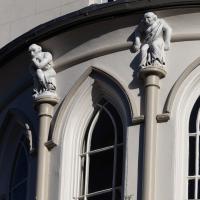
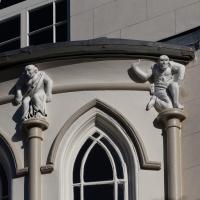
Gargoyles? Caryatids? Gargyatids? Caryoyles? There's probably a proper name for them, knowing architecture...
This is St Vincent's Priory, a very odd building on Clifton Hill. According to Maurice Fells' excellent Clifton: History You Can See:
Its name conjures up visions to the sounds of monastic of an ancient religious foundation with its hallowed walls echoing chanting. But St Vincent's Priory is a private house and the likelihood is that it was built as such and probably conceived as an architectural folly...
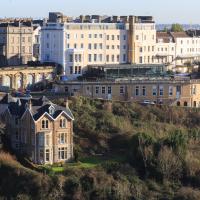
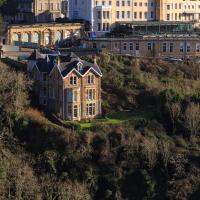
Just think, I could upgrade to a flat just up the hill from me, with an extra bedroom, for only about three quarters of a million quid...
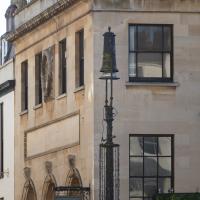
From Electric Arc Lamps in Bristol, by Peter Lamb, a supplement to the Histelec News, August 1997:
In looking at old photographs of late Victorian or early Edwardian scenes, many of you may have noticed very decorative street lights gracing the foregrounds. These lamp standards had long cylindrical shapes above the lamp, which distinguished them as being electric arc lamps. You may have wondered, like me, what was inside these housings. These cylinders, known colloquially at the turn of the century as “chimneys” were not chimneys at all, but housed the complex mechanisms regulating the carbon electrodes. Only two lamp standards of this distinctive design remain as street furniture on the Bristol streets and these are situated at The Mall, Clifton Village.
Given the long cylindrical shape and the fact it's on the Mall, pretty sure this must be one of the last two electric arc lamps still standing, or possibly the last one, as I couldn't find the other one.
EDIT: Having asked on Next Door, where there've been a few threads about historic lamp restoration, it seems the other one used to stand at the end of West Mall, not far away, was taken away for restoration a long time ago, and has yet to reappear.
There's another Bristol connection too, with Sir Humphrey Davy, as the article continues:
Sir Humphrey Davey is credited with inventing the first arc lamp, when he demonstrated his invention at the Royal Institution in 1810. It was powered by batteries and used charcoal elements enclosed in a vacuum. The vacuum allowed a longer arc with a much higher voltage. It was some years later (1844) that the principle was further developed by a Frenchman by the name of Foucault. He used carbons from the retorts of a gasworks, which were more durable. Thomas Wright devised the first arc lamp which involved adjustment of the carbons automatically as they burnt away, and W.C.Staite used an electric current for the regulation of the carbons. Foucault responded in 1858 by producing his regulating lamp.
(Yes, that is Foucault of Foucault's Pendulum fame.)
Lunchtime Cliftonwood Wander
18 Jan 2022
Another workday, another quick lunchtime trip to get me out of the house. This time my flimsy pretext is a tiny bit of Clifton Vale Close that I'd apparently not walked, and the fact that although I'd walked down Church Lane at least once before I still hadn't taken a single photo of it. Really I just fancied a mosey through Cliftonwood in the sunshine, with the promise of a coffee from Clifton Village at the top of the hill.
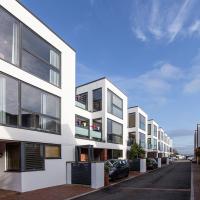
We've popped down here before, on the site of the Clifton National School that didn't survive bombing in the war.
Today, the modern flats look to me as I imagine their original models would have done back when they were still just an idea on an architect's table (or more likely computer monitor, I suppose.)
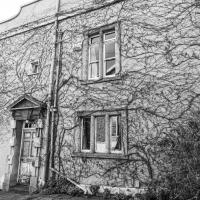
This is apparently "Amhurst", "House and stables, now pair of attached houses."
In a few pics' time we'll take a closer look at the door, and its description in the listing...
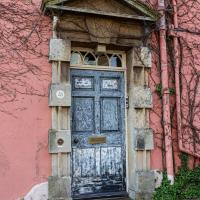
As promised, a bit more detail of the Amhurst door from the listing:
Left-of-centre doorway has Gibbs surround and thin consoles to a pediment, architrave with a split key, overlight with 4 pointed-arched panes and a 6-panel door, the upper ones raised.
Hopefully someone plans to give it a lick of paint at some point soon...
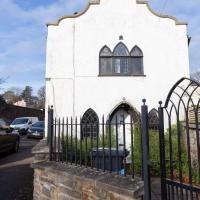
Mid-to-late 18th century, in the "gothick" style according to the listing. I approve of their spelling. This is definitely the right listing, as here's exactly what we see:
Symmetrical end has an elaborate Dutch gable with a 2-centred arched doorway with panelled door, and matching windows each side with lattice leaded lights. Above is a tripartite window with 2-centred arched heads, central casement with interlacing upper glazing bars and blind outer ones.
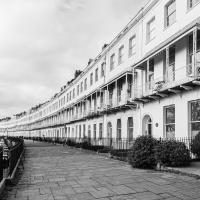
I imagine, given the fifteen minute gap between the last photo and this one, that I clambered up as far as the delightful Foliage Cafe and shot this on the way back home with my coffee. It's been a month between doing this walk and typing up the notes, though, so I couldn't tell you for sure.
Anyway, here's the gentle curve of Royal York Crescent, one of my preferred routes home as the view's rather lovely and the raised pavement takes you away from any traffic.
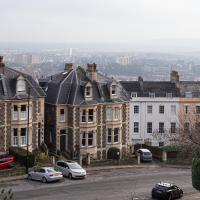
I've always really liked the big mansard-roofed houses along this stretch. There's something big and dignified about them.
And that's the end of another lunchtime jaunt. I don't know if there's any trips left in the backlog. Hopefully at some point the weather will let up a bit (we've just been through Storm Eunice and there's more heavy weather on the way, apparently) and I'll feel like heading out for a wander again.