Tagged: cloud
I got interested in Bristol's medieval water supplies after poking around near Jacobs Wells Road and Brandon Hill. It was during that research I found out about a pipe that's still there today, and, as far as I know, still actually functioning, that was originally commissioned by Carmelite monks in the 13th century. They wanted a supply of spring water from Brandon Hill to their priory on the site of what's now the Bristol Beacon—Colston Hall, as-was. It was created around 1267, and later, in 1376, extended generously with an extra "feather" pipe to St John's On The Wall, giving the pipework its modern name of "St John's Conduit".
St John's on the Wall is still there, guarding the remaining city gate at the end of Broad Street, and the outlet tap area was recently refurbished. It doesn't run continuously now, like it did when I first moved to Bristol and worked at the end of Broad Street, in the Everard Building, but I believe the pipe still functions. One day I'd like to see that tap running...
There are a few links on the web about the pipe, but by far the best thing to do is to watch this short and fascinating 1970s TV documentary called The Hidden Source, which has some footage of the actual pipe and also lots of fantastic general footage of Bristol in the seventies.
On my walk today I was actually just going to the building society in town, but I decided to trace some of the route of the Carmelite pipe, including visiting streets it runs under, like Park Street, Christmas Street, and, of course, Pipe Lane. I also went a bit out of my way to check out St James' Priory, the oldest building in Bristol, seeing as it was just around the corner from the building society.
There are far too many pictures from this walk, and my feet are now quite sore, because it was a long one. But I enjoyed it.
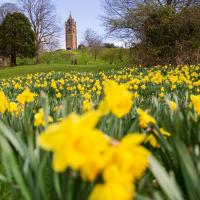
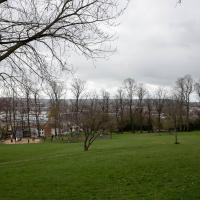
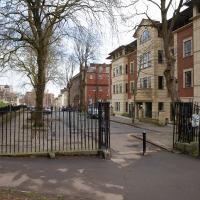
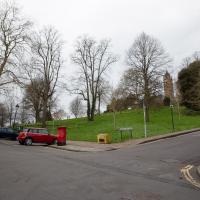
I didn't know it at the time I took this photo, but this is the former site of the Bethesda Chapel, destroyed during World War II. There's a picture of it on the Community Layer of the Know Your Place site.
I found out when I was doing some research on this later photo—Alma Church in Clifton was originally a daughter church of Bethesda Chapel, and has "Clifton Bethesda" engraved in the pediment.
Bethesda Chapel was founded by George Müller, one of the founders of the Plymouth Brethren, and director of Ashley Down orphanage, looking after more than ten thousand orphans in his lifetime.
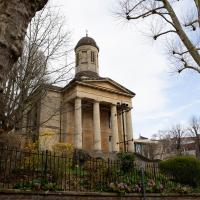
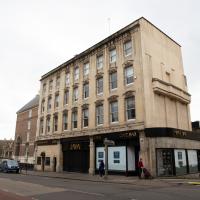
This is the place that still has some of the reused fixtures and fittings of the RMS Mauretania installed inside.
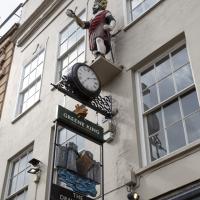
"Built in #Bristol in 1851, the Demerara was the 2nd largest ship ever successfully launched (after the SS Great Britain.) However, her maiden voyage was a catastrophe when the tugboat guiding her misjudged the tides and she was broken in the Avon. She was later salvaged for parts... For many years the Demerara's figurehead, salvaged from the wreck, stood above a shop in Steep Street (now Colston Street) and a replica of it can still be seen above the Drawbridge pub on St. Augustine's Parade." — via @WeirdBristol. Well worth clicking through to: tweet 1; tweet 2 to see some pictures.
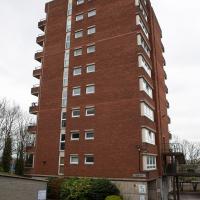
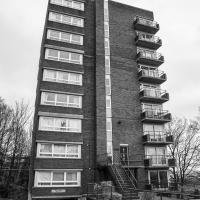
I bumped into my friend Lisa in town during yesterday's wander, and we decided to have a wander today, too. We managed quite a long ramble, starting up through Clifton and nipping down Park Row to investigate the two tower blocks I'd noticed popping up behind Park Street yesterday, then took in a few roads I'd not managed to get to before, including cutting through the grounds of Bristol Grammar School.
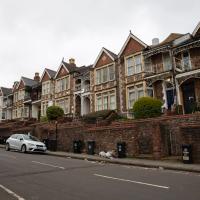
It's the little details that stand out for me on Woodland Road. I imagine it's prettier when it's not bin day, mind.
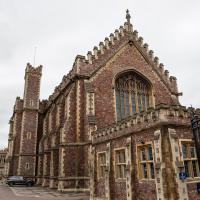
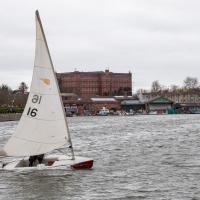
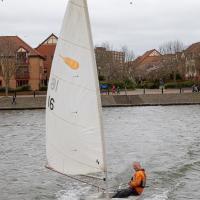
Hotwells Evening
29 Mar 2021
Just a little potter around Hotwells with Sarah and Vik. I didn't visit any new streets, but I liked a couple of the photos a lot.
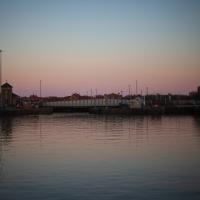
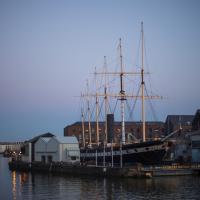
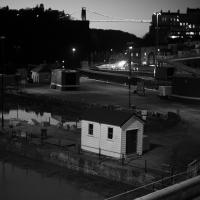
Coffee Run
31 Mar 2021
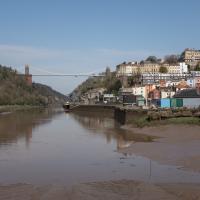
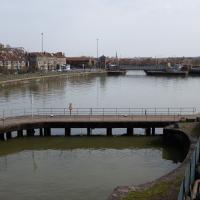
Not a literal run, but I didn't hang about, as I had a job interview to get to (I was an interviewer, not the interviewee, but you still have to be there on time...) Along the way to pick up a lunchtime coffee I mostly seemed to take photos of the high tide, though I also came across a bit of outreach work for small spiny mammals...
I noticed I'd missed a bit of Circular Road and Ladies Mile, and it was a nice evening for a sunset wander up to Clifton. There was something I recorded along the way, not photographically but in video.
Bristol Zoo, the world's oldest provincial zoo, has recently decided to close its Clifton site after 185 years of occupation, which means that the sounds of wild animals will no longer drift incongruously through this leafy Georgian area. They're moving everything up to their existing second site, The Wild Place Project near Cribbs Causeway. As I was wandering the Downs, I heard some fierce roaring noises, so I decided to see if I could get a little closer while they were still going on and record a sound that's soon to disappear.
I don't have a way yet to put video directly on this site, so here's a link to the video of my attempt to catch a bit of the zoo noises that I just popped on YouTube. It's sad that this might be the last time I hear such noises in Clifton.
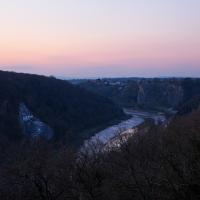
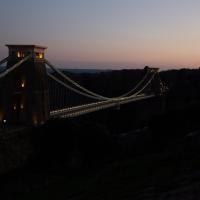
I still think of them as the "new" lights, but I think they were replaced in the early 2000s, so they're not that new.
An Evening Wander to the Gallows
06 Apr 2021
I'd originally intended just to pop up to the area around Alma Road, where I'd missed a few streets on earlier wanders. It was such a nice evening, though, I decided to extend my walk up to the very top of Pembroke Road, just outside my one mile radius, to take a few snaps of something intriguing I'd found in my researches.
I've driven, walked and jogged past the little triangle of land at the top of Pembroke road a great deal in my time in Bristol, but I didn't know that it used to be the site of a gibbet, in fact that the road itself there used to be called Gallows Acre Lane. According to the Durdham Down history trail, by Francis Greenacre (an excellent name for a Downs researcher!) among other sources:
...it was below this quarry near the top of Pembroke Road, once called Gallows Acre Lane, that a gibbet stood. It was sometimes occupied by those who had committed robberies on the Downs and was last used in 1783 to hang Shenkin Protheroe for the murder of a drover. Stories quickly spread that he descended from the gibbet at midnight every night and stalked through Clifton. Such was the alarm that his body was cut down and buried.
Also very close to this little triangle of land was one of the gates of the extensive turnpike system...
Anyway. Along the way I encountered a wooden tortoise and a real squirrel, among other things. It was a good walk, and more light in the evenings means I can move my wanders out of the ticking countdown clock of work lunch-hours and be a bit more leisurely.
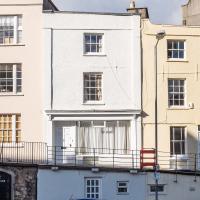
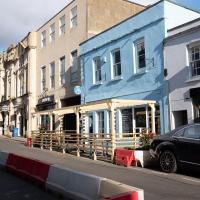
A great fish restaurant, clearly gearing up for some al fresco dining once the lockdown eases up a bit.
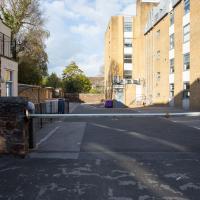
I only snapped this so I'd remember that I didn't miss this "street", but that it was a private car park.
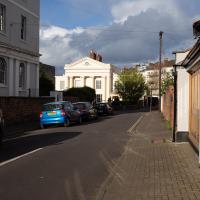
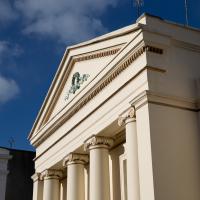
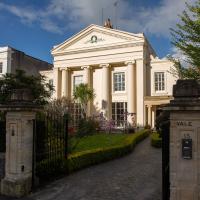
According to the listing:
A fine composition with an Ionic tetrastyle-in-antis temple front, with a full entablature and dentil pediment with scroll and wreath in the tympanum.
It's certainly eyecatching, and very much doing its own thing compared to the rest of the road. Built c. 1845.
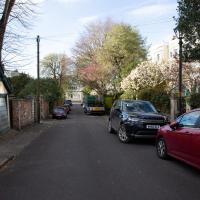
The actual street isn't much to look at. Unusually for Clifton, the front of one terrace stares directly at the back of another.
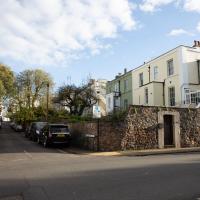
Well, I suppose that's actually the back of Pembroke Road, but it's on Buckingham Vale.
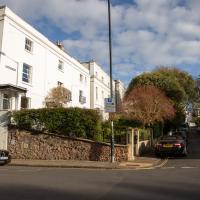
There are apparently some fine houses on Buckingham Vale apart from the posh neoclassical on the far end, but you don't get much of a view of them.
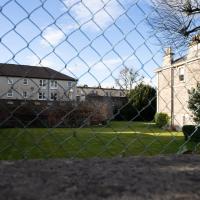
Okay, so it's not much of a secret, but it's hard to work out who it belongs to. There's a lot of big properties on Alma Road. I think this garden might belong to Laurel Bank, number 21, formerly Clark's Grammar School, apparently.
Interestingly, it seems that Clark's was a network of schools, including one not far from where I grew up in Ilford, on Cranbook Road. There's a website with some memories of the former Bristol school here, and one of the photos, titled "The Staffroom Window" is pretty much identical to my photo here.
I remember nothing of Clark's from my childhood, though they seem to be exactly the kind of place that my lot—Ilford County High—would have played cricket against, or something, so perhaps they got a mention in the occasional assembly.
Clifton Village Lunchtime Coffee
07 Apr 2021
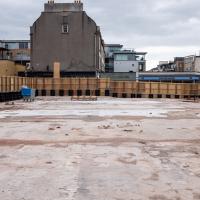
Unusually for my recent lunchtime coffee trips, I managed to find a new road to walk down: Caledonia Mews, which has a little entrance off Princess Victoria Street and runs between it and Caledonia Place. I've noticed it before a couple of times—if you look up from Princess Victoria Street you can see some of it, standing tall above the low buildings on the street itself—but until last night I'd not set foot in it, I think.
As well as focusing on this charming little mews, I looked in on the demolished site of the old WH Smith, and spotted what I think is part of the now-private-houses St Vincent Rocks Hotel that I'd not really noticed before, tucked away between Sion Lane and Sion Hill.
A London Wander in Southville
10 Apr 2021
There's a bit of Southville that I've been meaning to get to for some time, where the streets seem to take some strong inspiration from London. There's a Camden Road that crosses with an Islington Road, and a Dalston Road, even an Edgeware Road. For me these names are more evocative than the rather more exotic names I passed by to get there—Sydney Row or Hanover Place, say, because I've actually been to the places in London. The last time I was in Islington I saw Monkey Swallows the Universe play at The Angel, and I can't think of Camden without remembering a gondola trip with my friend Tara where a cheery youth played Beatles music for us on a saz...
I really liked this little area, with its mostly well-kept pretty houses and hints here and there of the creative side of the residents. It's arty and down-to-earth at the same time, and I wouldn't mind living there, I think.
On the way there I got the chance to walk through Underfall Yard for the first time in a while, and on the way back I had my first take-away hot food for many months, grabbing some crispy fried squid from the excellent Woky Ko at Wapping Wharf.
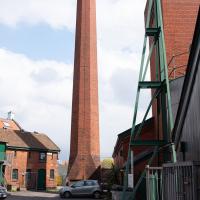
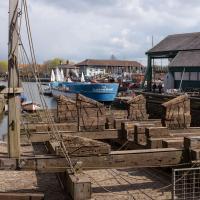
This is the first time I've been able to walk through Underfall Yard in months; it's been closed during the lockdown, and it's really reminded me how much nicer the route around the harbourside is when it's open. Cumberland Road is just dull.
Apparently the electric motor that still winches ships up out of the water on this "heave-up" slip (patented 1819 by Thomas Morton of Leith) dates from 1924, when it replaced the previous hydraulic system. I've never been there to watch a ship be hauled up, but it regularly deals with things as large as the Matthew.
The listing has this to say:
Patent slip and quay walls. Mid C19, restored 1888. Granite and Pennant rubble. 1 in 14 inclined slip with rails and timber cradle on wheels, drawn by an electric winch. Quay walls extend approx 50m along frontage of the Underfall Yard. HISTORICAL NOTE: Built on land reclaimed behind Jessop's 1809 Overfall Dam, originally part of the c1850 Nova Scotia Yard, purchased by the Docks Committee in 1880. Capable of raising a load of 250 tons. (Lord J and Southam J: The Floating Harbour: Bristol: 1983-: 65).
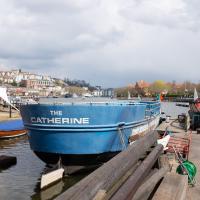
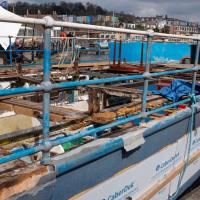
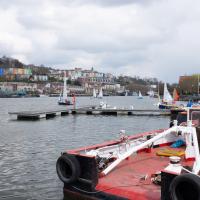
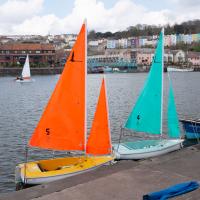
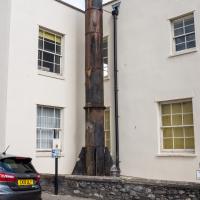
Or, I imagine, chimney. But the fins at the bottom really do make it seem quite rockety, and when I asked about it on Twitter someone did find a strong resemblance to some NASA hardware.
As to why Charles Hill & Sons apparently needed an industrial incinerator in the basement of their office, I've not yet found out.
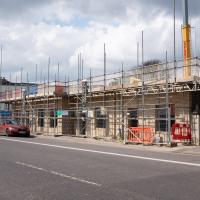
The former stone mason's place. Geograph has a good photo of what it looked like before. From what I can see from the planning website, it might be becoming offices, rather than the flats I'd assumed would emerge. I may have been mis-reading the vast array of planning applications, though; I suppose we'll see...
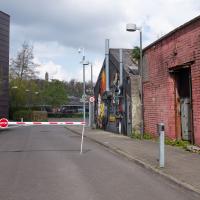
The door across this is normally closed. You can just about see Wallace and Gromit smiling on the side of the building, presumably not coincidentally, given that Aardman Animations' office is down there and up the driveway to the left.
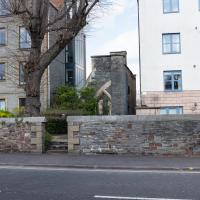
I think this may be a remnant of St Raphael's Church, whose adjacent almshouses for aged seamen are now the site of the flats at Perret's Court, just to the left there.
Ah! Yes, according to ChurchCrawler:
1853-9 by Henry Woodyer, closed 1878 following disapproval of the bishop and not reopened until 1893. Some war damage, the church was again closed and became part of a factory in 1953 and demolished 1954. Part of the W front still stands in the garden between two blocks of flats.
Long Bemmie Wander with Lisa
11 Apr 2021
My friend Lisa joined me again, this time for a long wander through "Bemmie". In fact, I tweeted recently using "Bedmo" as my abbreviation for Bedminster, and apparently there's something of a culture war going on. From what I can glean, the longer-term residents call it "Bemmie" and consider "Bedmo" a name made up by hipster gentrifiers.
I had no idea, but then I didn't grow up around here, and I don't live in Bedminster, and I'm not a hipster. I'm not sure I've ever gentrified anywhere, either; Hotwells was already quite gentrified by the time I arrived. I probably just lowered the tone a bit.
Anyway. Lisa and I entered Bemmie by the traditional toll gate (though actually you'd only have paid if you were coming from the Long Ashton direction, not merely nipping across from Hotwells) and then almost literally combed the streets to knock several new roads off my list of targets. Along the way we saw lots of street art, as you'd expect, and admired the area's panoply of gorgeous knockers.
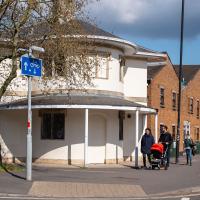
The reason Ashton Gate is called Ashon Gate is because it's the site of the former turnpike gate between Bristol and Ashton (now known as Long Ashton.) This is the actual toll house, still standing. "The Toll House closed in 1866 and was incorporated c1980 with Toll House Court", says the listing.
Toll House Court is now used by Second Step, a mental health charity, as part of their High Support Accommodation programme to combat homelessness.
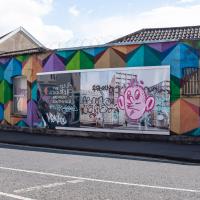
The new development on the site of the old brewery (which I visited once for a behind-the-scenes peek with some food- and beer-blogger friends) isn't going down that well with the neighbours.
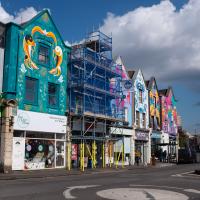
Work continues on the Six Sisters project, the "UK's largest female-led street art project".
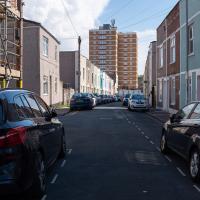
Though actually this very end of it appears to be Fairfield Place, a tiny continuation of the road around the next corner. That's Gaywood House in the distance; we'll be visiting its very odd doctor's surgery in a bit...
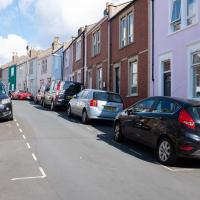
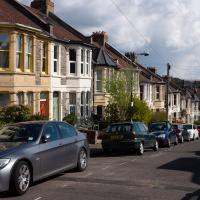
We move from Fairfield Place to Fairfield Road and the views open up. I was instantly reminded of my previous visit to the parallel Mount Pleasant Terrace.
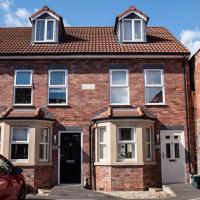
Normally when you're looking at a date on the side of a building in Bristol it's a little further in the past. It's interesting to see one so recent. I wonder if in a hundred years time people will stand here thinking about the dim and distant past.
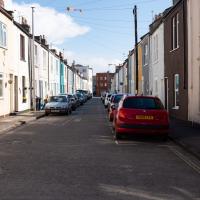

Not sure what this collection of buildings around a courtyard is at the end of Exmoor Street. This didn't seem to be its front entrance. Maybe I've seen it from the other side at some point, but I can't put two and two together...
Aha! After a bit of searching on a map, yes, I found them: this is actually the back of the houses in the elbow of Grenville Road, in the distance on this pic. It's just called The Mews, I think.
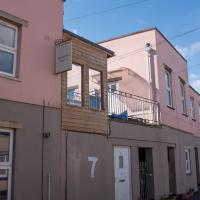
Better Look at an Extension
14 Apr 2021
Apart from a lovely coffee and a slice of Victoria sponge from Twelve, there weren't any new sights on this little lunchtime jaunt except for a slightly better look at the long raised extension at the back of the St Vincent's Rocks Hotel, where I at least got to see the arches it's raised up on. I also got a fair bit of exercise by walking up the Zig Zag to get there, and saw far more people out than I have in months, what with the lockdown having just been significantly lifted. As I walked past The Mall pub they were turning people away from their already-full garden, and the (outdoor) cafe tables were pretty full up.
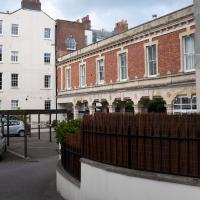
I only found out that this was a raised extension when I read the listing after snapping the last photo. Today I ventured as close as I could and got to glimpse a bit of the rather nice support arches.
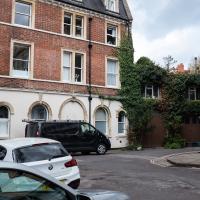
I'm guessing there used to be a grand front door, but then later the hotel annexed the building and didn't need it any more? But it's only surmise.
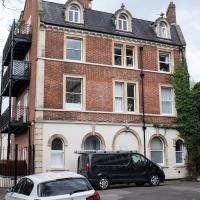
These aren't listed per se, but they're on the "local list" and named as 8-14 St Vincents Rocks, so I think that confirms that it used to be part of the hotel.