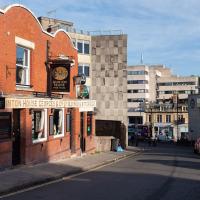
Tagged: vehicle
The more I research it, the more I find that Hotwells had far better transport links back in Victorian and Edwardian times than it has today. Along with buses that went to more useful places than the City Centre, there were trams, the funicular up to Clifton, the landing stage for paddle steamer services and two railway stations all within easy walking distance of me.
Today I took a day off work as preparation for doing the bookkeeping for my tax return1, and took a wander along to the site of what would have been my nearest station, Hotwells (or Clifton, as it started out in life), nestled in the shadow of the suspension bridge, the Bristol terminus of the Bristol Port Railway and Pier.
From there I wandered down the Portway, following the original line, until I got to the area around Sneyd Park Junction, where the tunnel from the slightly later Clifton Extension Railway joined up with this originally-isolated BPR line. Then I headed up to Clifton through the "goat gully" at Walcombe Slade, seeing the few above-ground bits of evidence of the tunnel (which is still in regular use) along the way.
It was a lovely day, and a good walk, and it was interesting to daydream of the times when I could have walked a few minutes from my flat down to Dowry Parade, caught a short tram ride to Hotwells Stations, and then headed from there to Avonmouth, perhaps even to board a transatlantic passenger service. The completion of the Clifton Extension Railway that linked the Avonmouth station with Temple Meads made relatively direct transatlantic travel from London via Bristol possible, with passengers travelling up from Paddington to Temple Meads, on to Avonmouth on the Clifton Extension Railway and Port Railway and Pier line, then perhaps catching a Cambpell's paddle steamer—which sometimes acted as tenders for large steamers—to a larger ship that was headed out for Canada, say.
1 I've learned that the best approach is to take two days off and deliberately do something that's not my bookkeeping on the first day, as otherwise I just inevitably end up procrastinating and feeling guilty on the first day no matter what. I have an odd brain, but at least I'm learning strategies for dealing with its strange ways as I get older...
2 Information mostly gleaned from Colin Maggs' The Bristol Port Railway & Pier and the Clifton Extension Railway, The Oakwood Press, 1975.
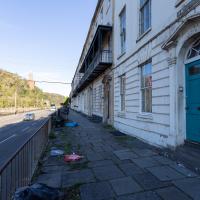
St Vincent's Parade looking a bit more run-down than normal. This street, like the one I live in, was built as lodging houses for visitors to the hot wells. I imagine it was quite a pleasant aspect before later developments like the building of the Portway.
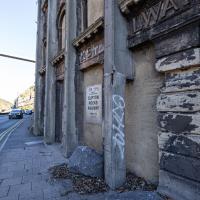
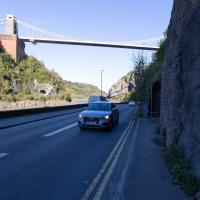
One of the many problems with the Hotwell Road and Portway is the complete dearth of places to safely cross this road, with a varying number of lanes and a speed limit that hits 50mph for stretches.
You can stand for a very long time looking both ways before taking your life into your hands and scurrying across. It took me quite some time to dash to the other pavement at the point where this one runs out and your only choice is to head up the Zig Zag or cross.
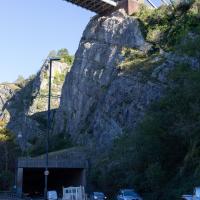
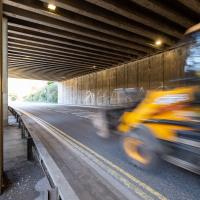
The acoustics are quite something. This is the traditional point on the Bristol Half Marathon where someone inevitably shouts "Oggy oggy oggy!" thus starting the familiar back-and-forth. Of course, it's closed to traffic on that morning, so you can actually hear yourselves shout.
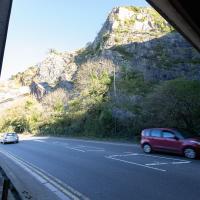
It doesn't look like much, because it isn't much any more. However, this used to be the site of Hotwells Station (formely Clifton Station, before the opening of Clifton Down and the continued existence of Clifton Bridge meant the proliferation of stations with "Clifton" in the name warranted some disambiguation.)
Nestled in this little nook underneath the suspension bridge, it was the Bristol terminus of the Port Railway and Pier, whose aim was to avoid increasingly big ships having to wait for the right tides to come into Bristol and unload. They ran a line from Hotwells Station, here, to a deep-water pier at Avonmouth so the ships could moor there regardless of the tide, and transport cargo and/or passengers to and from Bristol, with this being the Bristol terminus. Work started at Shirehampton in 1863.
Originally this was an isolated line, but it was later hooked up to the rest of the rail network by the Clifton Extension Railway, and a tunnel under Clifton. That's a connection we'll be exploring a bit today, at least with a few of its visible above-ground bits.
The line saw its biggest use during the First World War, as dockers, munition workers, hospital trains and so forth ran back and forth between Bristol and the port. They even added an entire extra platform, Hotwells Halt, just down the road, to cope with the increase in traffic, platform space being at something of a premium in this unexpandable little nook, which runs from the bridge to the first of two tunnels in the cliff face to head onward to Sea Mills.
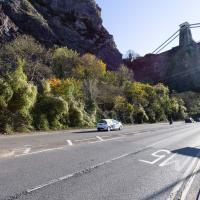
From the other angle. It was a single short platform, squeezed in to this little inset in the cliff face. Here you'd have been looking at the station wall, with the entrance and office at the far end. In this photo on Pinterest you can see the three tracks—the main platform track, a run-around loop so the engine could make its way around the carriages and onto the other end of the train, and a siding. At the far end is the station master's house, just behind a turntable that would have been used to turn the engine fully around for the return journey.
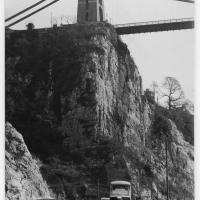
Here we see the Portway road, presumably fairly shiny and new, after many, many things, including the railway line from Hotwells to Sea Mills, were removed to make way for it. As you can see, they've done a splendid job of redeveloping the space where the station was into a little mini-park area, back in the day when the traffic wasn't a constant rush of noise and fumes and you didn't have to scamper across like you were playing a game of Frogger. It might well have been a pleasant place to sit. It certainly wouldn't be now.
Also, guess what there is fencing in the park area? Yes, some nice iron railings. I have no idea whether these are same ones I found—today's seem in surprisingly good nick considering this photo would have likely been taken almost a hundred years ago, and also how many railings were torn up during WWII.
This photo was taken before the war, as you can see a tram still running in the background—a Luftwaffe bomb took the tram system down in 1941 and it was never replaced. It also was obviously taken after 1926, as the Portway opened to traffic on 2 July 1926, having cost £800,000 to build, about £47m in today's money. So, that fixes it to a 15-year period, I think, but I'm not enough of a historian to be able to pin it down further.
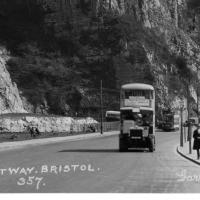
Bottom section of the postcard. I like the way there's a bus and a tram in it, but I'd quite like the bus not to be there so we can see the whole of the former station site. Motion blur makes it hard to figure out the bus and tram details.
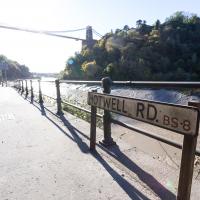
Not many people realise that it's still the Hotwell Road even out this far. It only becomes the Portway at the junction with Bridge Valley Road.
Bower Ashton is an interesting little area just south of the river from me—in fact, the Rownham Ferry used to take people over from Hotwells to Bower Ashton, operating from at least the twelfth century to around the 1930s.
It's a strangely contradictory little area, with a cluster of old and new houses sandwiched in between the busy A-roads and significantly more industrial area of Ashton and the bucolic country estate of Ashton court roughly east to west, and also between Somerset and Bristol, north to south.
I've been around here before, mostly poking around Bower Ashton's arguably most well-known bit, the Arts faculty campus of the University of the West of England, but I'd missed at least Parklands Road and Blackmoors Lane, so I initially planned just to nip across briefly and wander down each in turn. On a whim, though, I texted my friends Sarah and Vik in case they were out and about, and ended up diverting to the Tobacco Factory Sunday market first, to grab a quick flat white with them, extending my journey a fair bit.
To start with, though, I nipped to a much more local destination, to see something that you can't actually see at all, the Gridiron...
(I also used this wander as a test of the cameras in my new phone. I finally upgraded after a few years, and the new one has extra, separate wide and telephoto lenses compared to the paltry single lens on my old phone. Gawd. I remember when speed-dial was the latest innovation in phones...)
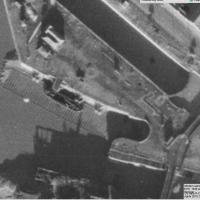
Image from 1946 Aerial layer of KYP Bristol/English Heritage.
As you can see, it was pretty big, and clearly still in use in 1946...
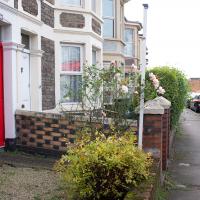
Most of the front gardens on this little stretch retain what's presumably the original garden walls, all rather nicely put together in a chequerboard pattern of bricks.
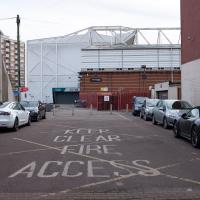
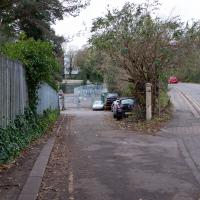
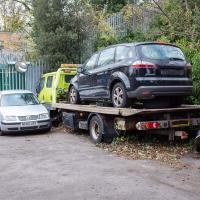
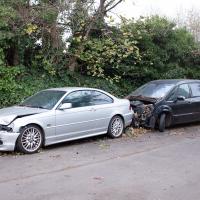
One of the businesses on this little estate of random things is Rob Perry Salvage, which presumably explains the odd row of wrecked cars parked in the access lane.
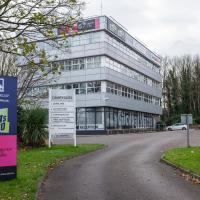
The South West Broadcast Centre for Celador Radio, it says. That certainly explains the big dipole antenna on the roof. I haven't heard of Hits Radio, but I suppose I'm generally more your Radio 4 type.
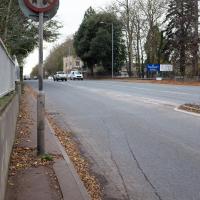
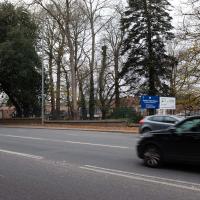
This happens to me all the time in this area. I try to get somewhere by aiming in the most obvious direction, and the pavement just peters out leaving me with the options of either going back the way I came or dashing across four or five lanes of traffic.
The entire area is very pedestrian-hostile. I assume the parents and kids making their way to the school opposite know all the right routes to avoid this kind of problem, but as a visitor it's very annoying.
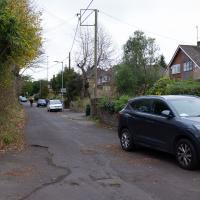
The Gridiron and Bower Ashton Part Two
03 Dec 2021
On my last wander, to Bower Ashton, I was intending to knock Blackmoors Lane off my list "to-do" list, but got a bit diverted. I also took a little look into the history of the Gridiron, once a cheaper alternative to dry dock that was nestled just south of North Entrance Lock.
Today I had to go to send a parcel off somewhere, so I decided on going to the North Street Post Office via Blackmoors Lane. I didn't have much intention of anything else, but as luck would have it I walked out both at low tide and also as some lockkeepers seemed to be having a bit of a training session, and one of the more senior people was (a) happy to answer a few random questions on the Gridiron and (b) actually knew a lot about it, as Gridiron maintenance had been one of his jobs, more than twenty years ago...
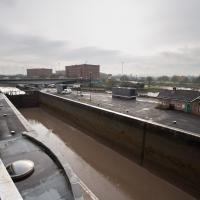
If you look at the lock wall, about halfway between the lock gates and the inset ladder, you'll see a little square hole. I had no idea what it was for until today, and I had no idea I was going to find out...
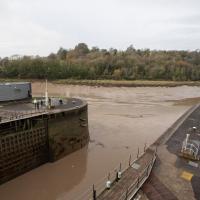
There were various people on the other side, I got the impression it was some kind of training session, perhaps. Later I'll have a quick chat with the man in the high-vis jacket over there.
In the meantime, I do always enjoy seeing the giant gridded lock gates uncovered by a low tide.
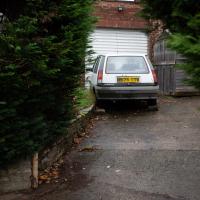
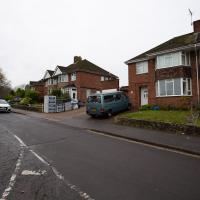
Here it is: my target road to tick off the list.
These are the houses in that archive photo.
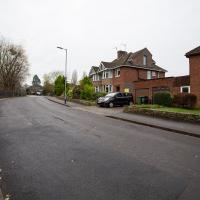
Some of the houses along here are definitely 1950s, as you can hear in this oral history, where Eileen Pimm describes the process of watching the house she still lives in being built in 1957.
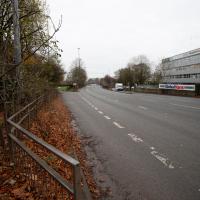
As usual around here, I want to go that way but there's no crossing and no pavement, so we'll head back through this little green and head for that bridge you can see that spans the left-hand lane here.
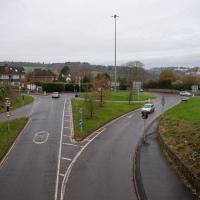
Considering I didn't know there was a historical photo to copy when I shot this, it's not too far off the same viewpoint.
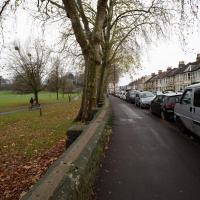
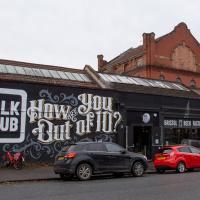
This isn't so much of a photo as a reminder to talk about the amazing malty smell that wafts out and inhabits this whole stretch of North Street when there's some brewing going on. Presumably it's the days when they're boiling wort.
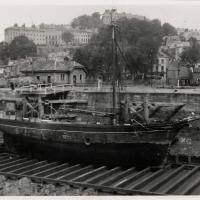
Here's the best photo of the Gridiron I've found so far: Item PG/3596 in the Isle of Man Photographic Archives.
The photo is dated 14 May 1946 and by amazing coincidence, looking at the boat's configuration and position, I think it may be exactly the same boat that's in the 1946 aerial photo from Sunday's wander.
Edit: later I found this colour picture of the Gridiron on Jem Southam’s Instagram feed, which was a lovely surprise!
A Door, a Square, a Few Night Shots
04 Dec 2021
I didn't take many pictures on this quite long wander, partly because Lisa and I wandered across to Bedminster via Bower Ashton, which I've snapped quite a lot of on the last couple of walks, and also because we lost the light fairly quickly, though spending a half-hour drinking mulled wine in the Ashton might have had a little to do with that...
Before we left Hotwells I wanted to visit a door I'd heard about on Cornwallis Crescent and also take a little look at a couple of houses in Dowry Square to consider the 1960s regeneration of Hotwells.
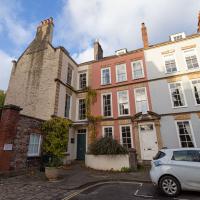
I've snapped this before, too: the home of Humphry Davy, but here it again for context, as it's currently on the market for £1,200,000...
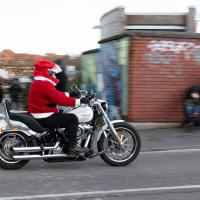
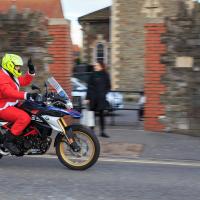
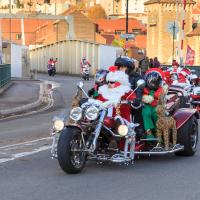
Okay, away from our little Dowry Square explore and across to Bower Ashton. Along the way, we saw many, many Santas. On motorbikes. As you do.
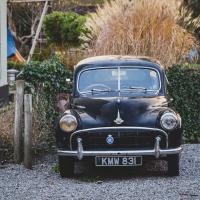
Given how much Bower Ashton feels like an anachronism, walking past this wasn't that surprising. 1954 Morris Minor, I think.
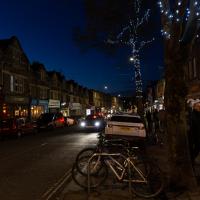
Night fell fairly fast on our way from our mulled wine at The Ashton to North Street to have a poke around the stock of Storysmith bookshop in their new location—they've just moved here from much further east along the road.
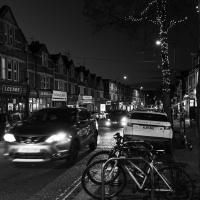
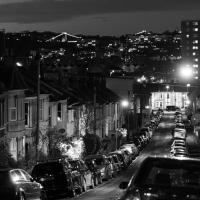
The last Bedminster shot of our walk. There wasn't much light for photography by this time.
A Water-Based Wander
11 Dec 2021
I woke up on this Saturday with a headache, feeling like I'd not slept at all. As well as that, I'm still in some pain from the wisdom tooth extraction I had a few weeks ago. I moped about the flat for a while and then decided that the best thing to do was to force myself out on at least a small walk to get some fresh air and coffee.
Was there anywhere I could walk locally that I'd never been? Actually, yes! Although it's not a road, and I didn't walk it, there is actually one route that I've not travelled so far in my wanders. And it even had coffee near its far end...
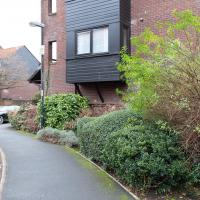
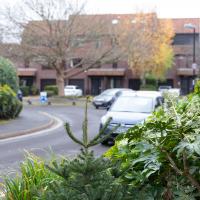
It took me some time to realise that it's the well-planned and well-cared-for plants around this estate that really improves it as a place. It's less of a fairly bland 1980s housing estate, and more of a rampant shrubbery that just happens to have a fairly bland 1980s housing estate inside it. There's a huge variety of greenery, a lot of shrubs and trees and some lovely well-kept individual gardens to boot.
It's also been quite cleverly thought out with a view to defending against such dangers as tagging—much of the ample wall-space is protected by cubic yard upon cubic yard of dense and often prickly planting.
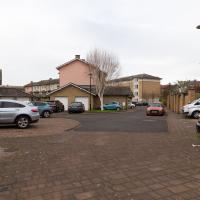
I came this way on a whim, assuming that I'd be able to find my way back out to the Hotwell Road. At this point we've moved from Rownham Mead to Pooles Wharf Court, who always feel like they're a bit more protective of their space, so a quick exit seemed only polite...
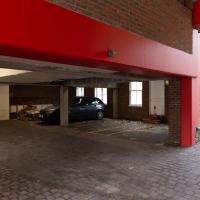
I've walked down this alley once before, but in the other direction, so I don't think I've ever noticed this before. This is a car park, but ...
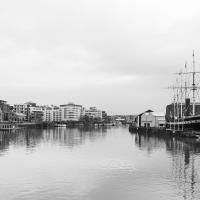
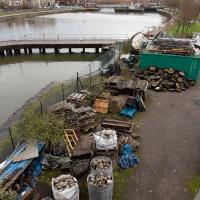
I'm heading for a coffee from Imagine That, in the Bristol Marina. Which is on the other side of harbour. Normally I'd have walked down that side to get there, but today...
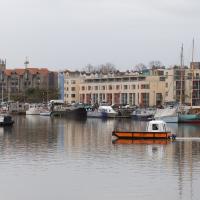
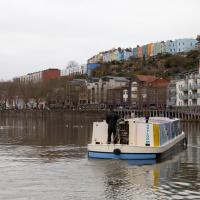
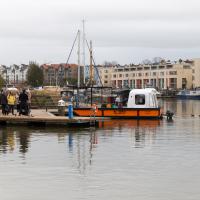
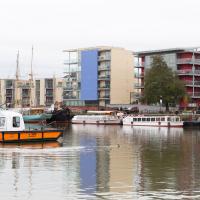
First, though, we'll take a poke around the Harbour Inlet. Here's Skyloom just pulling away from the pump-out station.
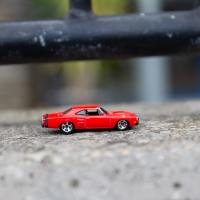
Nearly trod on this as I was heading down the steps. Popped it safely on the side in case the owner comes hunting. Dodge Charger, maybe? Some kind of American muscle car, anyway.
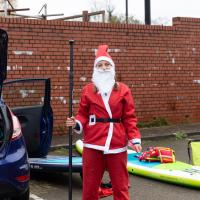
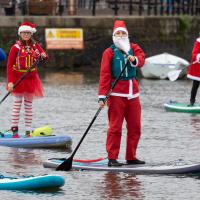
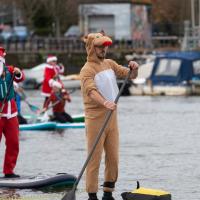
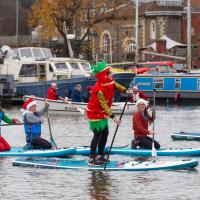
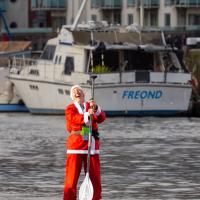
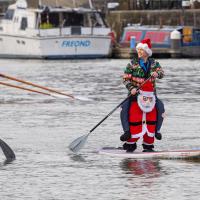
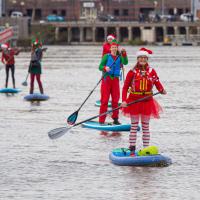
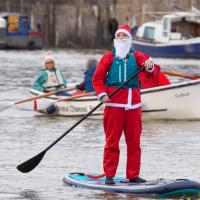
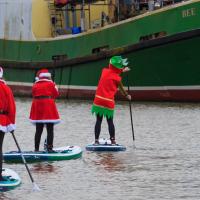
My friend Lisa texted me to see if I wanted to pop down and take a photo or two of the event she was taking part in: Santa SUP. SUP Bristol organise stand-up paddleboarding on the floating harbour, and their annual Santas-on-paddlboards event is quite the sight.
On the way there, I grabbed a historical photo I'd been wanting to recreate for a while of the shiny and new Cumberland Basin flyovers back in 1965, because I reckoned I could fit finding the same viewpoint into my outbound journey. Also, after having only used it on a wander for the very first time yesterday, I managed two crossings in the cross-harbour ferry today to get to the best locations for snapping the paddleboarders...
So, then, this wander is mostly a bunch of photos of paddleboarding Santas. Tis the season... Enjoy!
A Constitutional to Burwalls and Back
21 Dec 2021
The recent lack of posts here is mostly due to my feeling very run down following having a couple of wisdom teeth extracted. Having had an emergency appointment yesterday1, hopefully I'll be on the mend now, though it does mean I'm on the kind of antibiotics where you can't touch alcohol for the whole of the Christmas period. I have tried to keep myself a little distracted from the pain by working on the nuts and bolts of this website—you should notice that the front page loads rather faster now than it used to, and that there's a shiny new statistics page that I'll probably be continuing to work on. Oh, and you should find that the tags below the photos are now clickable and will take you to a page of all other wanders that have photos with the same tag.
Today I felt like I needed to drag myself out of the house, but I didn't want to go too far, and I needed to get to the Post Office up in Clifton Village to post a Christmas card (spoiler for my parents: it's going to be late. Sorry.) As luck would have it, idly looking at the map I spotted that I'd missed off a section of Burwalls Road in the past, and that's basically one of the long-ways-round to Clifton Village, crossing the river to Rownham and walking up the hill on the Somerset side before coming back across the Suspension Bridge.
As I was heading for Burwalls Road I decided to make Burwalls itself the focal point of the walk, but unfortunately the mansion grounds are private and the place is hard to snap. Still, at least it gave me a destination. Burwalls was the mansion built by Bristol press magnate Joseph Leech, who I've mentioned before after buying a vintage book he wrote on a previous wander. There's a good article about the house on House and Heritage which has some photos from angles I couldn't ever get to. (Well, maybe with a drone, but it seems like the kind of area where they may be kitted out for clay pigeon shooting, so I probably wouldn't risk it.)
1 My dentist admitted that she probably needed to keep her internal monologue a bit more internal after we started the appointment with her staring into my mouth and immediately saying, "oh, *that's* weird." These are words one doesn't want to hear from a medical professional.
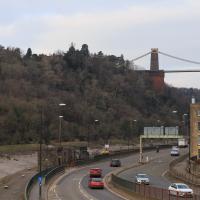
As my plan was to knock off the remaining section of Burwalls Road, my first photo is the small segment of Burwalls itself that you can see from near my house. Burwalls is the mansion on the hilltop, peeping out about halfway from the left edge of the photo and the Suspension Bridge.
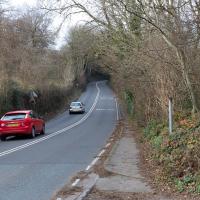
Speaking of major roads, this is why you wont' see a track down the actual road here on my maps: no pavements. On the plus side, there's the forested path with the amazing name of Dead Badger's Bottom starting on my right, and a little raised off-road walkway in the trees on the left, starting about where you can see the speed limit sign.
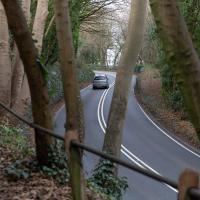
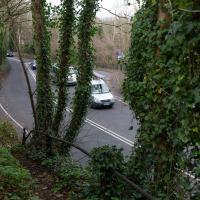
A delightful little return to the road, which peters out in a disconcerting rough slope in between two blind bends on a busy road with no pavement. It's not spectacularly pedestrian-friendly over here. This might explain why I never walked down the bit of Burwalls Road opposite. The forest path up Dead Badger's Bottom1 on the far side of the road skips the first section.
1 No, I will never get tired of saying that.
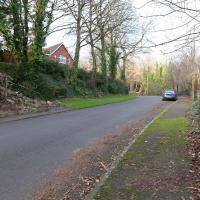
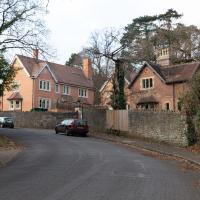
The Burwalls site is split into two halves, according to some of the estate agents' details I've looked at. This read section has some more modern-looking places where you can buy an entire house, if you're rich.
The mansion itself has been divided up into "lateral apartments". If you don't know what those are, you probably can't afford one.
I was just about starting to feel better—the antibiotics seemed to have kicked in for my dental issues, and it had been some days since I'd left the house, and I was at last starting to get itchy feet. So, a wander. But where? Well, there were a few industrial bits near Winterstoke Road in the Ashton/Ashton Vale areas of Bristol that needed walking. I knew they were likely to be quite, well, unattractive, frankly. So why not do them while I wasn't feeling exactly 100% myself? Maybe it would fit my mood. Hopefully you're also in the mood for a bit of post-industrial wasteland, for that's what some of this feels like...
Then, at the last minute, I thought again about the Bristol International Exhibition—I've got a book about it on the way now—and that gave me another goal, which could just about be said to be in the same direction, and I decided to walk significantly further than my normal 1-mile limit and try recreating another historical photo...
Sadly I don't know much about the Ashton area; it's just on the edges of my mile and I rarely have cause to go there. It's brimming with history, I'm sure: the whole South Bristol area rapidly developed from farmland to coal mines to factories to its current interesting mixture of suburbs and industrial work over the last few hundred years. As a more working class area less attention was paid to it by historians, at least historically-speaking, than the Georgian heights of Clifton, and much of it has been knocked down and reinvented rather than listed and preserved. I see here and there some of this lack is being addressed, but I'm afraid I'll be very light on the history myself on this wander, as most of my usual sources aren't throwing up their normal reams of information as when I point them at Clifton, Hotwells or the old city.
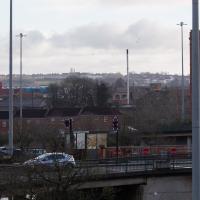
This may be somewhere around my actual destination today, though perhaps a little too much toward the east.
The buildings and green space on the hill in the background are the Knowle West Health Park. I'm pleased to have figured this out by using an OS map and a ruler and projecting a line from where I'm standing through the Tobacco Factory flag that you can just see poking up from Bedminster (you can see it on the corner of the building in this earlier pic](https://omm.gothick.org.uk/image/7175), then looking for densely-packed contour lines further out of town. Very old-school, but it worked!
I'm probably heading in more of a Bedminster Down direction. It's a similarly elevated green space further west, which is hidden behind the bond warehouse on the right in this pic.
This area continues to be blighted with ugly and neglected-looking infrastructure. We're just on the edges of Ashton Vale, which is among the 30% most deprived areas in the country. At the north of my one-mile radius we have Clifton, among the least 20% deprived. Source: UK indices of deprivation.
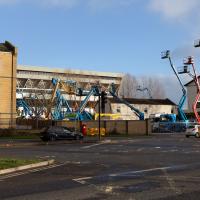
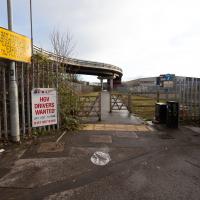
Interesting sign up on the left there. This isn't talking about the Metrobus line, which as you can see rises above the crossing, but about the MetroWest train plans, I think, which would see a revivial of the old Portishead line. That's not happening until at least 2024, but clearly the business park is fearful of the impact.
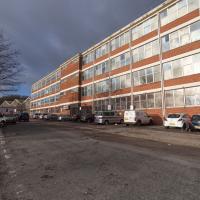
"Hello? Yes, I'd like to order a cubic mile of bland industrial building, please. No, anything'll do."
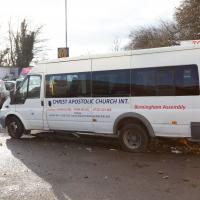
I'd really hope for at least a chartreuse microbus for carrying long-haired friends of Jesus...
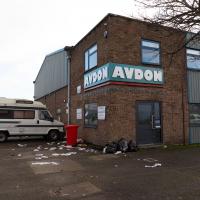
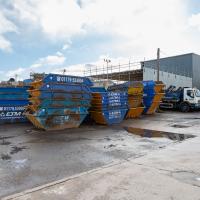
Don't say I never take you anywhere. Of all the places I've wandered, I think I can truthfully say that this is best candidate for the "arse end of nowhere" award. Welcome to the ETM Recycling Centre at the end of Ashton Vale Road.
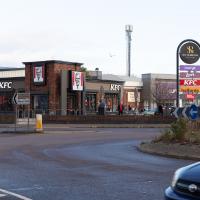
I appear to have walked to a drive-thru KFC. Rookie error. I think the last time I was in a KFC was at least twenty years ago. I have nothing against fried chicken per se; it's just that on the few occasions I've had it since then Miss Millie's has been more convenient.
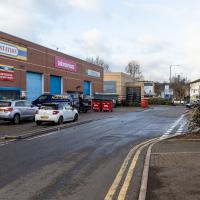
See, there's a reason I've been putting off these roads. I didn't think I'd find much to excite, or that was aesthetically pleasing, and here I am, proved right.
A Random New Year's Day Wander
01 Jan 2022
I picked a fairly arbitrary reason for a wander today. Really, I just wanted to do a New Year's Day wander just to get out of the house and to set a precedent for the year to come.
My ostensible reason was to investigate what looked like a road on my map that quartered the lawn in front of the Ashton Court mansion. As it turned out, this is just a muddy footpath/desire line similar to a half-dozen other tracks nearby, and must be some kind of bug or misclassification with the mapping system I'm using, but that's not important. What's important is that I went for a little walk on the first day of the year. As a bonus, I did happen to wander down a couple of sections of new footpath, so technically I broke some new ground too, which is nice.
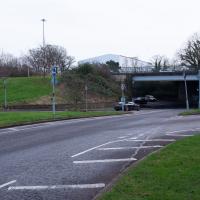
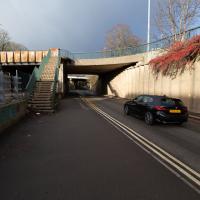
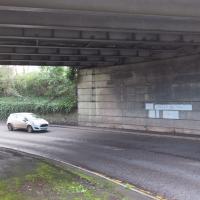
Last time I walked over the top of this I noticed that there was at least a vestige of pavement along the side of the underpass, so given the quiet New Year's Day traffic I figured I'd try getting over there and walking under for the first time in my life...
Quick Clifton Jaunt Finishing with Southville
09 Jan 2022
It's been pretty dismal recently, weather-wise, so when Sarah called up to say that she and Vik had just left the swimming pool at the student union building up in Clifton, and would I like to join them for a trip to the Last Bookshop, also known as The £3 Bookshop, for reasons you can probably deduce, I leapt at the chance.
Not many photos on this walk, but I did manage to get down a little road I'd never been to before, basically just the access road to a car park at a block of flats, but it was on the map looking all tempting, so I figured I'd knock it off the list as we were passing.