Tagged: vehicle
Shops, Hedgehogs and Cows
06 Jul 2021
I really only took the GPS and camera on a "just in case" basis, as I knew I was only going for a coffee in Greville Smyth Park along a well-trodden path this lunchtime. Still, I saw a few new things along the way, so I figured it was worth uploading the handful of photos I took...
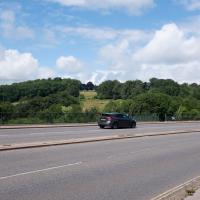
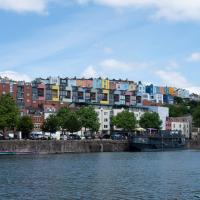
Dead centre of this picture is a herd of cows, though I imagine you'd be hard pressed to find them once this picture is shrunk down a bit for the web. They were more obvious to my naked eye, wandering around on the hill. You don't often see cows from town.
I thought that was part of Ashton Court's Red Deer Park, but perhaps they're diversifying...
Of course, in the old days you'd have seen plenty of cattle near here in the city. Just behind the Pump House were the cattle sheds and an abattoir that used to stand where the Rownham Mead housing development is now. You can see them in one of the pictures on the City Docks website, here.
A Cliftonwood Revisit with Lisa
10 Jul 2021
Lisa had a couple of hours to spare before going up in a hot air balloon (exciting!) so we went for a quick local walk, revisiting a bit of Cliftonwood we've seen before, exploring the secret garden I'd visited before that I thought she'd enjoy (I didn't take any new photos there) and then pushing on to another garden, Cherry Garden. Last time we passed this way, I'd noticed the gate, but we hadn't gone in as I'd assumed it was private. I'd since found it on CHIS's list of communal gardens in Clifton, so I wanted to have a look inside this time, and try to figure out whether it was private-communal or public, and possibly Council-owned, like several of the other gardens in Clifton.
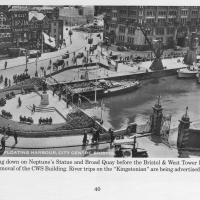
Photo taken from the book Bygone Bristol: Hotwells and the City Docks, by Janet and Derek Fisher.
You can see the gate from the previous photo at the start of Narrow Quay. Plenty of other changes in the area, too: the statue of Neptune stands at the head of the water; there are no Cascade Steps yet; cranes still stand on Broad Quay, and you can just about tell that there's still a main road running right across the middle of Queen Square in the distance.
The gate stands half-closed; presumably before the E and W sheds were converted into the cinemas, bars and restaurants of the Watershed and other publically-accessible attractions there was still some need to keep the (working) dockside a little more secure, and I'm guessing it might have been locked at night.
The gates are listed and have apparently been there since 1894.
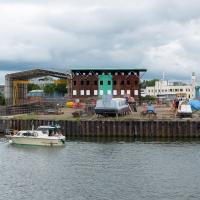
The boatyard seems quite quiet at the moment, but there's definitely work still going on—as you'll see from Mike Taylor's little Instagram video here, where you can see them lifting his boat out with the 50-ton capacity travel lift, ready for a lot of work to be done, just a few weeks ago.
Lunchtime Zig Zag Climb
13 Jul 2021
A snappy little trip up the Zig Zag to the shops. It's a steep old route, the Zig Zag, going from just over river level to about the height of the suspension bridge (101 metres) in a compact switchback of a footpath.
I was too busy struggling to breathe to take many snaps of the actual Zig Zag (I've been trying to make it up all the way without stopping the last few times, but I've not quite managed it yet). I did at least take a few snaps either side on this quick lunchtime jaunt to fetch coffee (Coffee #1) and a sarnie (Parsons) from Clifton Village...
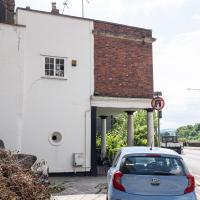
But I don't think it's the original end -- if you check this picture from a history pamphlet I posted on Twitter you'll see that it looks like the Colonnade used to curve around rather more, and there's an even better view on this drawing from the British Library collection of Hotwell Parade. Looking at the historic basemap layers there on KYP it certainly seems like sometime between 1855 and 1874 (both Ashmead maps) the first couple of houses in the terrace were lopped off, leaving only numbers 3, 4, 5 and 6. I imagine they were shaved off at the same time as the second Hot Well House was demolished, which was in 1867. It used to stand on Hotwell Point, sticking out into the river, and the whole lot was removed to ease navigation.
I've never actually looked at the Colonnade door numbers to see if they're still like that—I'll try to remember the next time I pass.
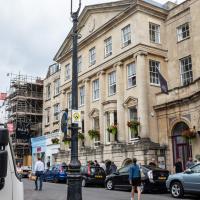
One of many fine old lamp posts in Clifton Village. The late, great Maggie Shapland apparently used to keep an eagle eye on them and make sure they were returned if they were ever carted off for repair. The Clifton Club lurks grandly in the background.
Although you may immediately think "gas lamp", here's an extract from Electric Arc Lamps in Bristol by Peter Lamb, published as a supplement to the Histelec News, newsletter of the Western Power Electricity Historical Society:
In looking at old photographs of late Victorian or early Edwardian scenes, many of you may have noticed very decorative street lights gracing the foregrounds. These lamp standards had long cylindrical shapes above the lamp, which distinguished them as being electric arc lamps. You may have wondered, like me, what was inside these housings. These cylinders, known colloquially at the turn of the century as “chimneys” were not chimneys at all, but housed the complex mechanisms regulating the carbon electrodes. Only two lamp standards of this distinctive design remain as street furniture on the Bristol streets and these are situated at The Mall, Clifton Village.
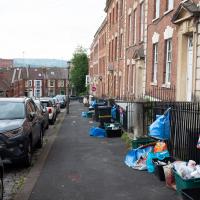
Apparently one of the reasons that collections are being missed (this lot's been on Albermarle Row for nearly a fortnight) is a shortage of drivers. There's a general HGV driver shortage at the moment, as well as a backlog of testing for new drivers.
Autonomous Vehicle
14 Jul 2021
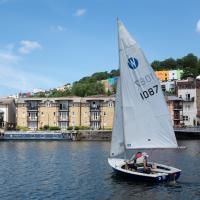
As it turned out, I didn't manage to get a coffee on my lunchtime coffee trip, as Imagine That were briefly shut down by a Covid-19 exposure notification (false alarm, it seems.) On the plus side, my trip was made worthwhile by spotting a couple of people from the University of Bath Mechanical Engineering Department testing an autonomous body-finding catamaran, which isn't a phrase I was ever expecting to write...
Pastures New!
17 Jul 2021
Okay, not much in the way of actual pasture to be had in Bedminster these days, like most of Bristol, but I did take advantage of the current rather toasty weather in Bristol to go and sit under a tree in Greville Smyth Park to read a book for a while before firing up the GPS and taking a little detour around some back streets of Ashton and Bedminster rather than going straight to Coffee #1 for an espresso frappé. This is the first walk in a while where I've actually crossed off an entire new street (the frankly unexciting Carrington Road) as well as exploring a couple of back alleys, just because they were there, really. Along the way I spotted a few examples of graffiti of various qualities, including a live work-in-progress by SNUB23 on Ashton Road and the finished Six Sisters project on North Street.
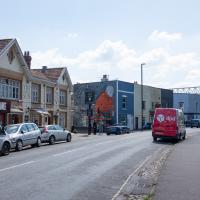
It was actually the sound of Six Underground, the astoundingly good Sneaker Pimps number, coming from this direction that caught my ear before the in-progress mural caught my eye, but they both had the same source, as it turned out...
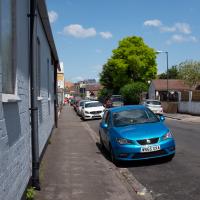
I'd noticed I'd missed this end bit of Durnford Street in previous wanders, so on my way to knocking off some full-length roads (and alleyways, as it turned out) I took a snap. It's not very prepossessing.
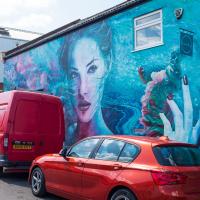
...on Bendy Studio, by Nick Harvey. Shame I couldn't get a clear shot. I do like a Siamese fighting fish...
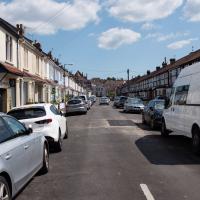
Not much to say, really. The strange mock-Tudor upper halves of the right-hand-side of the street were about the only distinguising feature, and personally I'm not sure that's distinguishing in a good way.
I've clearly sniped this one from the end of the road on a previous pass, but this is definitely the first time I've actually walked the length of it.
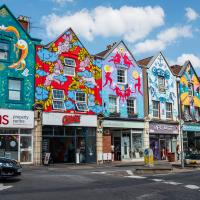
This was a work in progress last time I passed. Now all Six Sisters of this female-led graffiti project are finished and fair glowing in the sunshine.
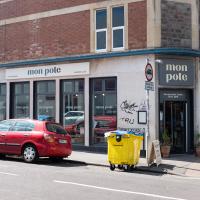
This Scandinavian design shop has replaced the Hobbs House Bakery Cafe. While I enjoy Scandinavian design, anyone who's looked at my interior design and then looked at my actual exterior can fairly swiftly work out that I enjoy bread rather more. Still, I can get my hands on a Sherston Overnight White (best loaf in the world for toasting, according to both Hobbs House and to me) elsewhere, and clearly Mon Pote needed the extra space—this location is four times the size of their previous one, which was also much further up the road.
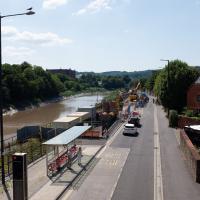
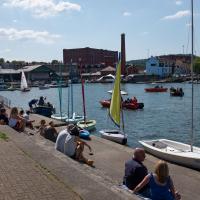
On a gorgeous summer's Saturday like this the steps by the Cottage pub would normally have been absolutely rammed with people drinking. I suppose there's still plenty of social distancing going on. Doesn't look like anyone's got a drink, either, so perhaps the Cottage have had to stop letting people take beer out here for the duration? I did pass their outside bar a minute later, though so perhaps not.
I'm so un-used to drinking now that I'd probably be laid out by a single beer in the sunshine. My Covid months have been largely dry.
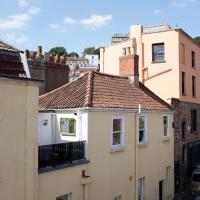
The little balcony there seems to have had increasing numbers of home comforts added over the last year or two. It's astroturfed, too... I suppose lockdowns make you try to use as much available space as possible, even if you are right next to the A4, and all the noise and traffic fumes that entails.
A Journey to the Far East
25 Jul 2021
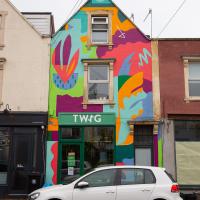
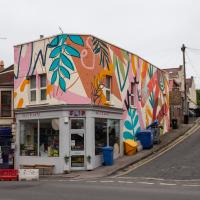
The far east of the intersection of my one-mile radius and Bedminster, anyway. I was feeling a bit tired this morning, so I motivated myself to get out of the door by imagining one of Mokoko's almond croissants. That got me on my way, and I wandered across to Bedminster, through Greville Smyth Park, along most of the length of North Street (looking out for new Upfest 75-pieces-in-75-days artwork as I went) and then onto some new roads at the far end.
I only wanted to knock a few streets off my "to do" list, but by the time I'd diverted here and there to check out various bits of graffiti and other attractions and come back via the aforementioned purveyors of Bristol's finest croissants, I'd walked 7.4km. Not bad for someone who woke up tired, and at least I've done something with my day. I'm very glad the weather broke (we had tremendous thunderstorms yesterday), even if some of the pictures might've looked better with a blue sky. I was getting fed up with walking around in 29°C heat...
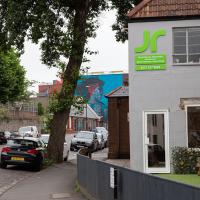
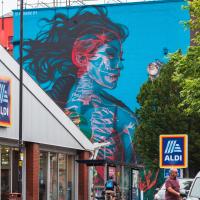
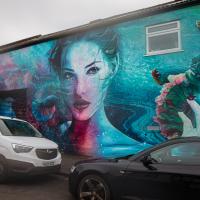
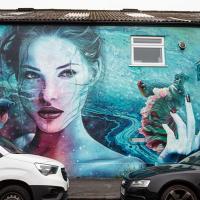
Well, like last time there's still a van and a car in the way, but at least the van's smaller this time.
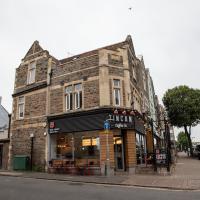
Best coffee on North Street, for my money. I made the practical choice and abstained, though, as it's hard to take photos with a coffee in one hand.
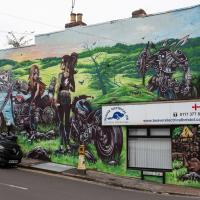
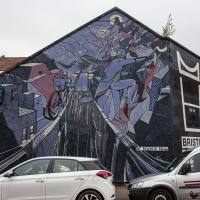
Keith Hopewell's piece is one that got vandalised a few days ago, apparently by someone who hates Upfest. It seems to be mostly intact, though, barring the bit in the bottom right (close-up next pic.) Perhaps it was mostly saved by the CCTV camera that appears to be growing out of the girl with her back to us's left leg...
I like this piece, especially the somewhat Samuri-looking robot/cyborg/whatever-he-is.
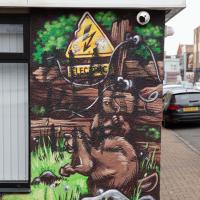
It says "BLACK METAL LIVES", apparently, and it seems like it might be some kind of comment on the Black Lives Matter movement, but it's not entirely clear what the motivation is, really, apart from not liking Upfest. "KILL UPFEST" was painted elsewhere.
There are obviously moral grey areas here, but for me I think the intent behind putting up the vast (commissioned and permitted/encouraged by the property owners) artworks from international artists that is Upfest is both creative and kind, and the scrawling over it with barely-understandable threatening bullshit is not, and I side with kindness.
I imagine that the person who daubed the crap over other people's art probably stays at home on rainy days and posts hate in the comments sections on newspaper websites instead.
Green Squares and Secret Gardens
31 Jul 2021
At the end of July I went to have a look around some of the private gardens opened up by the annual Green Squares and Secret Gardens event. Sadly it was compressed into a single day this year, for various Covid-related reasons, it seems, so I didn't get to poke around too many places. I went to:
- A talk by the oldest resident of Victoria Square
- The St Vincent's Rocks Hotel garden
- The Paragon garden
- Cornwallis Crescent gardens, both east and west
- The Polygon garden
And snapped a few things in between, too. It was a lovely day—a bit too hot, if anything—and it was interesting to get into a few places I'd only ever seen from the outside, especially The Paragon and Cornwallis gardens, which are the least visible to passing strangers of all of them.
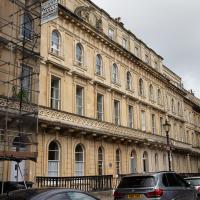
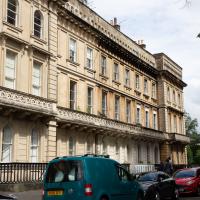
This section of Victoria Square, the second side to be built (Lansdown Road is the oldest—Regency—bit) is called Royal Promenade, and it built to resemble a palace. William Batemen Reed built it, then went on to build the Queens Hotel opposite the Victoria Rooms, which every Bristolian I know would more likely recognise by the description "the old Habitat at the top of Park Street" :D
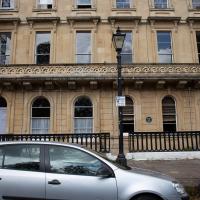
Apparently if the Royal Promenade were symmetrical, the windows of 7 and 8 would be the same size. As it is, 8 is clearly very slightly grander.
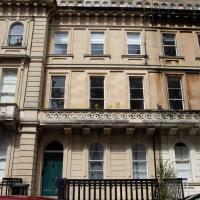
You can't see the join. Number 4 was obliterated when a bomb hit it in 1941, taking significant chunks of numbers 3 and 5 with it. Clearly they did a good job of the post-war restoration. There's a mention of the bombing on one of the BBC's People's War pages.
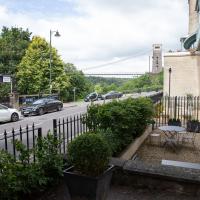
This is how the other half live—making sure that the Suspension Bridge is still there without having to leave one's boules court.
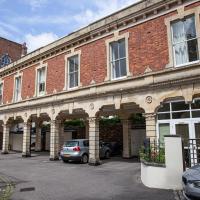
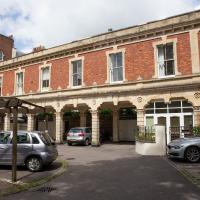
Here's the listing. This bit's described thus:
To the rear a late C19 long brick extension raised on open arches
I've been trying to get a decent picture of this for a while.
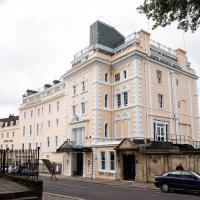
Freshly painted, with the scaffolding only recently removed, and looking rather lovely. To its right is the old entrance to the earlier Hotwell pump house that used to stand down on the Hotwell Road, and just to the right of that is the entrance to the Clfiton Rocks Railway. Behind all that is the site of the original Clifton Spa pump room, a grand "long room" that was later used as a cinema and then a ball room. I wonder if there are any plans to renovate it? It was still disused, last I heard, but that was a long time ago, when I peeped through from a Rocks Railway open day....
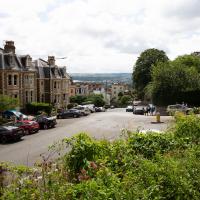
A Long Wander Of Miscellany and Magick
08 Aug 2021
This was a wide-ranging wander. I started off crossing the river to Bedminster, to walk a single little cul-de-sac, Hardy Avenue, that I'd managed to miss on at least one previous walk. Then, pausing only to explore a few back alleyways, I headed for a few destinations related mostly by the Hughes family, who I've been researching a little as part of background for a possible novel, as several of them were involved in the Stella Matutina.
However, mostly it's the artistic side of the family I wanted to explore today, as that's where most of their public history lies (as you might expect, there's often not much in the public record about the workings of an occult organisation.) First I visited College Green, where the façade of the Catch 22 Fish & Chip shop still bears the work of Catherine Edith Hughes. Then I wandered up to the top of Park Street to pop into the Clifton Arts Club's annual exhibition, as Catherine, her half-brother Donald, his wife Hope and at least two other Hugheses were members. Donald was chairman for 40 solid years; Hope was Secretary for eight, and Ellard and Margaret Hughes, two more Hughes siblings, were members along with Catherine.
Finally I walked home with a small diversion to Berkeley Square, to confirm the location of Donald Hughes's house by checking for a particular plaque by the front door.
I must admit I'm not entirely sure where all this research is really leading me, but I'm finding it quite interesting to bump across the faint lines of history that link the Hermetic Order of the Golden Dawn, founded in 1888, to modern, quotidian Bristol.
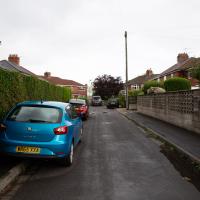
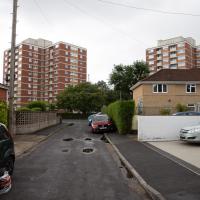
This may be a more interesting view than you'd think at first sight. Whitemead and Winterstoke House, with Southbow House out of sight on the far side, were finished in 1962, as the post-War housing crisis continued. There's a fascinating article in the Bristol Post about them, especially Whitemead House, the block on the left here, which was famously used for external scenes in Only Fools and Horses after filming moved to Bristol, standing in for the fictional Nelson Mandela House in Peckham where the Trotters lived.
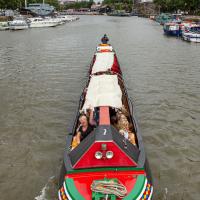
Things must be getting back to normal if you can't cross a bridge in Bristol without a hen or stag do waving at you.
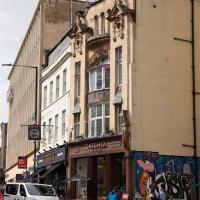
These days it's a fish and chip shop, but it started as the Cabot Cafe.
According to this description of an etching by Alexander Heaney:
Built in 1904 for an estate agent, Walter Hughes, to the design of Latrobe & Weston, architects well known for their cinemas. Above the word ‘Café’ can just be seen the Pomegranate mosaic with enamel insets by the client's daughter, Catherine Hughes, taken from Charles Rickett's bookbinding for Oscar Wilde's A House of Pomegranates, 1891.
Caroline's Miscellany tells us:
Less bright, but equally beautiful, are the copper panels to either side. These continue the pomegranate theme and are pure Art Nouveau. Other details, by contrast, are more baroque (a mixture of styles characteristic of LaTrobe and Weston's work).
Cabot Cafe suffered damage in the Second World War. We are fortunate, then, that this intriguing facade nevertheless survived to delight us today.
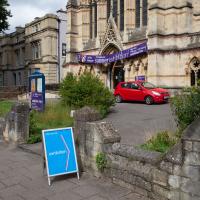
It's almost like I planned this in advance. This is the 111th annual open exhibition of the Clifton Arts Club, founded 1906.
The Clifton Arts Club featured several members of the Hughes family. The three I'm interested in are Catherine Huges, of the earlier pomegranates, her brother Donald Hughes, and his wife Hope Hughes. They were all at some point members of the Stella Matutina as well as various arts groups in the city. Donald was a member of the Bristol Savages—ahem, sorry, Bristol 1904 Arts, as they've recently rebranded—and apparently something of a leading light on the Bristol art scene.
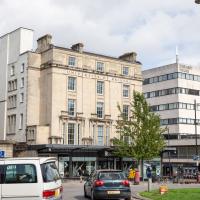
Currently the University of Bristol's Beacon House, it was originally the Queens Hotel, built by William Bateman Reed, who also built a stretch of Victoria Square, among other things. Every Bristolian older than thirty probably still thinks of it as "the old Habitat building", though. I've got curtains in this very room that were bought there...
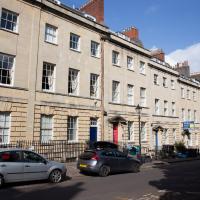
Continuing with my magical/Hughes related theme: the last time I was in Berkeley Square, I was trying to figure out where the vault of the Hermes Temple might have been destroyed; a passing mention of its destruction in Ithell Colquhoun's Sword of Wisdom says it was stored in Berkeley Square and destroyed in 1964.
The Vault would have been a septagonal wooden room with esoteric symbols painted on every surface. The Museum of Witchcraft in Boscastle have a picture of one towards the bottom of this page. That one, in Havelock North, New Zealand, would have looked very similar to the Bristol Hermes vault, I think, as they were contemporary Stella Matutina vaults and they were probably each at least partly designed by Robert Felkin, who emigrated from Bristol to New Zealand to form the Smaragdum Thalasses temple there.
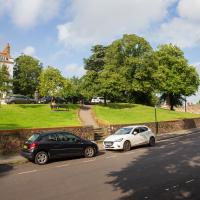
This is the site of a proposed wildflower meadow, suggested for rewilding by West Bristol Climate Action. It's normally host to quite a few daffodils in spring, but mostly it's just lawn. (These paths curving up to the churchyard would have made rather more sense when St Andrews was still standing there.)
Not sure what progress the proposal has made, but I think a splash of wild colour would go quite well here.
Museum of the Moon, and a Bit of Redland
21 Aug 2021
Lisa and I mostly went out to have a look at Luke Jerram's Museum of the Moon as its tour hit Bristol Cathedral—I missed it when it was previously in town, at Wills Hall, I think—but we also took a trek up to Redland. Lisa's kind enough to indulge my strange current fascination with the Edwardian eccentrics that made up the Stella Matutina, so we swung by a couple of places with a vague connection to the Bristol branch of the organisation. Well, it was good walking, anyway...
As a stunning bonus, one of the picture's descriptions has more information than you'd probably want on the Bristol Port Railway and Pier's Clifton Extension Railway line, but I did happen to coincidentally write up this wander after reading about the extension line during my lunch hour at work today. It's a thrilling life, I tell you...
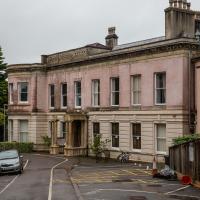
Cotham House seems to make more architectural sense from the back. Maybe this was originally the front?
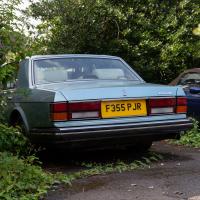
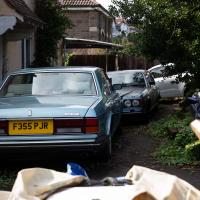
...and then noticed that it was actually a brace of Rollers. I think the rather more downtrodden one behind was probably bought for spares, but who knows? Maybe they just keep that one for country drives.
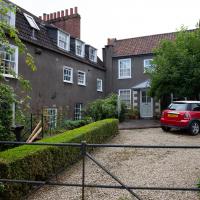
This little crop of cottages is on a little road called St Vincent's Hill. I was interested because I'm trying to track down Catherine Hughes's house, where the first Hermes Temple meetings were held. This was apparently "St Vincent's Studio, Grove Road, Redland", and I imagine it was very close to these cottages, if not actually one of them.
Apparently there is still something around here called The Studio, but I couldn't spot it. Maybe I'll come back at some point and have more of a look around.
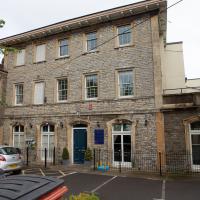
There were a lovely little set of cottages, and very well-kept. According to Historic England, they're mid-18th century, but "Much restored c1990".
Mostly the Metal Animals of a Clifton Garden
30 Aug 2021
Lisa and I went for a longish walk, but I didn't take many photos. Mostly we just wandered and nattered. Unusually, my target was outside my 1-mile radius on Burlington Road in Redland, where I snapped quite a few photos of the collection of artistic animals by Julian Warren. This was mostly to provide a fairly arbitrary destination for a roundabout walk in Clifton...
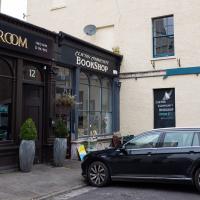
We popped in. I bought one of Ngaio Marsh's books of Inspector Alleyn stories. The community bookshop is run to benefit Studio Upstairs, an arts and health charity. The Bristol branch is down on the Albion Dockside estate behind Bristol Marina.