Tagged: window
Museum of the Moon, and a Bit of Redland
21 Aug 2021
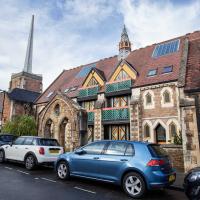
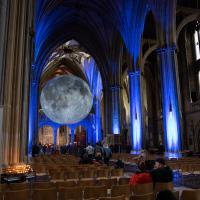
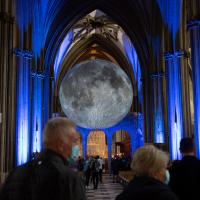
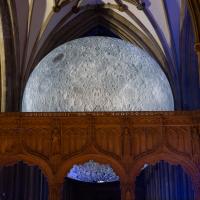
Lisa and I mostly went out to have a look at Luke Jerram's Museum of the Moon as its tour hit Bristol Cathedral—I missed it when it was previously in town, at Wills Hall, I think—but we also took a trek up to Redland. Lisa's kind enough to indulge my strange current fascination with the Edwardian eccentrics that made up the Stella Matutina, so we swung by a couple of places with a vague connection to the Bristol branch of the organisation. Well, it was good walking, anyway...
As a stunning bonus, one of the picture's descriptions has more information than you'd probably want on the Bristol Port Railway and Pier's Clifton Extension Railway line, but I did happen to coincidentally write up this wander after reading about the extension line during my lunch hour at work today. It's a thrilling life, I tell you...
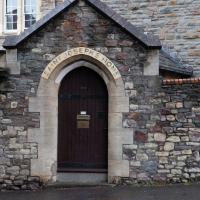
"They afterwards built, in connexion with their convent, an asylum for the reception of about one hundred sick and aged poor, means for the maintenance of whom they obtained by soliciting alms from door to door"
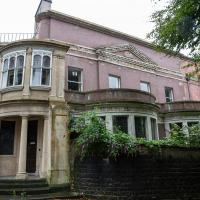
Formerly a house, now a nurses' home, according to Historic England. Seems to add up, as it appears to now be on the grounds of the Bristol Homeopathic Hospital, which is "being used as the student health service for Bristol University"
On the left of the door is the service wing, apparently. It's a sprawling old place, and seems very awkwardly shoehorned into this corner. It looks from old maps like it was backing onto a quarry for a while, before that was filled in and the homeopathic hospital was built there.
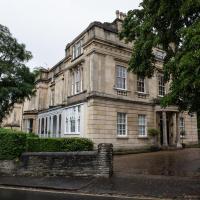
Yes, I'm back on the magical research. According to RA Gilbert's Golden Dawn Companion, this was one of the meeting places of the Hermes Temple of the Stella Matutina. I'm guessing one of the members lived there, but I'm not sure who. I'd probably need to cross-check the census records with the membership rolls, and the latter are quite patchy, anyway.
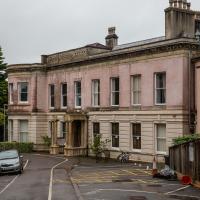
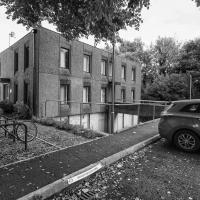
Cotham House seems to make more architectural sense from the back. Maybe this was originally the front?
Mostly the Metal Animals of a Clifton Garden
30 Aug 2021
Lisa and I went for a longish walk, but I didn't take many photos. Mostly we just wandered and nattered. Unusually, my target was outside my 1-mile radius on Burlington Road in Redland, where I snapped quite a few photos of the collection of artistic animals by Julian Warren. This was mostly to provide a fairly arbitrary destination for a roundabout walk in Clifton...
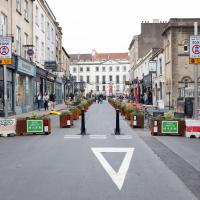
The controversy about the pedestrianisation of this section of Princess Victoria Street continues to rage on NextDoor (seriously; I just had a look and the most recent thread about it had more than three hundred comments!)
Anything to do with parking/people driving into Clifton Village is always an insanely hot topic. I've never been able to get that worked up about it, myself, but then I live within walking distance (and I'm not trying to run a business that relies on people driving to me...)
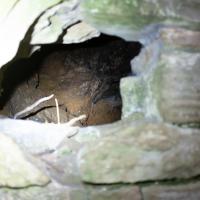
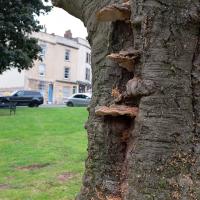
I'm no arborist. I have no idea whether the big-arse mushrooms growing from the side here are just plain old benign mushrooms or a symptom of the fungal infection that killed this poor old beech tree.
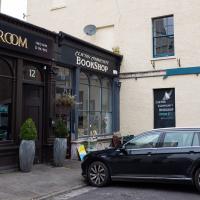
We popped in. I bought one of Ngaio Marsh's books of Inspector Alleyn stories. The community bookshop is run to benefit Studio Upstairs, an arts and health charity. The Bristol branch is down on the Albion Dockside estate behind Bristol Marina.
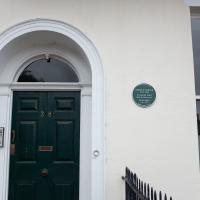
Since I found out that Angela Carter used to live around here, I've read The Bloody Chamber, and it was bloody brilliant.
Short and Sweet
06 Sep 2021
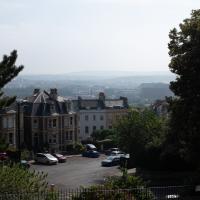
As if to prove that I don't have to go on giant rambles, here's a quick four-photo trip up to Clifton Village for a bit of cake. No new streets, just a tiny slice of life.
Shiny New Hope
24 Sep 2021
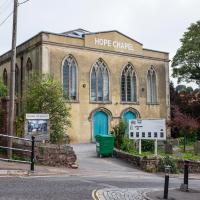
A quick lunchtime jaunt to Clifton Village. Along the way I admired the new sign on Hope Chapel and added to my tsundoku collection.
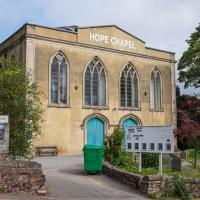
The scaffolding is down and there's a nice new sign (reminiscent of a historical one, I think,but I can't find the photo at the moment because Know Your Place Bristol is down) and you can just see the newly-installed solar panels on the roof behind it.
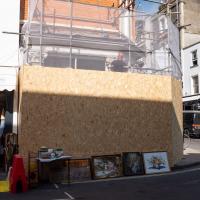
There's a mason at work on the carved pilaster tops on the frontage of the old Coventry (and before then, Stroud and Swindon) Building Society. They've moved everything to a central branch in town in the interests of efficiency, so now I have to go to bloody Broadmead to do anything.
(Yes, I actually went into town to get a cheque out of the building society just the other day, in 2021. I know I should chuck this old-fashioned malarkey in for a shiny electronic account, but it's for the management committee of the house I live in, so there's complexity and inertia involved...)
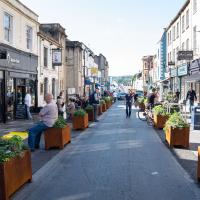
Among the many arguments about this pedestrianisation experiment, there has been quite the sub-debate over the delightfully modern COR-TEN steel steel/hideously ugly rusty* planters.
- Delete as applicable
A Morning of Research and a Cafe in a Castle
25 Sep 2021
I needed to pop to the library, as they'd kindly dug a book out of the reserve store at the B Bond warehouse for me and emailed me to let me know it was ready. So, I took a little trip to town, straight down the Hotwell Road, and spent a few hours reading before stretching my legs with a walk to a new cafe in the actual castle (or remnants thereof, anyway) of Castle Park, before heading back home down the other side of the harbour. As well as books and coffee, I bumped into a remote-controlled pirate ship, which isn't something you see every day, even in Bristol.
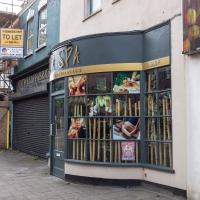
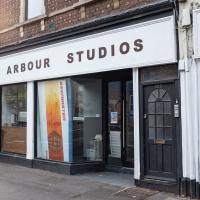
It's nice to see a new business open up on this stretch of the Hotwell Road. Since Asia Channel disappeared (and took with it my favourite local source of crispy beef) and the Hotwells Pine folks retired, it's all been looking a bit tatty.
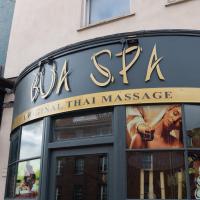
This place has already garnered several good reviews from locals on Nextdoor and Google Reviews. I must try it at some point.
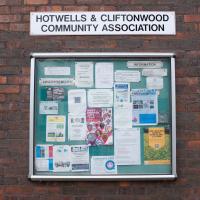
The sign about the wildflower meadow on Clifton Hill Bank is part of the consultation I mentioned the other day.
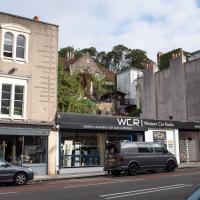
Have I ever looked up and noticed the view above Western Car Radio, which looks like perhaps the terraced back garden of St George's Primary? If I have, I don't seem to have snapped it before.
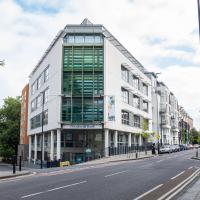
There are some unexpected links between Triodos Bank and some of the magical stuff I've been researching. I first found out when I checked the upcoming events at the Bristol Theosophical Lodge and saw a director of the bank would be giving a talk there. Apparently the bank is rooted in the ideas of Rudolf Steiner's anthroposophy. The Guardian says:
Its roots (like the UK bank Mercury Provident, which it took over in 1995), are in the anthroposophy movement. This refers to the ideas of the Austrian spiritualist thinker Rudolf Steiner, who died in 1925 and whose interests included education, 'biodynamic' agriculture, eurythmy (movement as art) and therapeutic medicine.
Triodos Bank's statutes committed it to anthroposophical principles until 1999, when this formal link was dropped, and in recent years the bank, under its current head Peter Blom, has embarked on a policy of reaching out beyond Steiner adherents and of broadening its appeal. Nevertheless, Triodos's origins are reflected in the fact that most of the Dutch directors come from within anthroposophy, and it is banker for many Steiner-inspired projects.
Bristol boasts one of the quietest rooms in the world. That one's in the Ultra-Low Noise Labs at the University of Bristol, where "Losing all auditory references does funny things to your balance, and I lurch slightly as the double doors open to let me out. It's a relief to hear the faint underlying buzz that indicates life as we know it."
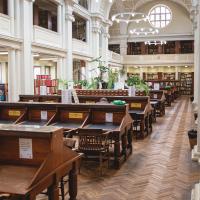
Sadly, although it looks the part, the reading room in the Reference section of Bristol Central Library is usually a caophony of irritations. I'm not sure what took the prize today: the burglar alarm going off outside for ages, the stertorous snoring, the queues of people trying to get 10p pieces for the photocopier like it was still 1985, the angry researcher trying to get a porter along to rouse and tick off the stertorous snorer...
In between all this I read through the letters of the Reverend W A Ayton, alchemist of the Golden Dawn, once described by W B Yeats as "the most panic-stricken person" he had ever known. I think he'd have had to read in Bristol Central Library it might have tipped him over the edge...
(I should temper this critique by at least oberving that the librarians are themselves uniformly friendly and helpful.)
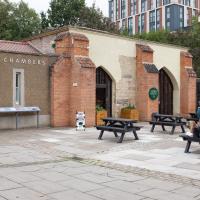
The chambers were apparently once the entrance to the castle's great hall. Historic England has this section of the castle at 13-14th century
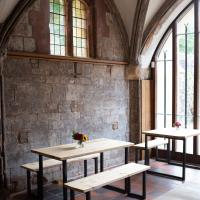
I was interested to see it, but a little underwhelmed, if I'm honest. A fairly bland interior and a perfectly adequate flat white—not much "wow" factor.
I recently indulged myself by buying a little piece of history. I've mentioned Samuel Loxton and featured and linked to his drawings before, often in the eminently browsable Loxton Collection albums that Bristol Libraries has on Flickr. So when I saw a Loxton drawing of Hotwells pop up on eBay, I decided to get myself a little treat.
I don't think there's any Loxton drawing that features the road I actually live in—it's not very visible from anywhere else, not being one of these Clifton terraces that's perched at the top of a hill, or anything like that, and it's invisible in most views of the area. However, this Loxton drawing, Hotwells, Looking across the river from near the Clifton Bridge station, is probably the closest near-miss I've seen.
I decided to wander out one morning and see if I could reproduce the picture, and also take a photo or two of what's now become of the Clifton Bridge Station, which is still just about discernible in places.
(Then on an even stranger whim I decided to check out a possible little cut-through from Cumberland Road to the harbourside I'd been eyeing up on my commute to work, so walked to Wapping Wharf for a croissant via this potential new route, but that bit's not quite as interesting...)
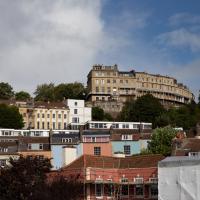
I'd broadly planned to figure out the vantage point Loxton had used for his drawing by lining up Windsor Terrace with The Paragon, so I started taking bearings fairly early.
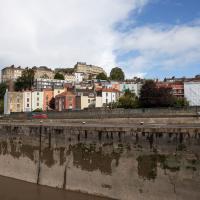
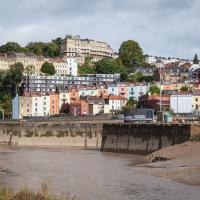
Here's a similar angle to my earlier attempt at recreating the Loxton view, only with a framing that gives a bit more detail of the buildings.
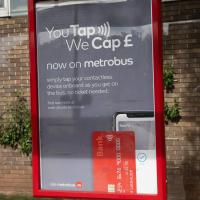
I don't actually know what "we cap £" means. I do know that it always seemed irritating that the Metrobus worked by having to buy a ticket in advance at fiddly little machines next to the stops, and that being able to just buy a ticket by tapping a card once you were on the bus would seem wildly futuristic if I hadn't had a Oyster card decades ago in London...
Having just tried to read the 2,500-ish word explanation of Tap & Cap, I'm still not sure exactly how to use it, but hopefully it at least means that Bristol bus drivers will no longer swear at you if you don't happen to have exactly the right change sorted out in advance...
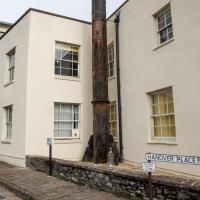
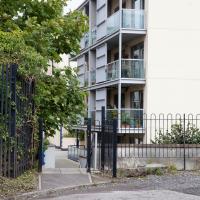
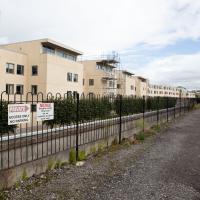
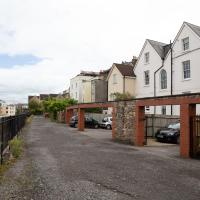
This, on the higher level, is the garages around the back of the houses on Cumberland Road.
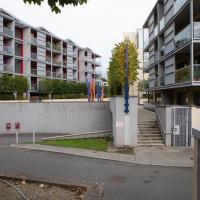
And that, on the far side, is my regular commuting route in the mornings (and often the evenings—I only walk along the north side of the harbour if I'm late for work or if I fancy a change, as the Hotwell Road is a bit too trafficky to be that pleasant.)
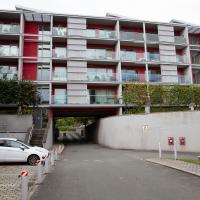
Docks Heritage Weekend Day One
09 Oct 2021
I could spend a lot of time at the Docks Heritage Weekend, poking my nose into industrial places along the harbourside that are usually closed off, but throw open their doors once a year to show off a bit of the backstage area of Bristol's floating harbour. In fact, I warn you: the next wander is a long one, and will have quite a few photos.
However, for today's wander, on the Saturday, my friend Lisa needed a shorter walk than our usual long rambles, as she's recovering from an operation and still a little under the weather, so we just wandered into town for some food and back, with me making mental notes of the places I wanted to come back to on the Sunday... We walked through Underfall Yard, along to the L Shed (this is the warehouse next to the M Shed museum, where they still have the kind of fun old industrial stuff that used to be crammed into the M Shed's predecessor, the old Industrial Museum), through the street food market in town to Ahh Toots for cake and then back home. So, still quite a walk, but no hills and not so much of Lisa having to hang around waiting for me to fool around taking photos as usual, at least...
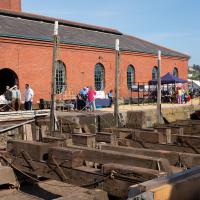
The Patent Slip is actually a grade II listed building. Personally I live in a II*-graded building myself; not sure I'd want to slum it down here.
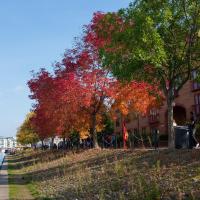
They're among the first to show autumn colour in Bristol, so by early October they're in full effect.
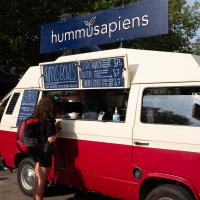
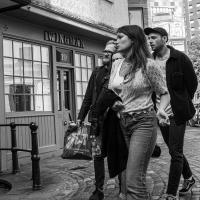
I figured I'd try a bit of street photography, seeing as there were actually people around. This isn't bad for a from-the-hip shot, but I'm a bit out of practice, as you'd expect.
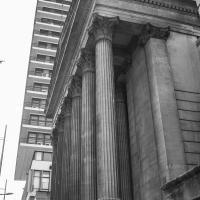
Of course, it's not on the quay any more, because they moved the quay. However, St Mary's Facebook page has at least one picture of it from when this strip of the city centre was still the river.
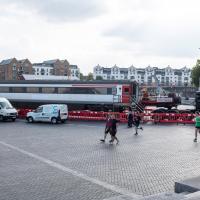
I wasn't expecting to see a train carriage in the Lloyds amphitheare. Apparently it's got something to do with Stephen Merchant's new drama The Outlaws. They're filming some of it down at my end of the harbour soon, too; I've had a letter through the door about night shoots that'll be closing sections of the Hotwell Road.
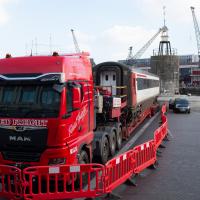
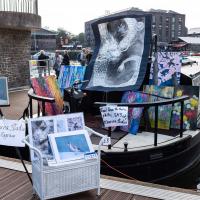
I'm afraid that this is a bit of a badly-curated wander, where I mostly just popped out to find out a little of the history of Underfall Yard and poke around the various open workshops, and, in hindsight, really didn't take pictures in any kind of coherent order. So there's a lot of pictures, but they don't really tell the story that, in hindsight, I seem to have been trying to tell, of the unusual electrical substation in Avon Crescent, the Bristol Electricity that predates the National Grid but is still in use, the history of the hydraulic power house... It's a bit of a mess.
But I suppose sometimes these wanders—always chronologically presented in the order I walked and took photos—simply will sometimes be a bit of a mess. Let's hope you still get something out of it, anyway...
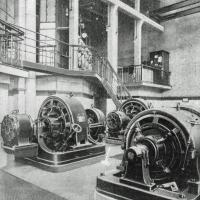
Via this Tweet and taken from KYP Bristol, showing the interior with a couple of Westinghouse rotary converters and a Peebles-La Cour motor converter, assuming this picture ties up roughly with this 1908 Institute of Mechanical Engineers' visit to works.
You can see a picture of similar Westinghouse converters to the two at the back in the Wikipedia rotary converter page and a Peebles converter that looks very similar to the one in the foreground on the cover of the Peebles motor converter catalogue in the sidebar of their entry in Grace's Guide. I'm guessing the additions on the ends of the Westinghouse converters were for different voltages? A rotary converter is basically a motor connected to a dynamo, so extra dynamos with different windings would give you different voltage outputs, I suppose, but I know very little about power generation.
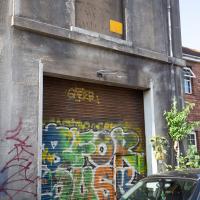
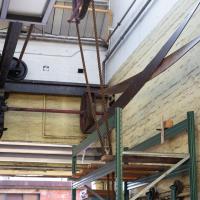
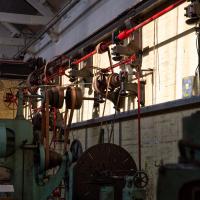
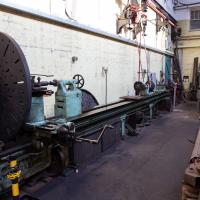
Most of the gear in this docks machine room is belt driven from a motor we'll see in a bit. The motor is electric but the drive system is pretty much the same as it was in the days of steam.
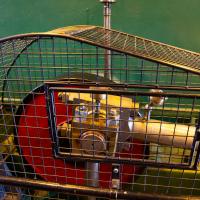
A hydraulic accumulator, (similar to its namesake in electronics, now more commonly known as a capacitor) stores the energy. (This is done rather than just using the pumps directly as, say, you can use these weaker pumps over a long period of time to store a large amount of energy that the accumulator can release more quickly to do a job that requires more power.)
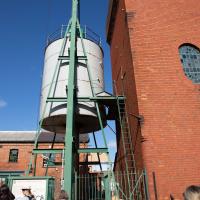
All that pumping next door has raised this accumulator—basically a big drum full of 80 tons of scrap metal—high off the ground where it normally sits these days. This is the stored energy that's sitting on top of the water in the hydraulic system, ready to be diverted to anything around the docks that needs power. Up until as recently as 2010, this was the power source that opened and closed the main Cumberland Basin lock gates. Without it no ship could have entered or left the harbour.
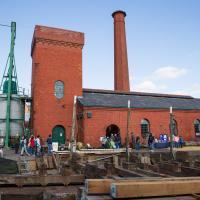
I've really taken all these photos in the wrong order, haven't I? This is an overview of the last many shots. The visitor centre is the right hand side of the building. The chimney behind is for the boiler that was inside in the days of steam. In the roof above the visitor centre was the header tank. The pump room we were in is where the open door is between the visitor centre part and the accumulator tower, on the left-hand end. Inside the tower is the old accumulator, and on the end of the building is the newer external accumulator, which as you can see has now descended fully to the ground as the hydraulic power has dissipated.
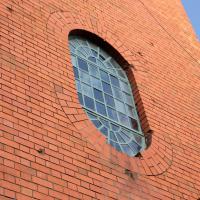
Can you guess? Yes, the Power House was obviously something of a target during the war. It was strafed by the Luftwaffe at one point.
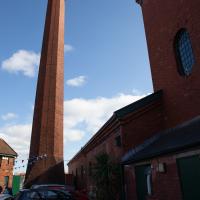
Before the pumps were converted to electricity, this chimney would have been pouring smoke out pretty much 24x7, as I understand it, from the boiler in the main building to the right. It's a pleasant little visitor centre now, with a nice cafe at the back. When this was a working dock I can only imagine that it must have been like hell on earth inside.
Fresh Fields
17 Oct 2021
For the first time in a while, I had the time and energy to go further afield and knock off some new roads from my "to do" list. I headed through the first Hotwells Festival to Ashton and Bedminster to cross off a few of the suburban roads south of North Street.
First, though, I decided to try to reproduce an old photo of the now-demolished Rownham Hotel just around the corner from where I live...
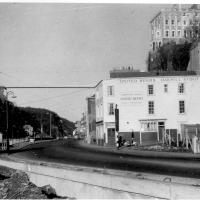
Here's the view I wanted to take a stab at reproducing. Bristol's Lost Pubs—a great website, which sadly currently seems to be lost itself—said:
Originally known as the Hotwells Tavern. Around 1873 when the entrance to Cumberland Basin was enlarged, a pub named the Rownham Tavern was demolished and Rownham ferry moved downstream towards the Hotwells Tavern, not long afterwards the name was changed to the Rownham Hotel. The pub was removed in 1969 for road Widening.
This particular image is from Brewerypedia; I'm afraid I don't know its original provenance.

Here's my version. I couldn't get to the exact original viewpoint without the railings on the far left being in the way of the picture, but this is pretty close.
So, presumably the house (or possibly two?) on the end of Freeland Place, which looks to my eye just as Georgian as the rest of the terrace, must've been built after the Rownham Hotel was demolished for the road widening in 1969...
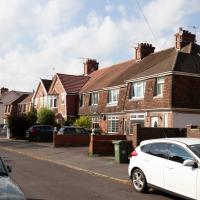
I've taken a few photos of the similar place around the corner, but I hadn't noticed there's another one of these odd mansion-mansard-bungalow-what-the-hell places here, too.
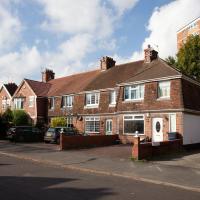
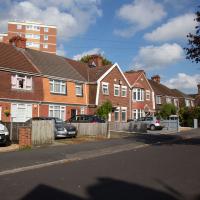
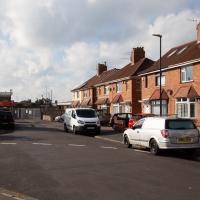
The rest of the road is just your normal-for-round-here brick boxes, really. At the end is the back of the little Winterstoke Road retail park, including PC World and Halfords, which I think are the only two shops I've ever been in there.
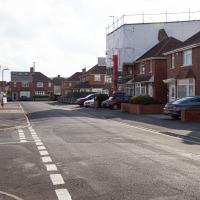
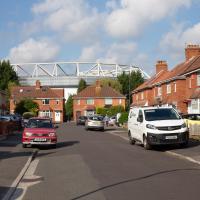
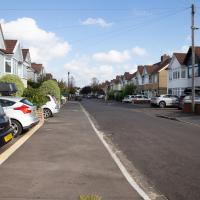
A Wide Angle View
30 Oct 2021
I had an unsuccessful wander last week, on Tuesday afternoon: my GPS died within about five minutes of leaving the house, and I didn't notice, plus I found hardly anything I'd been looking for. On the plus side, as I was wandering around Park Street I decided to nip into London Camera Exchange on the offchance they had a secondhand Canon 17-40mm lens. I've been thinking of buying one for around a year, I think.
Long story short: not only did they have one, but due to a mistake with their price labelling which they kindly honoured, I now have a shiny new (to me) wide-angle lens and it cost me less than £300, which is a very good price for one of these in good condition (and including a lens hood.)
So, rather than try to salvage Tuesday's walk, here's a walk where I basically just bimbled up to Clifton Village for a coffee and wandered around taking photos of as many wide views as I could find. I took a lot more photos than these seventeen, but as you might expect, a new lens takes some practice getting used to, so most of them ended up in the "outtakes" pile.
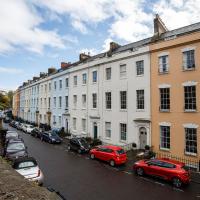
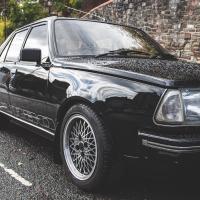
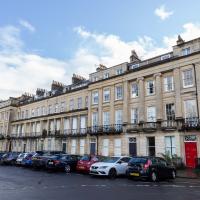
Pretty sure I couldn't have snapped the whole length of this terrace with my previous-widest lens, the 24-70. Fits fine in the 17-40.
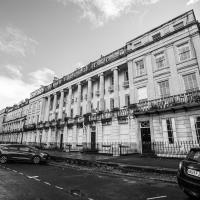
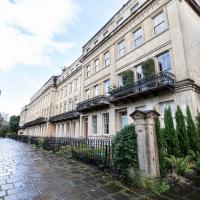
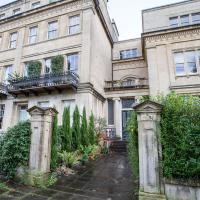
Set back on the end of Worcester Terrace is Worcester House. I've never succeeded in getting a good snap of it. Today does not seem to be an exception. Oh well.
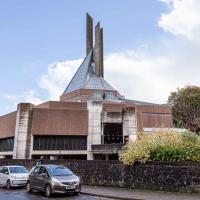
I've mentioned the spire before, I'm sure: colloquially known as the "three pin plug", it's apparently meant to represent the Holy Trinity.
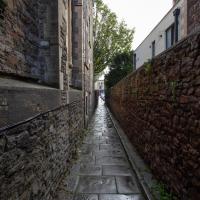
One of several odd short-cuts and alternative routes I worked out to vary my commute to work, when work was at the top of Whiteladies Road.