Tagged: tree
A Journey to the Far East
25 Jul 2021
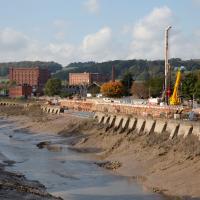
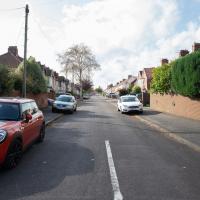
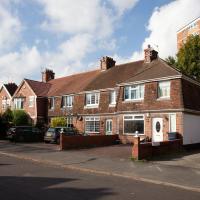
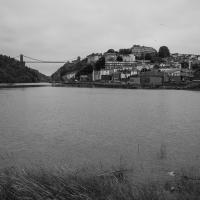
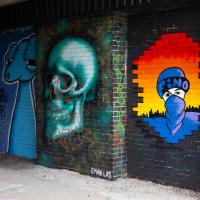
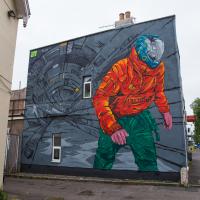
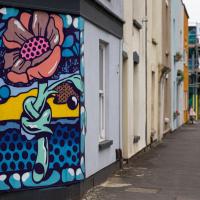
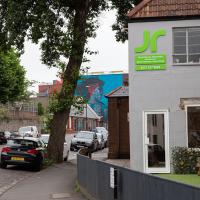
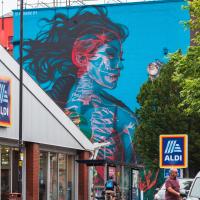
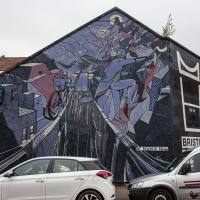
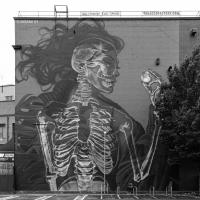
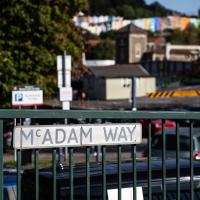
The far east of the intersection of my one-mile radius and Bedminster, anyway. I was feeling a bit tired this morning, so I motivated myself to get out of the door by imagining one of Mokoko's almond croissants. That got me on my way, and I wandered across to Bedminster, through Greville Smyth Park, along most of the length of North Street (looking out for new Upfest 75-pieces-in-75-days artwork as I went) and then onto some new roads at the far end.
I only wanted to knock a few streets off my "to do" list, but by the time I'd diverted here and there to check out various bits of graffiti and other attractions and come back via the aforementioned purveyors of Bristol's finest croissants, I'd walked 7.4km. Not bad for someone who woke up tired, and at least I've done something with my day. I'm very glad the weather broke (we had tremendous thunderstorms yesterday), even if some of the pictures might've looked better with a blue sky. I was getting fed up with walking around in 29°C heat...
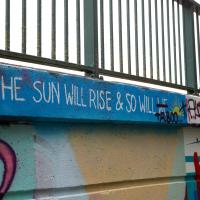
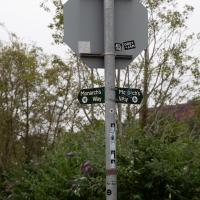
I had no idea this was part of the Monarch's Way, a modern route that tries to trace, as best it can, the path of King Charles II's escape following his defeat by Cromwell in 1651.
A Long Wander Of Miscellany and Magick
08 Aug 2021
This was a wide-ranging wander. I started off crossing the river to Bedminster, to walk a single little cul-de-sac, Hardy Avenue, that I'd managed to miss on at least one previous walk. Then, pausing only to explore a few back alleyways, I headed for a few destinations related mostly by the Hughes family, who I've been researching a little as part of background for a possible novel, as several of them were involved in the Stella Matutina.
However, mostly it's the artistic side of the family I wanted to explore today, as that's where most of their public history lies (as you might expect, there's often not much in the public record about the workings of an occult organisation.) First I visited College Green, where the façade of the Catch 22 Fish & Chip shop still bears the work of Catherine Edith Hughes. Then I wandered up to the top of Park Street to pop into the Clifton Arts Club's annual exhibition, as Catherine, her half-brother Donald, his wife Hope and at least two other Hugheses were members. Donald was chairman for 40 solid years; Hope was Secretary for eight, and Ellard and Margaret Hughes, two more Hughes siblings, were members along with Catherine.
Finally I walked home with a small diversion to Berkeley Square, to confirm the location of Donald Hughes's house by checking for a particular plaque by the front door.
I must admit I'm not entirely sure where all this research is really leading me, but I'm finding it quite interesting to bump across the faint lines of history that link the Hermetic Order of the Golden Dawn, founded in 1888, to modern, quotidian Bristol.
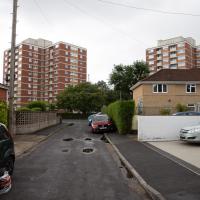
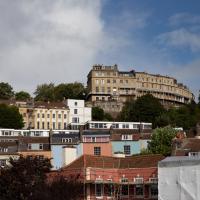
This may be a more interesting view than you'd think at first sight. Whitemead and Winterstoke House, with Southbow House out of sight on the far side, were finished in 1962, as the post-War housing crisis continued. There's a fascinating article in the Bristol Post about them, especially Whitemead House, the block on the left here, which was famously used for external scenes in Only Fools and Horses after filming moved to Bristol, standing in for the fictional Nelson Mandela House in Peckham where the Trotters lived.
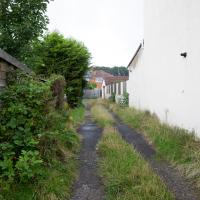
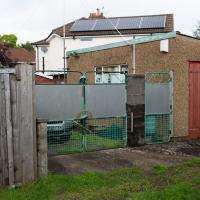
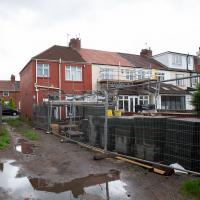
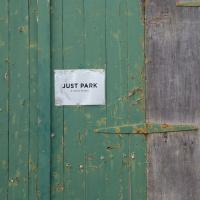
My guess is that these rental parking spaces are very popular when there's a match on at Ashton Gate. I could hear the cheering coming from the stadium from my front room in Hotwells over this weekend (I'm writing this on October 3, 2021, as I've got a bit of a photo-processing backlog!) so it seems that biggish matches—either football or Rugby or both—are back on.
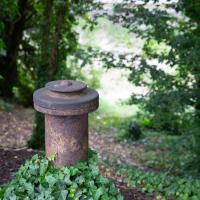
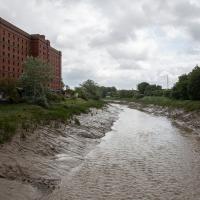
A little remnant of the Avon's history, I assume, gently rusting away on the bank by Cumberland Road
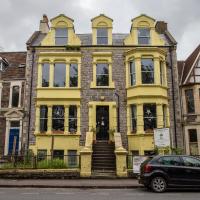
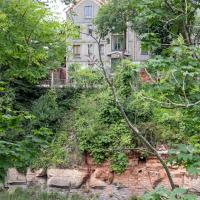
Mostly the Metal Animals of a Clifton Garden
30 Aug 2021
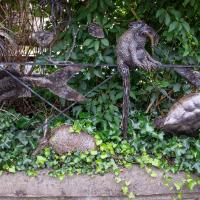
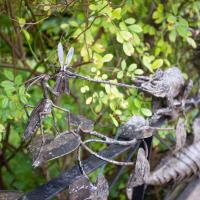
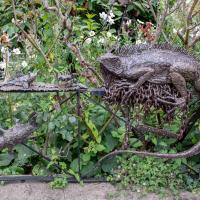
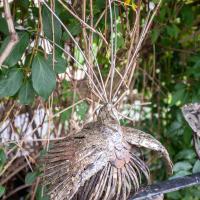
Lisa and I went for a longish walk, but I didn't take many photos. Mostly we just wandered and nattered. Unusually, my target was outside my 1-mile radius on Burlington Road in Redland, where I snapped quite a few photos of the collection of artistic animals by Julian Warren. This was mostly to provide a fairly arbitrary destination for a roundabout walk in Clifton...
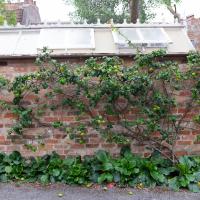
I don't know enough about fruit trees to know what this was, but I can tell you that the fruit was apple-ish and very sharp indeed.
Unusual to see an espalier on a north-facing wall. This one faces the little car park behind Freeland Place
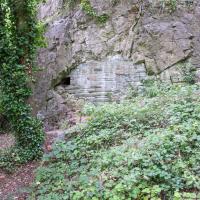
From an Avon Gorge Geology Excursion Guide I dug up:
Just south of the Observatory, on the right of the path is a children’s playground [ST 5667 7325] in the remains of a limestone quarry. In the back wall is a bricked-up adit, presumably representing the entrance to a former iron ore or lead mine (Fig. 10C). The roof of the adit is fissured and sparry, crystalline calcite can be seen in fissures.
The playground itself is in one of the the quarries used for the Suspension Bridge materials.
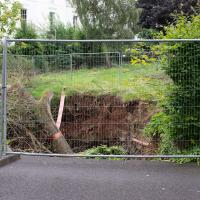
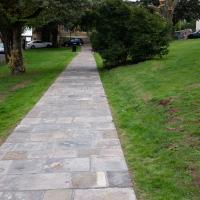
Well, I certainly don't remember Park Place having a nice path cut through it before, and it looks pretty new.
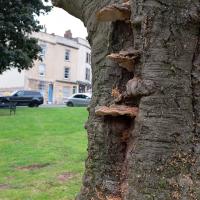
I'm no arborist. I have no idea whether the big-arse mushrooms growing from the side here are just plain old benign mushrooms or a symptom of the fungal infection that killed this poor old beech tree.
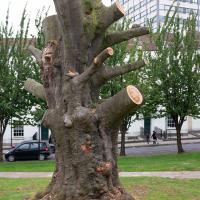
Local councillor Katy Grant had this to say in a Nextdoor post:
...many sonar and other tests have been carried out to see if felling it could be avoided. Sadly, there has been no way out, and there is a risk that the tree will imminently start to be a danger to passers-by. So this has been the sad outcome. A three metre monolith will be left behind, as a feature, and a habitat for insects and other creatures. A new beech will be planted alongside during thus winter's planting season. And six other trees will be planted along the edge of the Park Place green slope.
Short and Sweet
06 Sep 2021
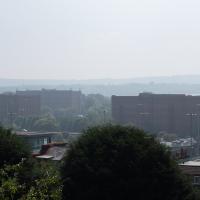
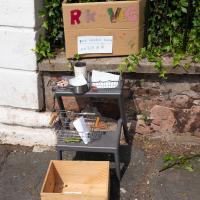
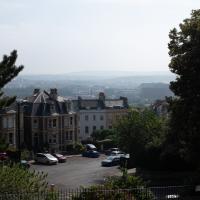
As if to prove that I don't have to go on giant rambles, here's a quick four-photo trip up to Clifton Village for a bit of cake. No new streets, just a tiny slice of life.
Shiny New Hope
24 Sep 2021
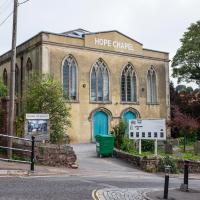
A quick lunchtime jaunt to Clifton Village. Along the way I admired the new sign on Hope Chapel and added to my tsundoku collection.
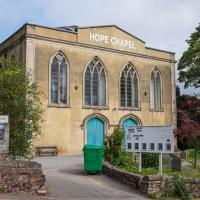
The scaffolding is down and there's a nice new sign (reminiscent of a historical one, I think,but I can't find the photo at the moment because Know Your Place Bristol is down) and you can just see the newly-installed solar panels on the roof behind it.
A Morning of Research and a Cafe in a Castle
25 Sep 2021
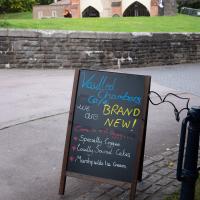
I needed to pop to the library, as they'd kindly dug a book out of the reserve store at the B Bond warehouse for me and emailed me to let me know it was ready. So, I took a little trip to town, straight down the Hotwell Road, and spent a few hours reading before stretching my legs with a walk to a new cafe in the actual castle (or remnants thereof, anyway) of Castle Park, before heading back home down the other side of the harbour. As well as books and coffee, I bumped into a remote-controlled pirate ship, which isn't something you see every day, even in Bristol.
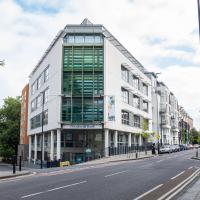
There are some unexpected links between Triodos Bank and some of the magical stuff I've been researching. I first found out when I checked the upcoming events at the Bristol Theosophical Lodge and saw a director of the bank would be giving a talk there. Apparently the bank is rooted in the ideas of Rudolf Steiner's anthroposophy. The Guardian says:
Its roots (like the UK bank Mercury Provident, which it took over in 1995), are in the anthroposophy movement. This refers to the ideas of the Austrian spiritualist thinker Rudolf Steiner, who died in 1925 and whose interests included education, 'biodynamic' agriculture, eurythmy (movement as art) and therapeutic medicine.
Triodos Bank's statutes committed it to anthroposophical principles until 1999, when this formal link was dropped, and in recent years the bank, under its current head Peter Blom, has embarked on a policy of reaching out beyond Steiner adherents and of broadening its appeal. Nevertheless, Triodos's origins are reflected in the fact that most of the Dutch directors come from within anthroposophy, and it is banker for many Steiner-inspired projects.
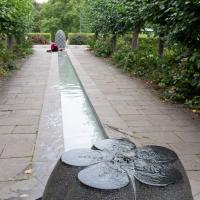
I like this little watery installation at Castle Park, so I try to cut through here if it's on my way.
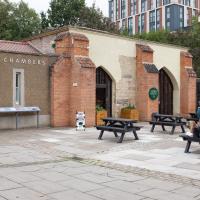
The chambers were apparently once the entrance to the castle's great hall. Historic England has this section of the castle at 13-14th century
I was interested to see it, but a little underwhelmed, if I'm honest. A fairly bland interior and a perfectly adequate flat white—not much "wow" factor.
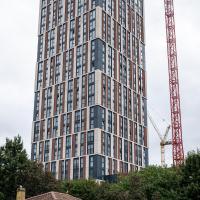
And towering over one of Bristol's oldest buildings, here's one of Bristol's newest, Castle Park View. Its 26 storeys towering up at 98 metres, it's now Bristol's tallest building, having beaten the 80m Castlemead and St Mary Redcliffe to joint second earlier this year. I'm not sure I'd fancy living in one of the 375 flats, but the view must be nice.
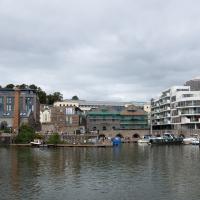
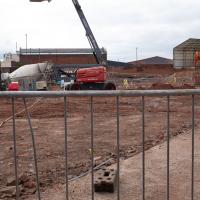
On the site of the old warehouse next to Albion Dock, whose canopy you can see top right. It will, inevitably, be some more posh flats.
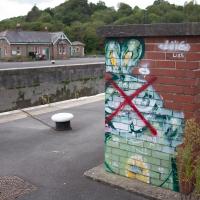
There's a deeply disturbing reason that this rabbit has been crossed out, but I've written that up in a later Wander, so you'll have to wait for an upcoming photo in October.
I recently indulged myself by buying a little piece of history. I've mentioned Samuel Loxton and featured and linked to his drawings before, often in the eminently browsable Loxton Collection albums that Bristol Libraries has on Flickr. So when I saw a Loxton drawing of Hotwells pop up on eBay, I decided to get myself a little treat.
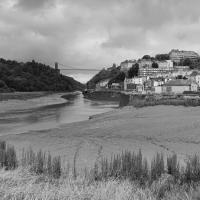
I don't think there's any Loxton drawing that features the road I actually live in—it's not very visible from anywhere else, not being one of these Clifton terraces that's perched at the top of a hill, or anything like that, and it's invisible in most views of the area. However, this Loxton drawing, Hotwells, Looking across the river from near the Clifton Bridge station, is probably the closest near-miss I've seen.
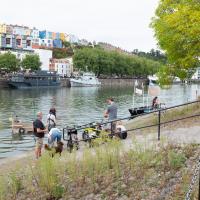
I decided to wander out one morning and see if I could reproduce the picture, and also take a photo or two of what's now become of the Clifton Bridge Station, which is still just about discernible in places.
(Then on an even stranger whim I decided to check out a possible little cut-through from Cumberland Road to the harbourside I'd been eyeing up on my commute to work, so walked to Wapping Wharf for a croissant via this potential new route, but that bit's not quite as interesting...)
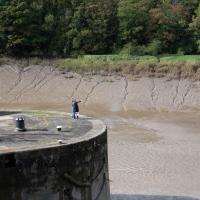
I'd broadly planned to figure out the vantage point Loxton had used for his drawing by lining up Windsor Terrace with The Paragon, so I started taking bearings fairly early.
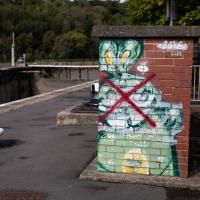
There's a frankly disturbing and gruesome reason why this rabbit has been crossed out. I'll tell you why in a few photos time.
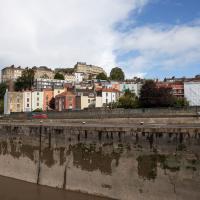
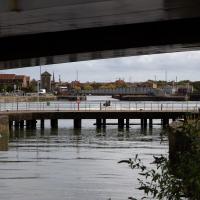
Every now and again some speedboat pops under Merchants Road Bridge and does a few quick loops of the Cumberland Basin. I guess that either they're allowed to go fast on the basin or they know they can get away with it...
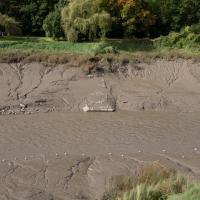
Site of the Rownham Ferry. Follow the link for a charming Loxton ink drawing on Know Your Place, also viewable at the Bristol Libraries Flickr collection.
This was a later site for the ferry, which earlier was a tad further out along the river. It would have been a key crossing point at this end of Bristol before the arrival of any bridges near here. Before the Ashton Swing Bridge and the Vauxhall footbridge arrived, the next-nearest crossing point would have been the Vauxhall ferry, which was where Vauxhaull Bridge stands now, I think.
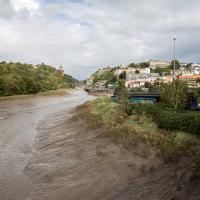
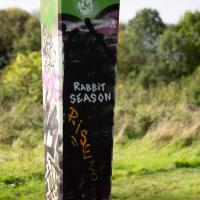
Okay, so here's the reason that the earlier rabbit had a big red cross through him, and that this one has been painted out. Bristol's graffiti community is currently trying to erase these rabbits after a terrible revelation about the man who had been painting them.
Here's the Bristol Post, on Damian Lasota, aka "Eldey" or "FollowMyRabbits":
A pervert with a penchant for grannies tried to rape one elderly woman in her home and sexually targeted another.
Damian Lasota was described by a judge as the "stuff of nightmares" after preying on the two lone females in Twerton, Bath.
His campaign of terror was halted after police installed CCTV at the women's homes and he was caught in action and arrested.
Lasota, 27, of Parry Close in Southdown, Bath, pleaded guilty to attempted rape, two charges of trespass with intent to commit a sex offence and two charges of exposure.
He appeared in the dock at Bristol Crown Court with a grey jumper draped over his head.
Judge Julian Lambert handed him a 20-year sentence, comprising of a 13-and-a-half year jail term and six-and-a-half years extended licence.
So, that's pretty damn terrifying, and also the reason why there won't be any more rabbits in Bristol. There's a little more info in this Somerset Live article.
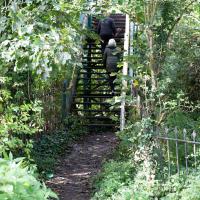
After carefully skirting the edges of the homeless people's camp that I accidentally found skirting the edges of the tall grass between the allotments and here, I came across my first destination: the footbridge from Clifton Bridge railway station. This is apparently the actual station footbridge, still in service for crossing the lines.
Many people in Bristol will know this as one of the chief ways people from this end of town used to get to Ashton Court, especially for the music festival or the balloon fiesta, before the shiny new Festival Way footpath was installed a decade or two back.
I've been across it before on my wanders, but I didn't know then that it was a remnant of a railway station, rather than just a standalone bridge.
Docks Heritage Weekend Day One
09 Oct 2021
I could spend a lot of time at the Docks Heritage Weekend, poking my nose into industrial places along the harbourside that are usually closed off, but throw open their doors once a year to show off a bit of the backstage area of Bristol's floating harbour. In fact, I warn you: the next wander is a long one, and will have quite a few photos.
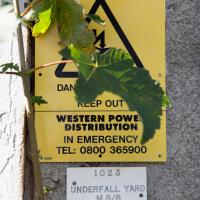
However, for today's wander, on the Saturday, my friend Lisa needed a shorter walk than our usual long rambles, as she's recovering from an operation and still a little under the weather, so we just wandered into town for some food and back, with me making mental notes of the places I wanted to come back to on the Sunday... We walked through Underfall Yard, along to the L Shed (this is the warehouse next to the M Shed museum, where they still have the kind of fun old industrial stuff that used to be crammed into the M Shed's predecessor, the old Industrial Museum), through the street food market in town to Ahh Toots for cake and then back home. So, still quite a walk, but no hills and not so much of Lisa having to hang around waiting for me to fool around taking photos as usual, at least...
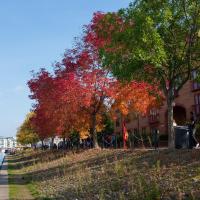
They're among the first to show autumn colour in Bristol, so by early October they're in full effect.
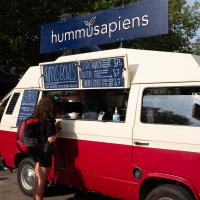
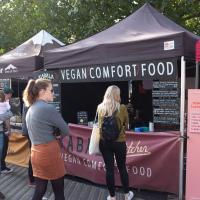
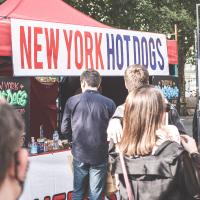
I have nothing against vegan food, I just fancied a hot dog today... I pushed the photo processing a bit more than I usually would on this site; that's because the photo's also destined for my venerable Tumblr blog, Cafe Signs.
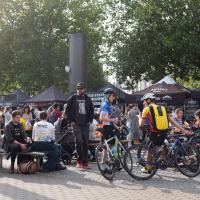
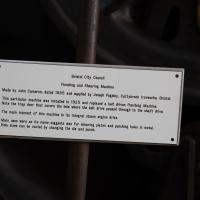
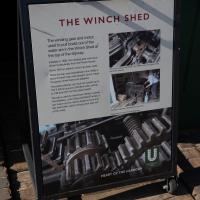
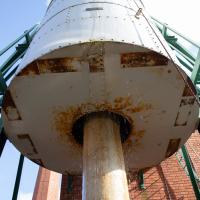
I'm afraid that this is a bit of a badly-curated wander, where I mostly just popped out to find out a little of the history of Underfall Yard and poke around the various open workshops, and, in hindsight, really didn't take pictures in any kind of coherent order. So there's a lot of pictures, but they don't really tell the story that, in hindsight, I seem to have been trying to tell, of the unusual electrical substation in Avon Crescent, the Bristol Electricity that predates the National Grid but is still in use, the history of the hydraulic power house... It's a bit of a mess.
But I suppose sometimes these wanders—always chronologically presented in the order I walked and took photos—simply will sometimes be a bit of a mess. Let's hope you still get something out of it, anyway...
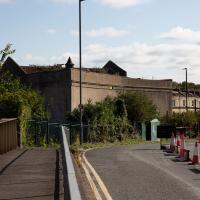
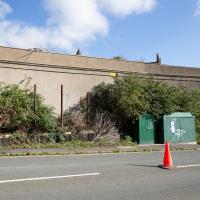
It's very hard to get a decent look at this building. This is the top half of the back of it.
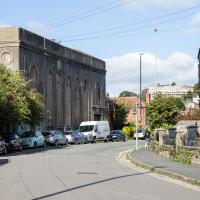
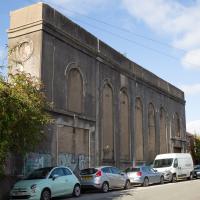
You can see this once apparently bright and airy building has had every window bricked up.
I understand that something in or around this building still supplies the odd electrical requirements (specifically, 360V "Bristol voltage") for some bits of Underfall Yard, which is our next stop, so more about that when we get there.
While it's not a listed building, is is notable: it's one of the earliest reinforced concrete buildings in the UK, apparently, construction starting in 1905. I assume it was up by 1907, as that's when Undefall Yard installed their electric pumps.
This oddity of history predates the National Grid and was originally fed from Feeder Road power station (well, Avonbank, on Feeder Road, to be precise. We've seen a bit of that history before, as a line marker for the line from Portishead to Feeder Road.) It was connected to Feeder Road by 1906, with a 6,600V line.
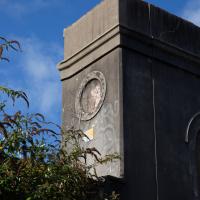
I've added a couple of historic views of the building as the next two photos in the wander, but I'll also pop this link to a Loxton drawing of the Avonbank electricity works, 1908 here.
Fresh Fields
17 Oct 2021
For the first time in a while, I had the time and energy to go further afield and knock off some new roads from my "to do" list. I headed through the first Hotwells Festival to Ashton and Bedminster to cross off a few of the suburban roads south of North Street.
First, though, I decided to try to reproduce an old photo of the now-demolished Rownham Hotel just around the corner from where I live...
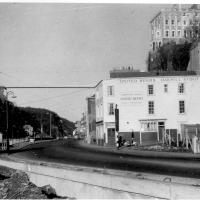
Here's the view I wanted to take a stab at reproducing. Bristol's Lost Pubs—a great website, which sadly currently seems to be lost itself—said:
Originally known as the Hotwells Tavern. Around 1873 when the entrance to Cumberland Basin was enlarged, a pub named the Rownham Tavern was demolished and Rownham ferry moved downstream towards the Hotwells Tavern, not long afterwards the name was changed to the Rownham Hotel. The pub was removed in 1969 for road Widening.
This particular image is from Brewerypedia; I'm afraid I don't know its original provenance.

Here's my version. I couldn't get to the exact original viewpoint without the railings on the far left being in the way of the picture, but this is pretty close.
So, presumably the house (or possibly two?) on the end of Freeland Place, which looks to my eye just as Georgian as the rest of the terrace, must've been built after the Rownham Hotel was demolished for the road widening in 1969...
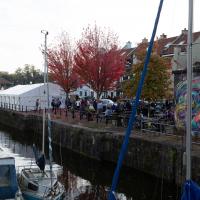
I wasn't in a particularly festive mood, so I decided mostly to bypass the Hotwells Festival. On a different day it might have been right up my street.
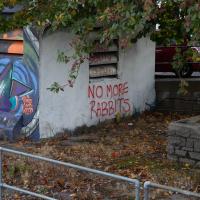
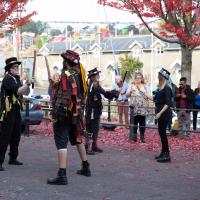
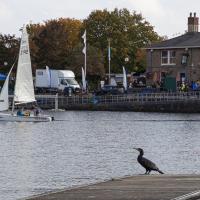
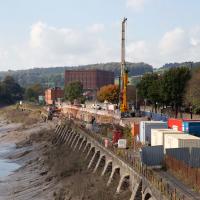
Apparently the repair of the Chocolate Path itself is now underway here. I won't hold my breath. Shame, as it's within my mile and one of my favourite walks and I've had no chance to walk down it since long before I started this little project.
To give you an idea of what it's like down on the path, here's a photo from 2017 from behind where I'm standing on Vauxhaull Bridge here.