Tagged: handwriting
Pastures New!
17 Jul 2021
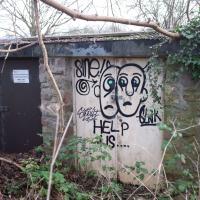
Okay, not much in the way of actual pasture to be had in Bedminster these days, like most of Bristol, but I did take advantage of the current rather toasty weather in Bristol to go and sit under a tree in Greville Smyth Park to read a book for a while before firing up the GPS and taking a little detour around some back streets of Ashton and Bedminster rather than going straight to Coffee #1 for an espresso frappé. This is the first walk in a while where I've actually crossed off an entire new street (the frankly unexciting Carrington Road) as well as exploring a couple of back alleys, just because they were there, really. Along the way I spotted a few examples of graffiti of various qualities, including a live work-in-progress by SNUB23 on Ashton Road and the finished Six Sisters project on North Street.
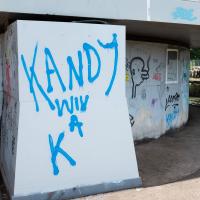
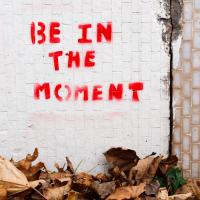
Some street art in Bristol is a little more primitive. Still, at least it reminded me of Liza "with a Z" Minnelli's collaboration with the Pet Shop Boys... I think she might even have got a smile out of Chris at one point, but the quality of the VT makes it hard to tell.
Green Squares and Secret Gardens
31 Jul 2021
At the end of July I went to have a look around some of the private gardens opened up by the annual Green Squares and Secret Gardens event. Sadly it was compressed into a single day this year, for various Covid-related reasons, it seems, so I didn't get to poke around too many places. I went to:
- A talk by the oldest resident of Victoria Square
- The St Vincent's Rocks Hotel garden
- The Paragon garden
- Cornwallis Crescent gardens, both east and west
- The Polygon garden
And snapped a few things in between, too. It was a lovely day—a bit too hot, if anything—and it was interesting to get into a few places I'd only ever seen from the outside, especially The Paragon and Cornwallis gardens, which are the least visible to passing strangers of all of them.
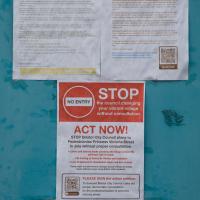
It's a little tamer now than it was back when anti-residents' parking zone protesters drove a tank through the city to deliver their petition. This one's about an experiment to pedestrianise Princess Victoria Street.
Won't make any difference to me one way or the other, really; I just walk up to Clifton Village for my shopping. Or, quite often, in completely the other direction, to North Street in Bedminster. I like both areas for shopping, and it's good to live close enough to either to get there on foot.
Shiny New Hope
24 Sep 2021
A quick lunchtime jaunt to Clifton Village. Along the way I admired the new sign on Hope Chapel and added to my tsundoku collection.
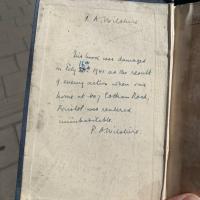
I have since blogged about this little find in the boxes of books outside Rachel’s and Michael’s Antiques.
A Morning of Research and a Cafe in a Castle
25 Sep 2021
I needed to pop to the library, as they'd kindly dug a book out of the reserve store at the B Bond warehouse for me and emailed me to let me know it was ready. So, I took a little trip to town, straight down the Hotwell Road, and spent a few hours reading before stretching my legs with a walk to a new cafe in the actual castle (or remnants thereof, anyway) of Castle Park, before heading back home down the other side of the harbour. As well as books and coffee, I bumped into a remote-controlled pirate ship, which isn't something you see every day, even in Bristol.
The sign about the wildflower meadow on Clifton Hill Bank is part of the consultation I mentioned the other day.
Fresh Fields
17 Oct 2021
For the first time in a while, I had the time and energy to go further afield and knock off some new roads from my "to do" list. I headed through the first Hotwells Festival to Ashton and Bedminster to cross off a few of the suburban roads south of North Street.
First, though, I decided to try to reproduce an old photo of the now-demolished Rownham Hotel just around the corner from where I live...

Well, presumably I'd be twice as happy, at least. Must tayk sum efurt 2 spell mor than haff ur wurds that badli.
I went out simply wanting to knock off the very last little unwalked section of Clanage Road, over by Bower Ashton, which has been annoying me for a while as it's quite close by and I've walked the other bits of it several times. So, my plan was to nip over to Greville Smyth Park via a slightly unusual route to wander Clanage Road and tick it off.
Along the way, though, I inevitably got a bit distracted. I took a few photos of Stork House, a grand Hotwell Road building that's recently been done up a bit (I imagine it's student lets, though I'm not sure) and which I found a reference to in a book about the Port Railway and Pier the other week, and also tried to match up a historical photo of Hotwells before the Cumberland Basin Flyover System laid it waste, which included some interesting markers I'll have to do a bit more digging into...

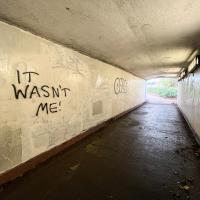
Quite the insult. This is in the underpass on the way to Ashton Gate. Normally I find it hard to make my way to North Street when coming from this direction, because of all the badly-marked underpasses that lead in improbable directions, but today I just followed the moderate throng of sports fans on the assumption that they were heading for Ashton Gate, which would take me in the right direction.
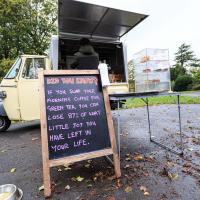
Apparently the proprietor's other half loves tea and can't stand coffee. I hope very much this turns into a sitcom where she runs a rival tea stall on the other side of the park with a big A-board that disses coffee.
The more I research it, the more I find that Hotwells had far better transport links back in Victorian and Edwardian times than it has today. Along with buses that went to more useful places than the City Centre, there were trams, the funicular up to Clifton, the landing stage for paddle steamer services and two railway stations all within easy walking distance of me.
Today I took a day off work as preparation for doing the bookkeeping for my tax return1, and took a wander along to the site of what would have been my nearest station, Hotwells (or Clifton, as it started out in life), nestled in the shadow of the suspension bridge, the Bristol terminus of the Bristol Port Railway and Pier.
From there I wandered down the Portway, following the original line, until I got to the area around Sneyd Park Junction, where the tunnel from the slightly later Clifton Extension Railway joined up with this originally-isolated BPR line. Then I headed up to Clifton through the "goat gully" at Walcombe Slade, seeing the few above-ground bits of evidence of the tunnel (which is still in regular use) along the way.
It was a lovely day, and a good walk, and it was interesting to daydream of the times when I could have walked a few minutes from my flat down to Dowry Parade, caught a short tram ride to Hotwells Stations, and then headed from there to Avonmouth, perhaps even to board a transatlantic passenger service. The completion of the Clifton Extension Railway that linked the Avonmouth station with Temple Meads made relatively direct transatlantic travel from London via Bristol possible, with passengers travelling up from Paddington to Temple Meads, on to Avonmouth on the Clifton Extension Railway and Port Railway and Pier line, then perhaps catching a Cambpell's paddle steamer—which sometimes acted as tenders for large steamers—to a larger ship that was headed out for Canada, say.
1 I've learned that the best approach is to take two days off and deliberately do something that's not my bookkeeping on the first day, as otherwise I just inevitably end up procrastinating and feeling guilty on the first day no matter what. I have an odd brain, but at least I'm learning strategies for dealing with its strange ways as I get older...
2 Information mostly gleaned from Colin Maggs' The Bristol Port Railway & Pier and the Clifton Extension Railway, The Oakwood Press, 1975.
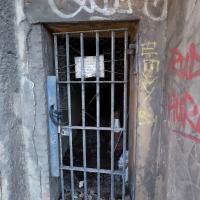
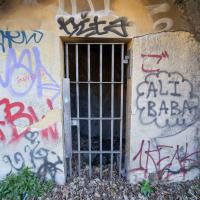
From The Bristol Hotwell, by Vincent Waite, ISSN 1362 7759, Bristol Branch of the Historical Association, 2002 reprint.
...in 1867 the new Pump Room was in turn demolished so that Hotwell Point could be removed and river navigation made safer. Thus the spring was lost after a long and eventful history. After much public agitation and complaining in the local press the spring was enclosed and piped to a small grotto hollowed out in the rock. Here a pump was set up in 1877 and an attendant provided by the Bristol Docks committee. In 1880 Dr. Griffin wrote a warning letter to the newspapers claiming that his analysis of this pump water proved that it was not from the original spring which in any case was too far away to retain its correct temperature. Yet up to 1913 the pump was still in use, and sometimes supplied as many as 350 persons a day. Then the long-threatened pollution of the water by the river became too obvious to be ignored and the pump was closed. The entrance, blocked up by a small wooden door, can still be seen in Hotwells Road near the Suspension Bridge.
The wooden door is no longer here, but this is definitely the place.
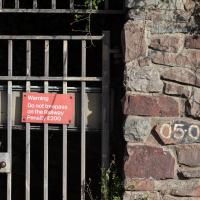
Yup, this is an access gate for the railway folk, presumably an easy route to this end of the tunnel. It's possible there's somewhere public to snap the tunnel from—there's a bridge further out of town toward Sea Mills, and there's a chance you could see the tunnel from there, but today's walk is already quite long enough, thank you.
From here the Clifton Extension Railway (from 1877) would have joined up with the line from Hotwells (completed twelve years earlier) at Sneyd Park Junction, a few hundred feet further out of town, and then proceeded to Sea Mills and beyond, terminating at Avonmouth. That bit of the line still runs; it's only the bit from Hotwells to here that was pulled up to make room for the Portway road, making Sneyd Park Junction no longer a junction.
Here a little fact I like: when the Bristol Port Railway ran out to Avonmouth from both Clifton Down station at the high far end of the tunnel near Whiteladies Road, and also from Hotwells, they offered a special splilt return ticket that let you walk down the hill from your home to Hotwells, take the train out to Avonmouth, then return to Clifton Down instead, so you could walk down the hill to home rather than walking back up. A lot of the dockworkers took this option, and it gladdens me to find that even these hardy folk were so put off by the hills of Bristol that they went for the lazy option!
Bower Ashton is an interesting little area just south of the river from me—in fact, the Rownham Ferry used to take people over from Hotwells to Bower Ashton, operating from at least the twelfth century to around the 1930s.
It's a strangely contradictory little area, with a cluster of old and new houses sandwiched in between the busy A-roads and significantly more industrial area of Ashton and the bucolic country estate of Ashton court roughly east to west, and also between Somerset and Bristol, north to south.
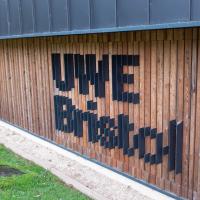
I've been around here before, mostly poking around Bower Ashton's arguably most well-known bit, the Arts faculty campus of the University of the West of England, but I'd missed at least Parklands Road and Blackmoors Lane, so I initially planned just to nip across briefly and wander down each in turn. On a whim, though, I texted my friends Sarah and Vik in case they were out and about, and ended up diverting to the Tobacco Factory Sunday market first, to grab a quick flat white with them, extending my journey a fair bit.
To start with, though, I nipped to a much more local destination, to see something that you can't actually see at all, the Gridiron...
(I also used this wander as a test of the cameras in my new phone. I finally upgraded after a few years, and the new one has extra, separate wide and telephoto lenses compared to the paltry single lens on my old phone. Gawd. I remember when speed-dial was the latest innovation in phones...)
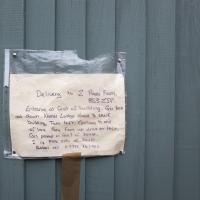
Maybe I'll have to go have a look at the front of these houses; I think I missed them on earlier walks
I was just about starting to feel better—the antibiotics seemed to have kicked in for my dental issues, and it had been some days since I'd left the house, and I was at last starting to get itchy feet. So, a wander. But where? Well, there were a few industrial bits near Winterstoke Road in the Ashton/Ashton Vale areas of Bristol that needed walking. I knew they were likely to be quite, well, unattractive, frankly. So why not do them while I wasn't feeling exactly 100% myself? Maybe it would fit my mood. Hopefully you're also in the mood for a bit of post-industrial wasteland, for that's what some of this feels like...
Then, at the last minute, I thought again about the Bristol International Exhibition—I've got a book about it on the way now—and that gave me another goal, which could just about be said to be in the same direction, and I decided to walk significantly further than my normal 1-mile limit and try recreating another historical photo...
Sadly I don't know much about the Ashton area; it's just on the edges of my mile and I rarely have cause to go there. It's brimming with history, I'm sure: the whole South Bristol area rapidly developed from farmland to coal mines to factories to its current interesting mixture of suburbs and industrial work over the last few hundred years. As a more working class area less attention was paid to it by historians, at least historically-speaking, than the Georgian heights of Clifton, and much of it has been knocked down and reinvented rather than listed and preserved. I see here and there some of this lack is being addressed, but I'm afraid I'll be very light on the history myself on this wander, as most of my usual sources aren't throwing up their normal reams of information as when I point them at Clifton, Hotwells or the old city.
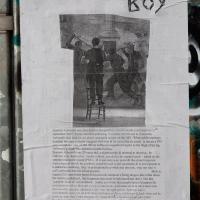
Here's the BBC report. This was posted on a telephone junction box in the "Daveside" area, the little strip of Festival Way that's used as a skate park in between the old railway depot and the White City allotments.

A Random New Year's Day Wander
01 Jan 2022
I picked a fairly arbitrary reason for a wander today. Really, I just wanted to do a New Year's Day wander just to get out of the house and to set a precedent for the year to come.
My ostensible reason was to investigate what looked like a road on my map that quartered the lawn in front of the Ashton Court mansion. As it turned out, this is just a muddy footpath/desire line similar to a half-dozen other tracks nearby, and must be some kind of bug or misclassification with the mapping system I'm using, but that's not important. What's important is that I went for a little walk on the first day of the year. As a bonus, I did happen to wander down a couple of sections of new footpath, so technically I broke some new ground too, which is nice.